Year-wise Weightage (2016–2026)

YearQuestions AskedMarks
2026312
202528
202414
2023312
202228
Show earlier years (2016–2021)
202114
202014
201928
201814
201714
201628
Q1
NEET 2016 Phase 1

If the velocity of a particle is $v = At + Bt^2$, where A and B are constants, then the distance travelled by it between 1 s and 2 s is:

Q2
NEET 2016 Phase 2

Two cars P and Q start from a point at the same time in a straight line and their positions are represented by $x_P = at + bt^2$ and $x_Q = ft - t^2$. At what time do the cars have the same velocity?

Q3
NEET 2017

Preeti reached the metro station and found that the escalator was not working. She walked up the stationary escalator in time $t_1$. On other days, if she remains stationary on the moving escalator, then the escalator takes her up in time $t_2$. The time taken by her to walk up on the moving escalator will be:

Q4
NEET 2018

A toy car with charge q moves on a frictionless horizontal plane surface under the influence of a uniform electric field E. Due to the force qE, its velocity increases from 0 to 6 m/s in one second duration. At that instant the direction of the field is reversed. The car continues to move for two more seconds under the influence of this field. The average velocity and the average speed of the toy car between 0 to 3 seconds are respectively:

Q5
NEET 2019

A person in a lift drops a coin. The coin takes time $t_1$ to reach the floor when the lift is at rest, and time $t_2$ when the lift is moving up with uniform velocity. Then:

Q6
NEET 2019

A person travelling in a straight line moves with a constant velocity $v_1$ for a certain distance x and with a constant velocity $v_2$ for the next equal distance. The average velocity v is given by the relation:

Q7
NEET 2020

A ball is thrown vertically downward with a velocity of 20 m/s from the top of a tower. It hits the ground after some time with a velocity of 80 m/s. The height of the tower is (g = 10 m/s$^2$):

Q8
NEET 2021

A small block slides down from the top of a smooth inclined plane starting from rest at t = 0. If $S_n$ is the distance travelled by it from t = (n-1) s to t = n s, the ratio $\dfrac{S_n}{S_{n+1}}$ is:

Q9
NEET 2022

The displacement-time (x-t) graphs of two moving particles make angles of 30° and 45° with the time axis as shown. The ratio of their respective velocities $v_1 : v_2$ is:
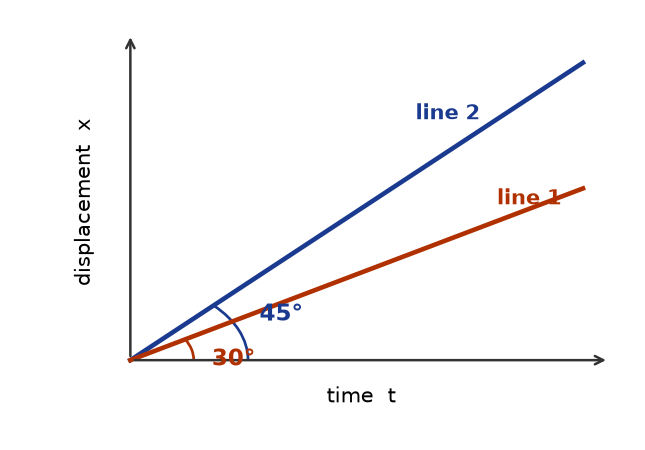
Motion In A Straight Line NEET PYQ diagram
Q10
NEET 2022

The ratio of the distances travelled by a freely falling body in the 1st, 2nd, 3rd and 4th second of its motion is:

Q11
NEET 2023 Phase 1

A ball is thrown vertically upward with a velocity of 4 m/s from a bridge. The ball strikes the water surface after 4 s. The height of the bridge above the water surface is (g = 10 m/s$^2$):

Q12
NEET 2023 Phase 1

A vehicle travels half the distance with speed v and the remaining half distance with speed 2v. Its average speed is:

Q13
NEET 2023 Phase 1

A bullet enters a wooden block with speed u and, after travelling 24 cm inside it, its speed reduces to u/3. Assuming uniform retardation, the further distance it travels before coming to rest is:

Q14
NEET 2024

The velocity (v)-time (t) graph of a body moving in a straight line is shown. Which of the following acceleration (a)-time (t) graphs best represents the motion?
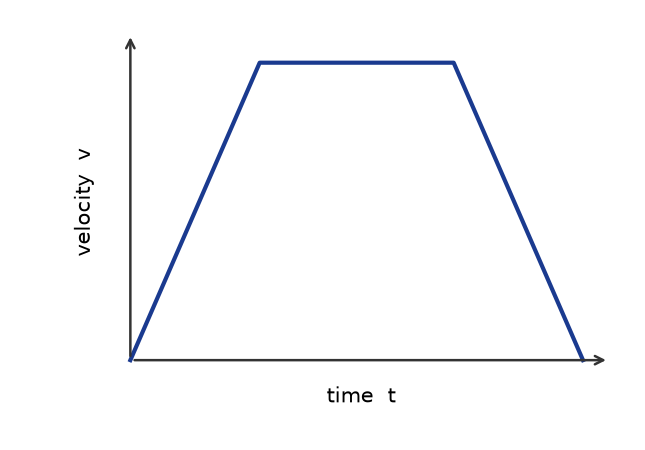
Motion In A Straight Line NEET PYQ diagram
Q15
NEET 2025

Buses leave cities X and Y in both directions at regular intervals of T minutes with the same speed. A girl driving from X to Y at 60 km/h notices that a bus moving in her direction passes her every 30 min, while a bus moving in the opposite direction passes her every 10 min. The interval T and the speed of the buses are respectively:

Q16
NEET 2025

The relation between time t and position x of a particle moving along a straight line is given by $t = x^2 + x$. The acceleration of the particle is:

Q17
ReNEET 2026

A particle moves along a straight line with position $s(t)=\alpha t^2-\beta t+\gamma$, where $\alpha=1\,\text{ms}^{-2}$, $\beta=6\,\text{ms}^{-1}$, $\gamma=5\,\text{m}$. The average speed of the particle (in $\text{ms}^{-1}$) from $t=0$ to $t=6\,\text{s}$ is:

Q18
NEET 2026 (1)

A ball is thrown vertically upward and falls back to the thrower. Which velocity (v)-time (t) graph correctly represents its motion? (upward taken positive)
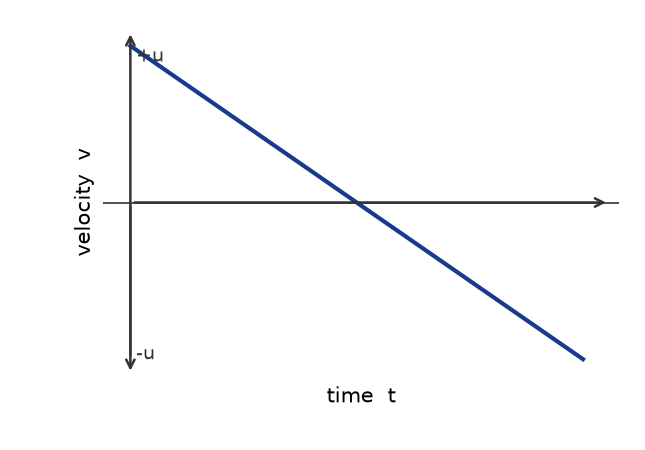
Motion In A Straight Line NEET PYQ diagram
Q19
NEET 2026 (1)

A ruler is dropped vertically and five persons try to catch it. Their reaction times are A = 0.20 s, B = 0.22 s, C = 0.18 s, D = 0.19 s and E = 0.21 s. The correct order of the distance travelled by the ruler before being caught by each person is:

Want more Motion In A Straight Line questions?

MedicNEET has 14,000+ NEET-style Biology questions with detailed NCERT-based explanations — including long, tricky questions that actually come in the exam.

Download MedicNEET App — Free
Practise Motion In A Straight Line MCQs — Free

Beyond the PYQs above — every Physics question format NEET now uses, starting with the newest ReNEET 2026-style reasoning MCQs. Tap an option for the answer and a worked solution. Free, no login.

🔢 Motion In A Straight LineNumericals — PYQ-Based

Exam-style numericals seeded from real NEET previous-year questions, kept inside the NEET syllabus boundary. Each with a worked solution.

  1. Q1. A bus starts from rest with a constant acceleration of 2 m/s. At the instant it starts, a man standing 25 m behind the bus begins to run after it at a constant speed. The minimum constant speed with which the man must run to just catch the bus is:
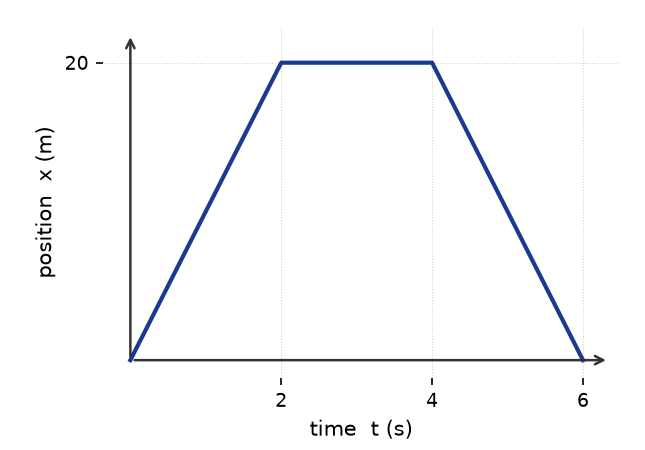
  2. Q2. The position-time graph of a particle is shown: it goes from (0,0) to (2 s, 20 m), stays at 20 m up to 4 s, then returns to 0 at 6 s. The velocity during the last segment (4 s to 6 s) is:
    NEET question diagram
  3. Q3. Two trains move on parallel tracks in the same direction with speeds 72 km/h and 54 km/h. The speed of the faster train as seen by a passenger in the slower train is:
  4. Q4. A car accelerates from rest at 4 m/s for 5 s, then immediately decelerates uniformly and comes to rest in a further 10 s. The total distance travelled by the car is:
  5. Q5. A stone is dropped from rest from the top of a tower. During the last second of its motion, it travels 35 m. Taking g = 10 m/s², the height of the tower is:
  6. Q6. A boat needs to cross a river of width 120 m. The boat's speed in still water is 5 m/s and the river current flows at 3 m/s. On the forward trip, the boat is steered at an angle θ upstream from the perpendicular so that it reaches the point exactly opposite on the other bank. On the return trip, the boat instead aims perpendicular to the banks (shortest-time crossing, allowing drift downstream — the landing point need not be the starting point). What is the ratio of the time taken for the forward journey to the time for the return journey?
  7. Q7. A stone is dropped from rest from the top of a tall building. After 2 seconds, another stone is thrown vertically downward from the same point with an initial velocity u. Both stones reach the ground simultaneously after a total time of 6 seconds (measured from when the first stone was dropped). What is the initial velocity u of the second stone? (Take g = 10 m s⁻²)
  8. Q8. A body falls freely from rest. The ratio of distances traveled in the 3rd and 5th seconds of its motion is (Take g = 10 m/s²):
  9. Q9. A stone is thrown vertically upward with an initial velocity of 20 m/s from the top of a tower 60 m high. The total time taken by the stone to reach the ground is: (Take g = 10 m/s²)
  10. Q10. An object is released from rest and falls freely. It covers a distance x in the first 3 seconds of its fall. What additional distance will it cover in the next 3 seconds?

You’ve practised 10 of 81 Motion In A Straight Line questions in this set.

Practise all 81 + every chapter — free app →

📘 Motion In A Straight LineConceptual Theory MCQs

Theory MCQs — assertion-reason, statement and standard — for the part of the physics paper that isn't numericals.

  1. Q1. The position-time (x-t) graph for a particle in rectilinear motion is shown. A tangent is drawn to the curve at the point corresponding to t = 2 s. What is the instantaneous velocity of the particle at t = 2 s?
  2. Q2. The velocity-time graph for a particle in one-dimensional motion is shown. A tangent is drawn to the curve at t = 2 s. What is the instantaneous acceleration of the particle at t = 2 s?
  3. Q3. Which of the following statements is CORRECT regarding the study of motion?
  4. Q4. Regarding the motion of an object in free fall: Statement I: In the ideal case of free fall, air resistance is neglected and the acceleration is taken to be constant. Statement II: For an object in free fall, the change in velocity with distance is constant.
  5. Q5. Galileo's studies of motion led to the modern definition of acceleration. Why is acceleration defined as the rate of change of velocity with respect to time, and not with respect to distance?
  6. Q6. The instantaneous velocity of a particle is defined as the limit of the average velocity as the time interval Δt approaches zero. Why is this limiting process necessary?
  7. Q7. In which of the following situations can a railway carriage be considered as a point object? The other situation is when it cannot.
  8. Q8. Which of the following statements is CORRECT?
  9. Q9. Given below are two statements: Statement I: The slope of a velocity-time (v-t) graph at any instant represents the displacement of the object at that instant. Statement II: The area under a position-time (x-t) graph for a moving object represents the velocity over a given time interval. In the light of the above statements, choose the correct answer from the options given below.
  10. Q10. An object moves along a straight line with constant negative acceleration. Which of the following graphs correctly represents the position-time (x-t) relationship for this motion?

You’ve practised 10 of 10 Motion In A Straight Line questions in this set.

Practise all 10 + every chapter — free app →

Motion In A Straight Line — NEET PYQ Analysis

Motion In A Straight Line is a Class 11 NEET Physics chapter consistently tested from 2016 to ReNEET 2026. This page has all 19 authentic previous year questions from real NEET papers — with answers and detailed solutions, not model questions.

For full chapter-wise practice in timed test mode, download the MedicNEET app — 22,000+ questions across the full NEET syllabus. Back to the NEET Physics PYQ index.