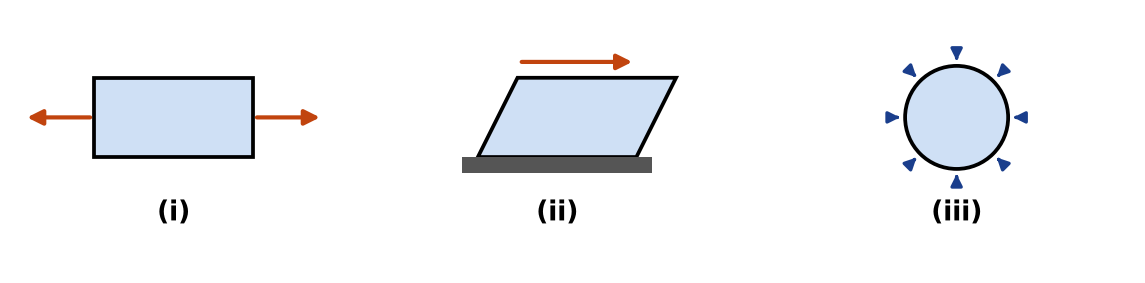
The bulk modulus of a spherical object is B. If it is subjected to uniform pressure p, the fractional decrease in radius is
Two wires are made of the same material and have the same volume. The first wire has cross-sectional area A and the second wire has cross-sectional area 3A. If the length of the first wire is increased by Δl on applying a force F, how much force is needed to stretch the second wire by the same amount?
When a block of mass M is suspended by a long wire of length L, the length of the wire becomes (L + l). The elastic potential energy stored in the extended wire is:
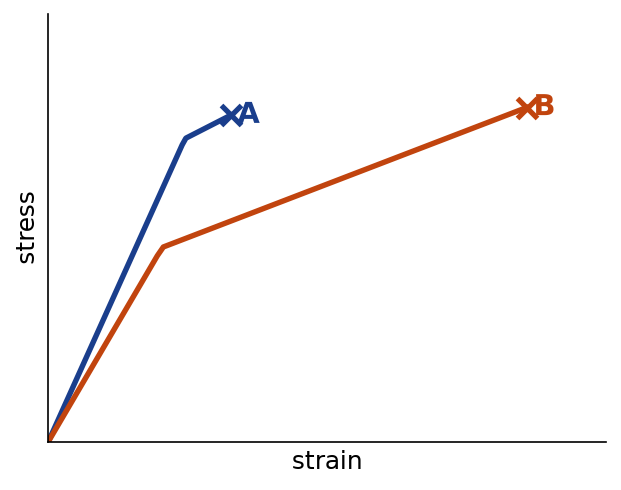
The stress-strain curves are drawn for two different materials X and Y. It is observed that the ultimate strength point and the fracture point are close to each other for material X, but are far apart for material Y. We can say that materials X and Y are likely to be (respectively)
Dimensions of stress are:
Given below are two statements: Statement I: The stretching of a coil spring is determined by the shear modulus of the material of the spring. Statement II: A coil spring of copper has more tensile strength than a steel spring of same dimensions. In the light of the above statements, choose the most appropriate answer from the options given below:
Two ways to go deeper on this chapter
Choose your next step
A wire is suspended from the ceiling and stretched by a weight W attached at its free end. The longitudinal stress at any point of cross-sectional area A of the wire is:
The amount of elastic potential energy per unit volume (in SI unit) of a steel wire of length 100 cm stretched by 1 mm is (Young's modulus of the wire = 2.0 × 10¹¹ N m⁻²)
A metallic bar of Young's modulus 0.5 × 10¹¹ N m⁻² and coefficient of linear thermal expansion 10⁻⁵ °C⁻¹, length 1 m and area of cross-section 10⁻³ m² is heated from 0 °C to 100 °C without expansion or bending. The compressive force developed in it is:
The maximum elongation of a steel wire of 1 m length if the elastic limit of steel and its Young's modulus respectively are 8 × 10⁸ N m⁻² and 2 × 10¹¹ N m⁻², is
Match List I with List II. List I: A. Young's Modulus, B. Compressibility, C. Bulk Modulus, D. Poisson's Ratio. List II: I. (Δd/d)/(ΔL/L), II. FL/(A.ΔL), III. -(1/V)(ΔV/P), IV. -V.P/ΔV. Choose the correct answer.
Want more Mechanical Properties Of Solids questions?
MedicNEET has 43,000+ NEET-style questions across Physics, Chemistry & Biology with detailed NCERT-based explanations — including the long, tricky questions that actually come in the exam.
Download MedicNEET App — Free