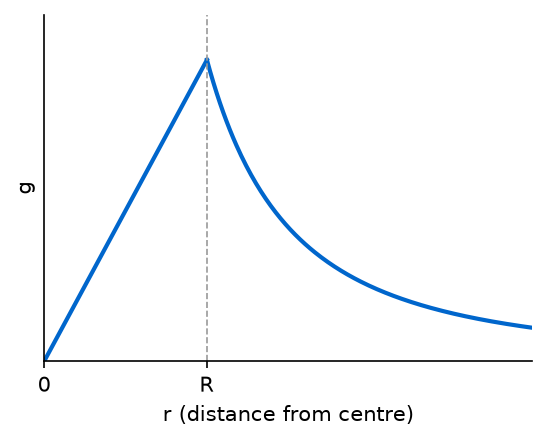
Starting from the centre of the earth (radius R), the variation of g (acceleration due to gravity) with distance r is best shown by which graph?
A satellite of mass m orbits the earth (radius R) at height h. In terms of g₀ (surface gravity), the total energy of the satellite is:
The ratio of escape velocity at earth (vₑ) to the escape velocity at a planet (vₚ) whose radius and mean density are twice that of earth is:
At what height from the surface of earth the gravitational potential and the value of g are −5.4×10⁷ J kg⁻¹ and 6.0 m s⁻² respectively? (Radius of earth = 6400 km)
The acceleration due to gravity at a height 1 km above the earth equals that at a depth d below the surface. Then:
Two astronauts are floating in gravitational free space after losing contact with their spaceship. The two will:
Two ways to go deeper on this chapter
Choose your next step
If the mass of the Sun were ten times smaller and the universal gravitational constant G ten times larger, which statement is NOT correct?
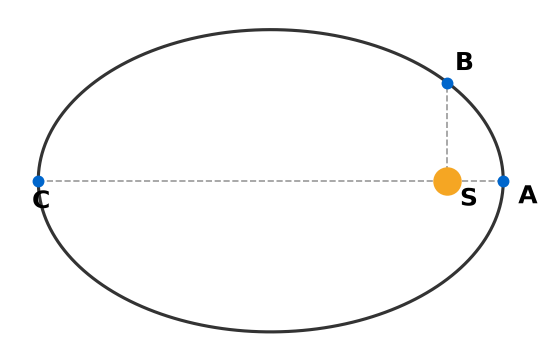
The kinetic energies of a planet in an elliptical orbit about the Sun at positions A, B and C are K_A, K_B and K_C. AC is the major axis and SB ⊥ AC at the Sun S (see figure). Then:
Taking gravitational potential energy at infinity to be zero, the change in PE (final − initial) of a mass m raised to height h above the earth's surface (radius R) is:
The work done to raise a mass m from the surface of the earth to a height h equal to the radius of the earth R is:
A satellite has period 24 h at height 6R_E from the earth's surface. The period of another satellite at height 2.5 R_E from the surface is:
The work done to raise a mass m from the surface of the earth to a height equal to the radius of the earth R is:
A mass falls from height h and its fall-time t is measured in units of the period T of a simple pendulum. On earth t = 2T. The setup is taken to another planet of half the earth's mass and the same radius, giving times t' and T'. Then:
A body weighs 200 N on the surface of the earth. How much will it weigh half way down to the centre of the earth?
The escape velocity from the earth's surface is v. The escape velocity from the surface of another planet of radius four times that of earth and the same mean density is:
A particle is released from rest at height S above the earth's surface. At a certain height its kinetic energy is three times its potential energy (taking the surface as reference). The height above the surface and the speed at that instant are respectively:
A particle of mass m is projected with velocity u = k·vₑ (k < 1) from the earth's surface (vₑ = escape velocity). The maximum height above the surface reached by the particle is:
A body of mass 60 g experiences a gravitational force of 3.0 N at a point. The magnitude of the gravitational field intensity at that point is:
Match List-I with List-II: List-I (a) Gravitational constant (G) (b) Gravitational potential energy (c) Gravitational potential (d) Gravitational intensity List-II (i) [L²T⁻²] (ii) [M⁻¹L³T⁻²] (iii) [LT⁻²] (iv) [ML²T⁻²] Choose the correct answer:
Two bodies of mass m and 9m are placed a distance R apart. The gravitational potential at the point on the line joining them where the gravitational field is zero is (G = gravitational constant):
If R is the radius of the earth and g the acceleration due to gravity on its surface, the mean density of the earth is:
A satellite orbits just above the earth's surface with period T. If d is the mean density of the earth and G the gravitational constant, the quantity 3π/(Gd) represents:
The escape velocity of a body from the earth's surface is 11.2 km/s. If the same body is projected upward with velocity 22.4 km/s, its velocity at infinite distance from the centre of the earth will be:
The minimum energy required to launch a satellite of mass m from the surface of the earth (mass M, radius R) into a circular orbit at an altitude 2R from the surface is:
The mass of a planet is 1/10th that of the earth and its diameter is half that of the earth. The acceleration due to gravity on that planet is:
A body weighs 48 N on the surface of the earth. The gravitational force on it at a height equal to one-third the radius of the earth from the surface is:
The radius of the Martian orbit around the Sun is about 4 times the radius of Mercury's orbit. The Martian year is 687 earth days. The length of one year on Mercury is about:
In a solar system, the time-period of revolution of a planet tracing a circular orbit of radius $R$ is proportional to:
Two planets $P_1$ and $P_2$ with equal mass have radii $R_1$ and $R_2$ respectively, where $R_2=\tfrac{R_1}{2}$. The escape speeds of $P_1$ and $P_2$ are $v_1$ and $v_2$ respectively. Then $\tfrac{v_2}{v_1}$ is:
Want more Gravitation questions?
MedicNEET has 43,000+ NEET-style questions across Physics, Chemistry & Biology with detailed NCERT-based explanations — including the long, tricky questions that actually come in the exam.
Download MedicNEET App — Free