Year-wise Weightage (2016–2026)

YearQuestions AskedMarks
202614
202528
2024
2023624
202214
Show earlier years (2016–2021)
2021312
2020
2019520
2018
201714
2016312
Q1
NEET 2016 Phase 2 · NEET 2023 Phase 1Dipole torque

An electric dipole is placed at an angle of 30° with an electric field of intensity 2 × 10⁵ N/C. It experiences a torque equal to 4 N·m. The charge on the dipole, if the dipole length is 2 cm, is

Q2
NEET 2016 Phase 1Coulomb force

Two identical charged spheres suspended from a common point by two massless strings of length l are initially at a distance d (d << l) apart because of their mutual repulsion. The charges begin to leak from both the spheres at a constant rate. As a result, the spheres approach each other with a velocity v. Then v varies as a function of the distance x between the spheres as

Q3
NEET 2016 Phase 2 · NEET 2023 Phase 1Dipole torque

An electric dipole is placed at an angle of 30° with an electric field of intensity 2 × 10⁵ N C⁻¹. It experiences a torque equal to 4 N m. Calculate the magnitude of charge on the dipole, if the dipole length is 2 cm.

Q4
NEET 2017Coulomb force

Suppose the charges of a proton and an electron differ slightly. One of them is −e, the other is (e + Δe). If the net of the electrostatic force and the gravitational force between two hydrogen atoms placed at a distance d (much greater than atomic size) apart is zero, then Δe is of the order of [Given: mass of hydrogen mₕ = 1.67 × 10⁻²⁷ kg]

Q5
NEET 2019Gauss spheres

A hollow metal sphere of radius R is uniformly charged. The electric field due to the sphere at a distance r from the centre

Q6
NEET 2019 Odisha

Two metal spheres, one of radius R and the other of radius 2R, have the same surface charge density σ. They are brought in contact and then separated. What will be the new surface charge densities on them?

Q7
NEET 2019Line charge

Two parallel infinite line charges with linear charge densities +λ C/m and −λ C/m are placed at a distance of 2R in free space. What is the electric field mid-way between the two line charges?

Q8
NEET 2019 OdishaGauss flux

A sphere encloses an electric dipole with charges ±3 × 10⁻⁶ C. What is the total electric flux across the sphere?

Q9
NEET 2019Coulomb force

Two point charges A and B, having charges +Q and −Q respectively, are placed at a certain distance apart and the force acting between them is F. If 25% of the charge of A is transferred to B, then the force between the charges becomes

Q10
NEET 2021

Two charged spherical conductors of radii R₁ and R₂ are connected by a wire. Then the ratio of the surface charge densities of the spheres (σ₁/σ₂) is

Q11
NEET 2021Dipole field

Polar molecules are the molecules:

Q12
NEET 2021Dipole torque

A dipole is placed in a non-uniform electric field as shown. In which direction will it move?
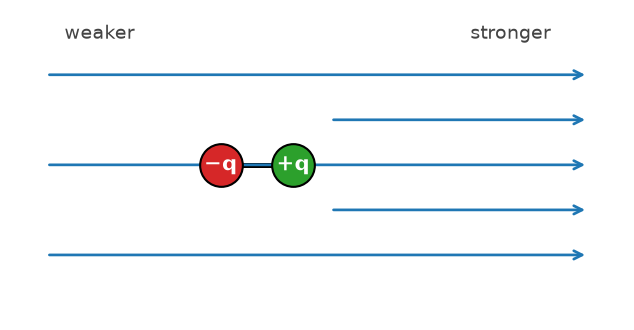
Electric Charges And Fields NEET PYQ diagram
Q13
NEET 2022Dipole field

Two point charges −q and +q are placed at a distance L apart, as shown in the figure. The magnitude of the electric field intensity at a distance R (R >> L) varies as
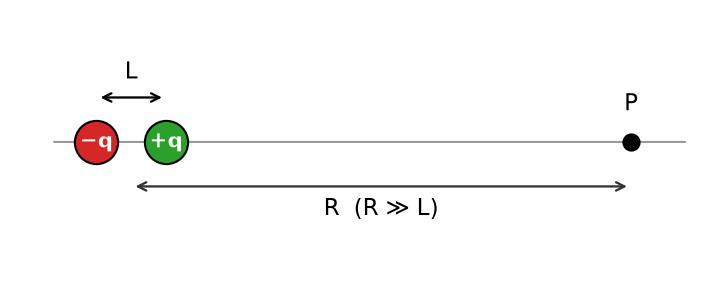
Electric Charges And Fields NEET PYQ diagram
Q14
NEET 2023 Phase 2Gauss flux

According to Gauss's law of electrostatics, the electric flux through a closed surface depends on:

Q15
NEET 2023 Phase 2Gauss flux

A charge Q µC is placed at the centre of a cube. The flux coming out from any one of its faces will be (in SI unit):

Q16
NEET 2023 Phase 2Gauss spheres

If a conducting sphere of radius R is charged, then the electric field at a distance r (r > R) from the centre of the sphere would be (V = potential on the surface of the sphere):

Q17
NEET 2023 Phase 1Gauss flux

If ∮ₛ E · dS = 0 over a closed surface, then:

Q18
NEET 2025Dipole torque

An electric dipole with dipole moment 5 × 10⁻⁶ C m is aligned with the direction of a uniform electric field of magnitude 4 × 10⁵ N/C. The dipole is then rotated through an angle of 60° with respect to the electric field. The change in the potential energy of the dipole is:

Q19
NEET 2025Coulomb force

Two identical charged conducting spheres A and B have their centres separated by a certain distance. Charge on each sphere is q and the force of repulsion between them is F. A third identical uncharged conducting sphere is brought in contact with sphere A first and then with B, and finally removed from both. The new force of repulsion between spheres A and B (radii of A and B are negligible compared to the distance of separation, so for calculating the force between them they can be considered as point charges) is best given as:

Q20
NEET 2026 (1)Gauss spheres

Which of the following statements are correct? A. Inside a conductor, the electrostatic field is zero. B. Electric field at the surface of a charged conductor does not depend on its surface charge density. C. The interior of a charged conductor can have no excess charge in the static situation. D. At the surface of a charged conductor, the electrostatic field must be normal to the surface at every point. E. The electrostatic potential is zero everywhere inside a charged conductor.

Want more Electric Charges And Fields questions?

MedicNEET has 14,000+ NEET-style Biology questions with detailed NCERT-based explanations — including long, tricky questions that actually come in the exam.

Download MedicNEET App — Free
Practise Electric Charges And Fields MCQs — Free

Beyond the PYQs above — every Physics question format NEET now uses, starting with the newest ReNEET 2026-style reasoning MCQs. Tap an option for the answer and a worked solution. Free, no login.

🔢 Electric Charges And FieldsNumericals — PYQ-Based

Exam-style numericals seeded from real NEET previous-year questions, kept inside the NEET syllabus boundary. Each with a worked solution.

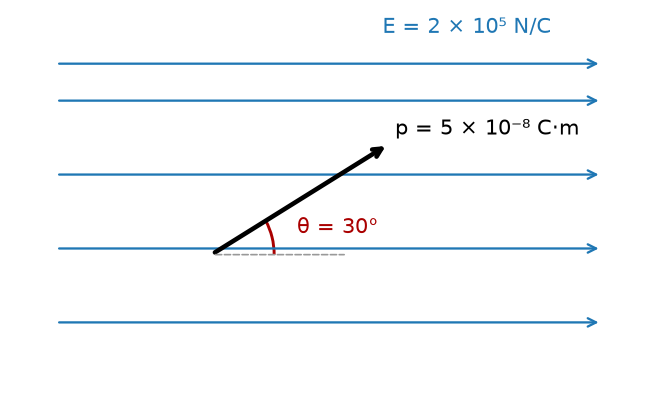
  1. Q1. The figure shows an electric dipole of dipole moment p = 5 × 10⁻⁸ C·m placed in a uniform electric field E = 2 × 10⁵ N/C. The dipole moment makes an angle θ = 30° with the direction of the field. What is the magnitude of the torque experienced by the dipole?
    NEET question diagram
  2. Q2. A conducting sphere of radius R carries a total charge Q uniformly distributed on its surface. A point charge q is now placed at the exact center of this conducting sphere. What is the magnitude of the electric field at a distance r from the center, where R < r < 2R?
  3. Q3. An electric dipole consists of two charges ±20 μC separated by a distance of 4 mm. The dipole is placed in a uniform electric field of magnitude 5 × 10⁵ N/C. When the dipole moment makes an angle of 30° with the electric field, the magnitude of the torque experienced by the dipole is:
  4. Q4. A uniformly charged solid non-conducting sphere of radius R = 6 cm carries a total charge Q = 18 μC distributed throughout its volume. What is the magnitude of electric field at a point located at r = 9 cm from the center of the sphere? (1/4πε₀ = 9 × 10⁹ N m² C⁻²)
  5. Q5. Two small metallic spheres of identical mass m = 0.20 g are suspended by insulating threads of negligible mass from a common point. Each sphere carries an identical charge q. Due to electrostatic repulsion, the spheres separate such that the angle between the two threads is 60°. If the length of each thread is 1.0 m and the system is in equilibrium, the magnitude of charge q on each sphere is approximately: (Take g = 10 m/s², k = 9 × 10⁹ N·m²/C²)
  6. Q6. Consider two identical atoms, each consisting of a nucleus with charge +Ze and Z electrons. Due to a quantum fluctuation, each electron has a charge magnitude slightly different from the proton: one carries charge -e and the other carries charge -(e + δe). If these two atoms are separated by a distance r (much larger than atomic size), and the net electrostatic force equals the gravitational force between them, then δe is of the order of: [Given: atomic mass m = 4.0 × 10⁻²⁶ kg, Z = 10, G = 6.67 × 10⁻¹¹ N m² kg⁻², k = 9 × 10⁹ N m² C⁻²]
  7. Q7. A thin non-conducting spherical shell of radius R = 30 cm carries a uniformly distributed charge of +12 μC. A point charge of -12 μC is placed at the center of this shell. An imaginary Gaussian surface in the form of a sphere of radius 45 cm is drawn concentric with the shell. What is the magnitude of the total electric flux through this Gaussian surface?
  8. Q8. Three identical point charges, each of magnitude +q, are placed at the vertices of an equilateral triangle of side 'a'. A fourth charge -Q is placed at the centroid of the triangle and is in equilibrium. If one of the three charges +q is now removed, what will be the magnitude of the net force on the charge -Q?
  9. Q9. An electric dipole consists of two charges +4q and -4q separated by a distance of 2a. The dipole is placed in a uniform electric field E₀. What is the magnitude of the maximum torque experienced by the dipole?
  10. Q10. Two infinitely large parallel metal plates A and B are placed 4 cm apart in air. Plate A has a uniform surface charge density of +σ = 4 × 10⁻⁸ C/m² on its inner face, and plate B has a uniform surface charge density of -σ = -4 × 10⁻⁸ C/m² on its inner face. What is the magnitude of electric field in the region between the plates? (Take ε₀ = 8.85 × 10⁻¹² C²/N·m²)

You’ve practised 10 of 73 Electric Charges And Fields questions in this set.

Practise all 73 + every chapter — free app →

📘 Electric Charges And FieldsConceptual Theory MCQs

Theory MCQs — assertion-reason, statement and standard — for the part of the physics paper that isn't numericals.

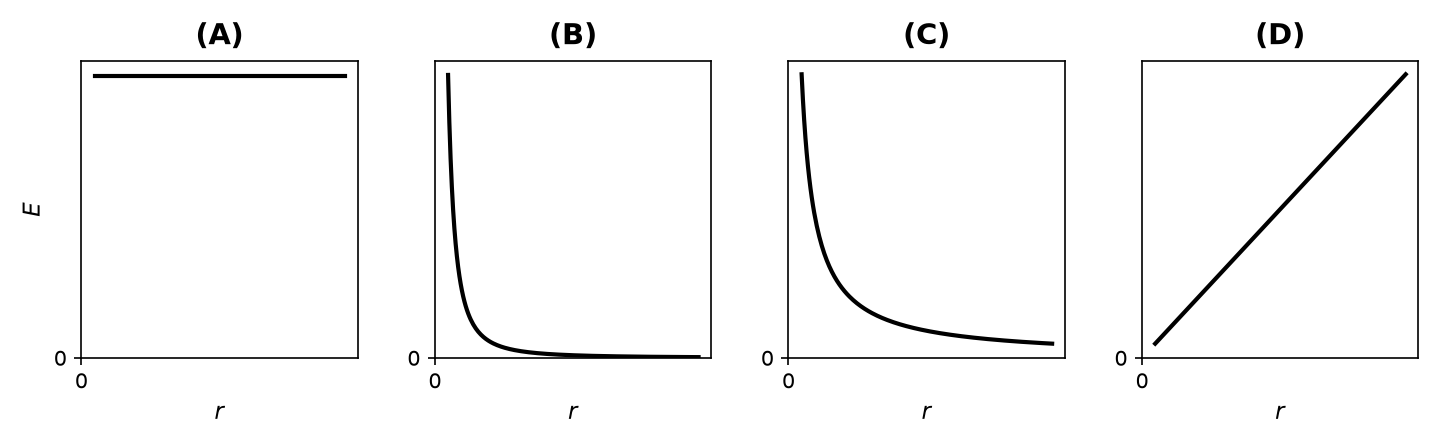
  1. Q1. The graph shows the variation of the magnitude of electric field, E, with radial distance, r, from a certain charge distribution. This variation corresponds to:
  2. Q2. A point charge is placed just OUTSIDE a closed surface, close to it but not enclosed. Which statement is correct about the net electric flux through that surface?
  3. Q3. Two point charges are separated by a distance 'r' and exert an electrostatic force 'F' on each other. If the distance between them is doubled to '2r', and then halved to 'r/2' from the original separation, how does the force change in these two scenarios?
  4. Q4. An electric dipole (charges +q and −q) is placed completely inside a closed Gaussian surface. The net electric flux through the surface is:
  5. Q5. The quantisation of charge principle states that any free charge 'q' on a body is an integral multiple of a basic unit of charge 'e'. Which statement correctly interprets the meaning of 'n' in the relation q = ne?
  6. Q6. The concept of an electric field was introduced to address a conceptual difficulty with Coulomb's law. What is the primary role of the electric field in describing the interaction between a source charge Q and a test charge q?
  7. Q7. A point charge +q is enclosed by a closed surface. The charge is now moved to a different position but still kept inside the same surface. Which of the following is true?
  8. Q8. Regarding the electric field at a point on the equatorial plane of an electric dipole, which of the following statements is CORRECT?
  9. Q9. Which of the following statements regarding the application of Gauss's law is CORRECT?
  10. Q10. An electrostatic field line representation is drawn for a system of charges. In region A, the field lines are closely spaced, while in region B, they are far apart. Which statement correctly interprets this representation?

You’ve practised 10 of 50 Electric Charges And Fields questions in this set.

Practise all 50 + every chapter — free app →

Electric Charges And Fields — NEET PYQ Analysis

Electric Charges And Fields is a Class 12 NEET Physics chapter consistently tested from 2016 to ReNEET 2026. This page has all 20 authentic previous year questions from real NEET papers — with answers and detailed solutions, not model questions.

For full chapter-wise practice in timed test mode, download the MedicNEET app — 22,000+ questions across the full NEET syllabus. Back to the NEET Physics PYQ index.