Year-wise Weightage (2016–2026)

YearQuestions AskedMarks
2026312
202528
202428
2023520
202214
Show earlier years (2016–2021)
2021
2020
2019312
201814
201714
2016312
Q1
NEET 2016 Phase 1Closest approach

When an α-particle of mass 'm' moving with velocity 'v' bombards a heavy nucleus of charge 'Ze', its distance of closest approach from the nucleus depends on m as:

Q2
NEET 2016 Phase 1Spectral series

Given the value of Rydberg constant is 10⁷ m⁻¹, the wave number of the last line of the Balmer series in hydrogen spectrum will be:

Q3
NEET 2016 Phase 2Rydberg formula

If an electron in a hydrogen atom jumps from the 3rd orbit to the 2nd orbit, it emits a photon of wavelength λ. When it jumps from the 4th orbit to the 3rd orbit, the corresponding wavelength of the photon will be:

Q4
NEET 2017Spectral series

The ratio of wavelengths of the last line of Balmer series and the last line of Lyman series is:

Q5
NEET 2018Energy levels

The ratio of kinetic energy to the total energy of an electron in a Bohr orbit of the hydrogen atom is:

Q6
NEET 2019 OdishaOrbit radius

The radius of the first permitted Bohr orbit for the electron in a hydrogen atom is 0.51 Å and its ground state energy is –13.6 eV. If the electron in hydrogen is replaced by a muon (μ⁻) [charge same as electron, mass 207 mₑ], the first Bohr radius and ground state energy will be:

Q7
NEET 2019Energy levels

The total energy of an electron in an atom in an orbit is –3.4 eV. Its kinetic and potential energies are, respectively:

Q8
NEET 2019 OdishaAngular momentum

In hydrogen atom, the de Broglie wavelength of an electron in the second Bohr orbit is: [Given Bohr radius a₀ = 52.9 pm]

Q9
NEET 2022Energy levels

Let T₁ and T₂ be the energy of an electron in the first and second excited states of hydrogen atom, respectively. According to Bohr's model of an atom, the ratio T₁ : T₂ is:

Q10
NEET 2023 Phase 2Spectral series

The wavelength of Lyman series of hydrogen atom appears in:

Q11
NEET 2023 Phase 2Angular momentum

The angular momentum of an electron moving in an orbit of hydrogen atom is 1.5(h/π). The energy in the same orbit is nearly:

Q12
NEET 2023 Phase 1Orbit radius

The radius of innermost orbit of hydrogen atom is 5.3 × 10⁻¹¹ m. What is the radius of the third allowed orbit of hydrogen atom?

Q13
NEET 2023 Phase 1Spectral series

In hydrogen spectrum, the shortest wavelength in the Balmer series is λ. The shortest wavelength in the Brackett series is:

Q14
NEET 2023 Phase 2Energy levels

The ground state energy of hydrogen atom is –13.6 eV. The energy needed to ionize hydrogen atom from its second excited state will be:

Q15
NEET 2024Nucleus size

Given below are two statements: Statement I: Atoms are electrically neutral as they contain equal number of positive and negative charges. Statement II: Atoms of each element are stable and emit their characteristic spectrum. In the light of the above statements, choose the most appropriate answer from the options given below:

Q16
NEET 2024Rydberg formula

Match List I with List II: List I (Spectral Lines of Hydrogen for transitions from) (A) n₂ = 3 to n₁ = 2 (B) n₂ = 4 to n₁ = 2 (C) n₂ = 5 to n₁ = 2 (D) n₂ = 6 to n₁ = 2 List II (Wavelengths (nm)) (I) 410.2 (II) 434.1 (III) 656.3 (IV) 486.1 Choose the correct answer from the options given below:

Q17
NEET 2025Angular momentum

A particle of mass m is moving around the origin with a constant force F pulling it towards the origin. If Bohr's model is used to describe its motion, the radius of the nth orbit and the particle's speed v in the orbit depend on n as:

Q18
NEET 2025Angular momentum

The de Broglie wavelength of an electron in the n = 2 state of hydrogen atom is close to: (Given Bohr radius = 0.052 nm)

Q19
ReNEET 2026Scatter count

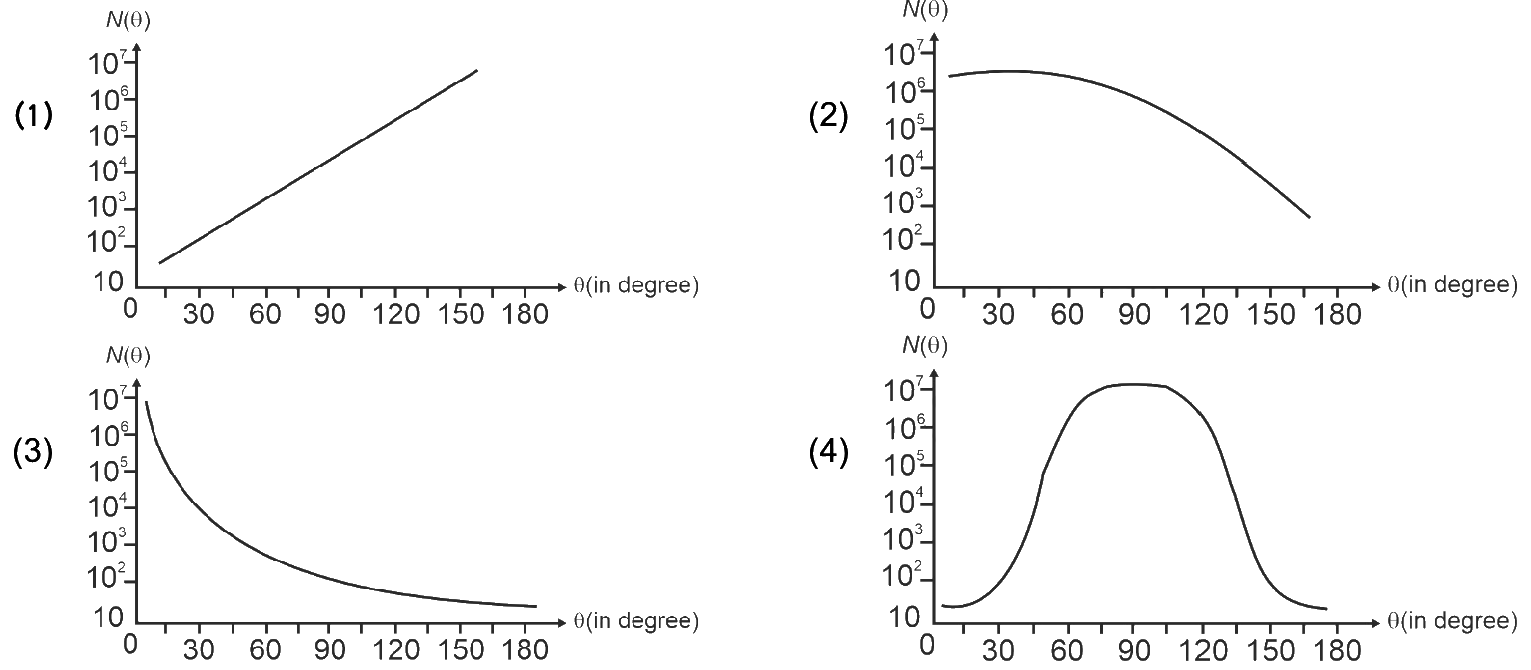
In the Geiger–Marsden experiment, the number of scattered $\alpha$-particles $N(\theta)$ is plotted as a function of scattering angle $\theta$. Which option represents the correct plot?
Atoms NEET PYQ diagram
Q20
NEET 2026 (1)Orbit radius

In the first excited state of hydrogen atom, the energy of its electron is –3.4 eV. The radial distance of the electron from the hydrogen nucleus in this case is approximately: (Take 1 eV = 1.6 × 10⁻¹⁹ J, e = 1.6 × 10⁻¹⁹ C and 1/(4πε₀) = 9 × 10⁹ N m²/C²)

Q21
ReNEET 2026Orbit radius

An electron is revolving in an excited state of a Hydrogen atom with velocity $\sqrt{25.6}\times10^{5}\,\text{ms}^{-1}$. The radius of the orbit is $x\times10^{-9}\,$m. The value of $x$ is: [$m_e=9\times10^{-31}\,$kg, $e=-1.6\times10^{-19}\,$C, $\dfrac{1}{4\pi\varepsilon_0}=9\times10^{9}\,\text{Nm}^2\text{C}^{-2}$]

Want more Atoms questions?

MedicNEET has 14,000+ NEET-style Biology questions with detailed NCERT-based explanations — including long, tricky questions that actually come in the exam.

Download MedicNEET App — Free
Practise Atoms MCQs — Free

Beyond the PYQs above — every Physics question format NEET now uses, starting with the newest ReNEET 2026-style reasoning MCQs. Tap an option for the answer and a worked solution. Free, no login.

🔢 AtomsNumericals — PYQ-Based

Exam-style numericals seeded from real NEET previous-year questions, kept inside the NEET syllabus boundary. Each with a worked solution.

  1. Q1. For the electron in the nth Bohr orbit of a hydrogen-like atom, the orbital frequency (number of revolutions per second) is f. The electron's circular motion constitutes an equivalent electric current i. Which expression correctly gives this current in terms of the electron charge e and the orbital frequency f, and how does i depend on n (for fixed Z)?
  2. Q2. In a hydrogen atom (Z = 1), the angular momentum of the electron in a certain Bohr orbit is L = 3h/2π, where h is Planck's constant. The radius of this orbit is closest to: (take the first Bohr radius as 0.53 Å)
  3. Q3. In the Bohr model of the hydrogen atom (Z = 1), the speed of the electron in the first orbit (n = 1) is v₁. What is the ratio of the speed in the third orbit to the speed in the first orbit, v₃ : v₁?
  4. Q4. A hypothetical atom consists of a nucleus with charge +Ze and a single electron. In the ground state, the electron orbits at radius r₀ with speed v₀. If this atom is actually a lithium ion (Li²⁺) with two electrons removed, and its ground state energy is measured to be -122.4 eV, what would be the ground state energy of a hypothetical beryllium ion (Be³⁺) with three electrons removed? [Given: Ground state energy of hydrogen = -13.6 eV]
  5. Q5. In a hydrogen atom, an electron is revolving in the second excited state (n = 3). What is the ratio of the magnitude of potential energy to the total energy of the electron in this orbit?
  6. Q6. The wavelength of the first line in the Lyman series of hydrogen spectrum is 121.5 nm. What is the wavelength of the first line in the Balmer series?
  7. Q7. A hydrogen atom initially in the ground state is excited to the n = 4 energy level. When the atom de-excites back to the ground state, the total number of different spectral lines that can be observed in the emission spectrum is:
  8. Q8. In hydrogen spectrum, the wave number of the series limit of Lyman series is found to be 'ν̃'. What will be the wave number of the series limit of the Paschen series?
  9. Q9. The wavelength of the first line of Lyman series in the hydrogen spectrum is λ₁. What is the wavelength of the first line of the Paschen series?
  10. Q10. An electron in a hydrogen atom makes a transition from n = 5 to n = 2, emitting a photon of wavelength λ₁. Another electron in a different hydrogen atom makes a transition from n = 7 to n = 4, emitting a photon of wavelength λ₂. If the ratio of the energy differences for these two transitions is used to find λ₁/λ₂, and it is known that the shortest wavelength in the Balmer series (n = ∞ to n = 2) is 365 nm, what is the wavelength λ₁ of the first transition? (Given: R = 1.097 × 10⁷ m⁻¹)

You’ve practised 10 of 38 Atoms questions in this set.

Practise all 38 + every chapter — free app →

📘 AtomsConceptual Theory MCQs

Theory MCQs — assertion-reason, statement and standard — for the part of the physics paper that isn't numericals.

  1. Q1. According to Bohr's model of the atom, which physical quantity of the orbiting electron is quantized in integral multiples of h/2π (where h is Planck's constant)?
  2. Q2. What was the principal conclusion drawn from the Geiger-Marsden experiment regarding the distribution of positive charge and mass within an atom, as proposed in Rutherford's nuclear model?
  3. Q3. Which of the following statements is CORRECT regarding early atomic models?
  4. Q4. Which of the following statements regarding the Geiger-Marsden experiment is CORRECT?
  5. Q5. According to de Broglie's interpretation, only certain Bohr orbits are allowed for the electron because in those orbits the electron wave:
  6. Q6. De Broglie explained Bohr's second postulate by treating the orbiting electron as a standing wave. The condition that the circumference of the nth orbit contains an integral number of electron wavelengths, 2πrₙ = nλₙ, directly leads to:
  7. Q7. In the hydrogen atom, the total energy of the electron in a stationary state is negative (Eₙ = −13.6/n² eV). What is the physical significance of this negative sign?
  8. Q8. The fact that each element emits a characteristic spectrum of radiation, such as the fixed lines seen for hydrogen, strongly suggests a direct relationship between which two properties?
  9. Q9. Consider the following two statements about the hydrogen spectrum: Statement I: The Lyman series of hydrogen lies in the ultraviolet region, while the Balmer series lies in the visible region. Statement II: The series limit of any spectral series corresponds to the longest wavelength of that series, obtained for the transition with n₂ = ∞. In the light of the above statements, choose the correct answer:
  10. Q10. In the context of Rutherford's α-particle scattering experiment, which of the following statements is CORRECT?

You’ve practised 10 of 36 Atoms questions in this set.

Practise all 36 + every chapter — free app →

Atoms — NEET PYQ Analysis

Atoms is a Class 12 NEET Physics chapter consistently tested from 2016 to ReNEET 2026. This page has all 21 authentic previous year questions from real NEET papers — with answers and detailed solutions, not model questions.

For full chapter-wise practice in timed test mode, download the MedicNEET app — 22,000+ questions across the full NEET syllabus. Back to the NEET Physics PYQ index.