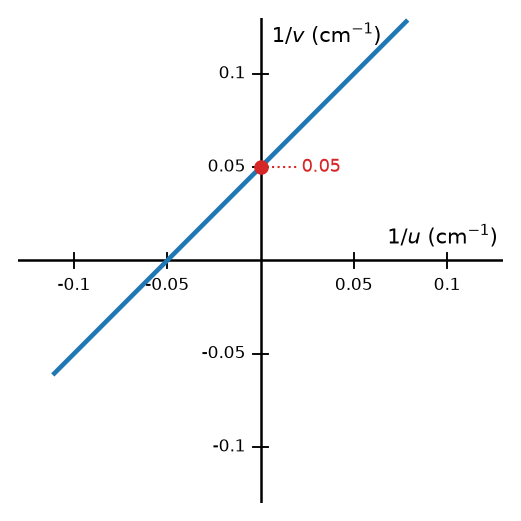
Match the corresponding entries of Column 1 with Column 2 (where m is the magnification produced by the mirror). Column 1: (A) m = −2 (B) m = −1/2 (C) m = +2 (D) m = +1/2 Column 2: (a) Convex mirror (b) Concave mirror (c) Real image (d) Virtual image
A person can see clearly objects only when they lie between 50 cm and 400 cm from his eyes. In order to increase the maximum distance of distinct vision to infinity, the type and power of the correcting lens the person has to use will be
The angle of incidence for a ray of light at a refracting surface of a prism is 45°. The angle of the prism is 60°. If the ray suffers minimum deviation through the prism, the angle of minimum deviation and refractive index of the material of the prism respectively are
Two identical glass (µ_g = 3/2) equiconvex lenses of focal length f each are kept in contact. The space between the two lenses is filled with water (µ_w = 4/3). The focal length of the combination is
An air bubble in a glass slab with refractive index 1.5 (near normal incidence) is 5 cm deep when viewed from one surface and 3 cm deep when viewed from the opposite face. The thickness (in cm) of the slab is
An astronomical telescope has objective and eyepiece of focal lengths 40 cm and 4 cm respectively. To view an object 200 cm away from the objective, the lenses must be separated by a distance
Two ways to go deeper on this chapter
Choose your next step
A beam of light from a source L is incident normally on a plane mirror fixed at a certain distance x from the source. The beam is reflected back as a spot on a scale placed just above the source L. When the mirror is rotated through a small angle θ, the spot of light is found to move through a distance y on the scale. The angle θ is given by
A thin prism having refracting angle 10° is made of glass of refractive index 1.42. This prism is combined with another thin prism of glass of refractive index 1.7. This combination produces dispersion without deviation. The refracting angle of the second prism should be
The refractive index of the material of a prism is √2 and the angle of the prism is 30°. One of the two refracting surfaces of the prism is made a mirror inwards by silver coating. A beam of monochromatic light entering the prism from the other face will retrace its path (after reflection from the silvered surface) if its angle of incidence on the prism is
An astronomical refracting telescope will have large angular magnification and high angular resolution when it has an objective lens of
An object is placed at a distance of 40 cm from a concave mirror of focal length 15 cm. If the object is displaced through a distance of 20 cm towards the mirror, the displacement of the image will be
Two similar thin equi-convex lenses of focal length f each are kept coaxially in contact with each other such that the focal length of the combination is F₁. When the space between the two lenses is filled with glycerin (which has the same refractive index, µ = 1.5, as that of glass) then the equivalent focal length is F₂. The ratio F₁ : F₂ will be
An equiconvex lens has power P. It is cut into two symmetrical halves by a plane containing the principal axis. The power of one part will be:
In total internal reflection, when the angle of incidence is equal to the critical angle for the pair of media in contact, what will be the angle of refraction?
A double convex lens has focal length 25 cm. The radius of curvature of one of the surfaces is double that of the other. Find the radii if the refractive index of the material of the lens is 1.5:
A ray is incident at an angle of incidence i on one surface of a small angle prism (with angle of prism A) and emerges normally from the opposite surface. If the refractive index of the material of the prism is µ, then the angle of incidence i is nearly equal to
A lens of large focal length and large aperture is best suited as an objective of an astronomical telescope since
A convex lens 'A' of focal length 20 cm and a concave lens 'B' of focal length 5 cm are kept along the same axis with a distance 'd' between them. If a parallel beam of light falling on 'A' leaves 'B' as a parallel beam, then the distance 'd' in cm will be
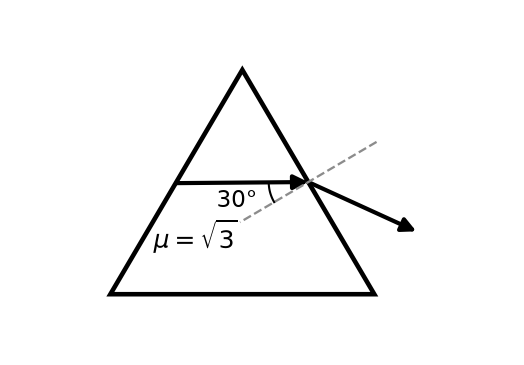
Find the value of the angle of emergence from the prism shown in the figure. The refractive index of the glass is √3 and the ray strikes the exit face of the prism at an internal angle of 30° to the normal.
A point object is placed at a distance of 60 cm from a convex lens of focal length 30 cm. If a plane mirror were put perpendicular to the principal axis of the lens and at a distance of 40 cm from it, the final image would be formed at a distance of
Two transparent media A and B are separated by a plane boundary. The speed of light in those media are 1.5 × 10⁸ m/s and 2.0 × 10⁸ m/s respectively. The critical angle for a ray of light for these two media is:
A biconvex lens has radii of curvature 20 cm each. If the refractive index of the material of the lens is 1.5, the power of the lens is:
A light ray falls on a glass surface of refractive index √3 at an angle of 60°. The angle between the refracted and reflected rays would be:
Two thin lenses are of the same focal length (f), but one is convex and the other one is concave. When they are placed in contact with each other, the equivalent focal length of the combination will be:
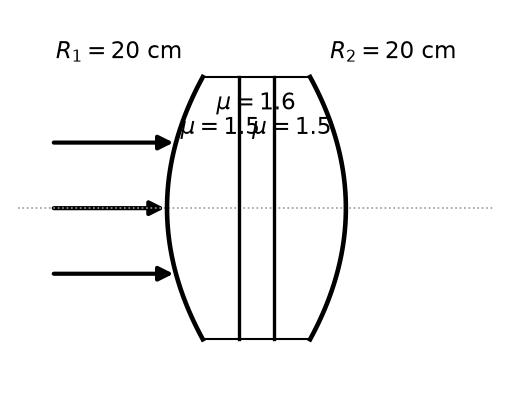
In the figure shown, what is the equivalent focal length of the combination of lenses (assume that all layers are thin)? The two outer lenses are glass (µ = 1.5) with curved-face radius 20 cm; the middle layer (µ = 1.6) is bounded by two plane faces.
An object is mounted on a wall. Its image of equal size is to be obtained on a parallel wall with the help of a convex lens placed between these walls. The lens is kept at a distance x in front of the second wall. The required focal length of the lens will be:
Light travels a distance x in time t₁ in air and 10x in time t₂ in another denser medium. What is the critical angle for this medium?
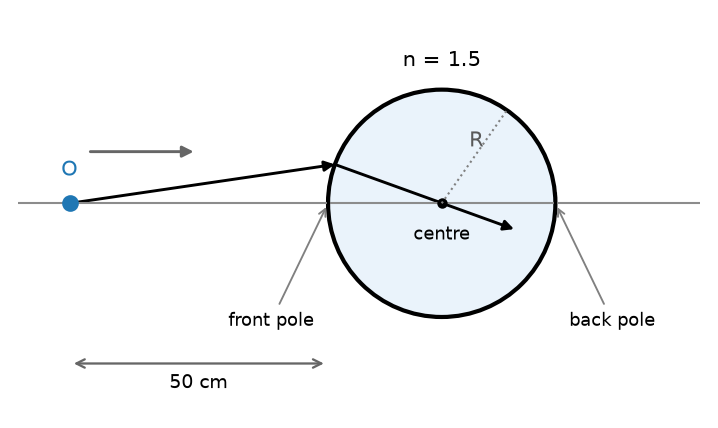
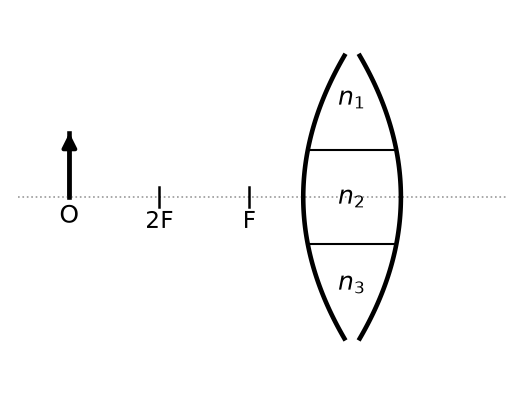
A lens is made up of 3 different transparent media as shown in the figure. A point object O is placed on its axis beyond 2f. How many real images will be obtained on the other side?
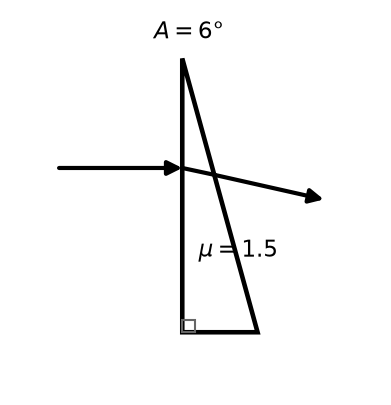
A horizontal ray of light is incident on the right-angled prism with prism angle 6°. If the refractive index of the material of the prism is 1.5, then the angle of emergence will be:
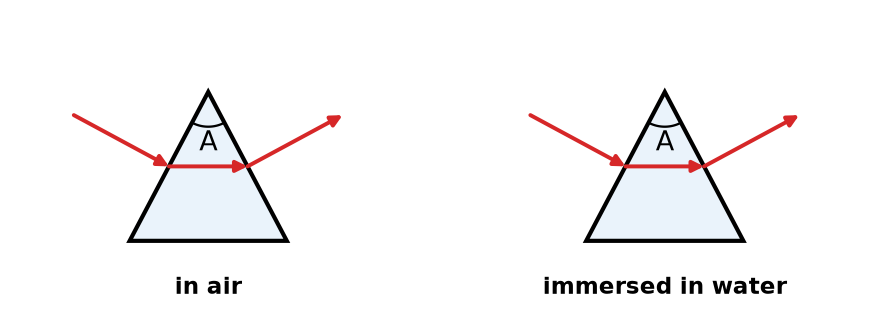
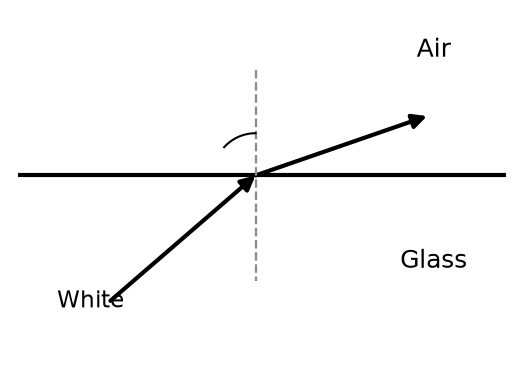
Which set of colours will come out in air for the situation shown in the figure?
A small telescope has an objective of focal length 140 cm and an eyepiece of focal length 5.0 cm. The magnifying power of the telescope for viewing a distant object is:
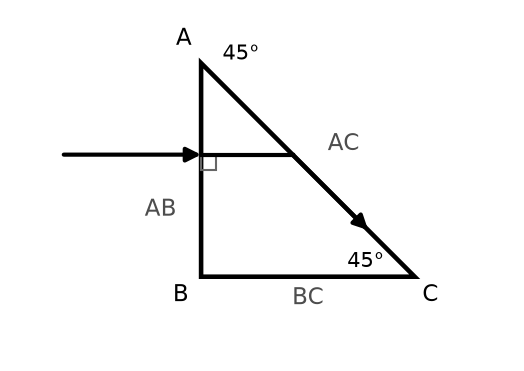
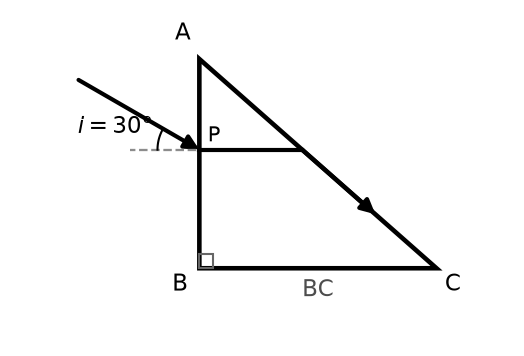
A light ray enters through a right-angled prism at point P with the angle of incidence 30° as shown in the figure. It travels through the prism parallel to its base BC and emerges along the face AC. The refractive index of the prism is:
In a certain camera, a combination of four similar thin convex lenses are arranged axially in contact. Then the power of the combination and the total magnification, in comparison to the power (p) and magnification (m) for each lens, will be respectively:
A microscope has an objective of focal length 2 cm, an eyepiece of focal length 4 cm and a tube length of 40 cm. If the distance of distinct vision of the eye is 25 cm, the magnification of the microscope is:
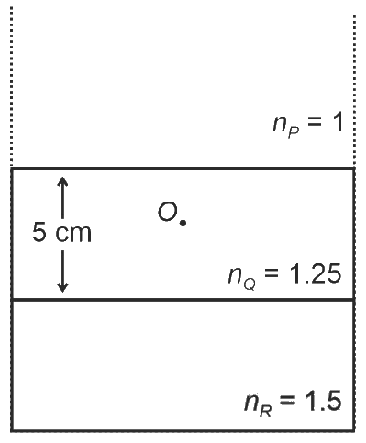
Three media $P$, $Q$ and $R$ have refractive indices $1$, $1.25$ and $1.5$ respectively. Medium $Q$ of thickness $5\,$cm is placed between extended media $P$ and $R$. An object $O$ is at the centre of $Q$. Viewed from $P$ (near normal) the apparent depth of $O$ is $h_1$; viewed from $R$ the apparent depth is $h_2$. The value of $|h_1-h_2|$ (in cm) is:
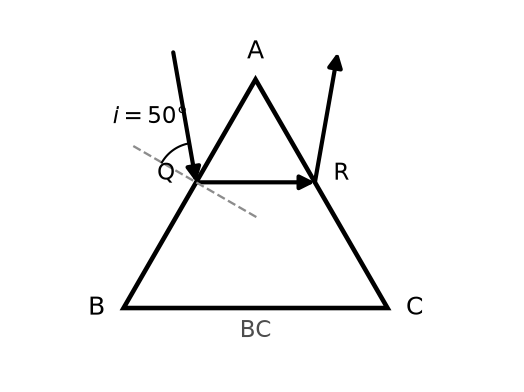
A ray of monochromatic light is passing through an equilateral prism (ABC) as shown in the figure. The refracted ray (QR) is parallel to its base (BC) and the angle of incidence (i) is 50°. Then the angle of deviation (δ) is:
In a concave lens, a ray of light emanating from the object parallel to the principal axis of the lens, after refraction:
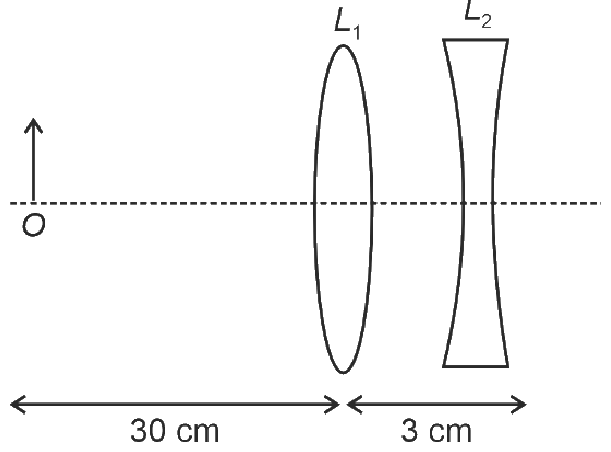
The lens combination shown consists of two lenses $L_1$ (focal length $+10\,$cm) and $L_2$ (focal length $-10\,$cm). An object $O$ is placed $30\,$cm to the left of $L_1$, and $L_2$ is $3\,$cm to the right of $L_1$. The position of the image formed is:
Want more Ray Optics And Optical Instruments questions?
MedicNEET has 43,000+ NEET-style questions across Physics, Chemistry & Biology with detailed NCERT-based explanations — including the long, tricky questions that actually come in the exam.
Download MedicNEET App — Free