Year-wise Weightage (2016–2026)

YearQuestions AskedMarks
2026520
202528
202428
202328
202214
Show earlier years (2016–2021)
202128
202014
2019520
201814
201728
201614
Q1
NEET 2016 Phase 2

A body of mass m is attached to the lower end of a spring whose upper end is fixed; the spring has negligible mass. When the mass m is slightly pulled down and released, it oscillates with a time period of 3 s. When the mass is increased by 1 kg, the time period becomes 5 s. The value of m (in kg) is

Q2
NEET 2017

A spring of force constant k is cut into lengths in the ratio 1 : 2 : 3. These pieces are first connected in series, giving force constant k′, and then in parallel, giving force constant k″. The ratio k′ : k″ is

Q3
NEET 2017

A particle executes linear simple harmonic motion with an amplitude of 3 cm. When the particle is at 2 cm from the mean position, the magnitude of its velocity equals the magnitude of its acceleration. Its time period (in seconds) is

Q4
NEET 2018

A pendulum hung from the roof of a tall building moves freely to and fro as a simple harmonic oscillator. The acceleration of the bob is 20 m/s² at a distance of 5 m from the mean position. The time period of oscillation is

Q5
NEET 2019

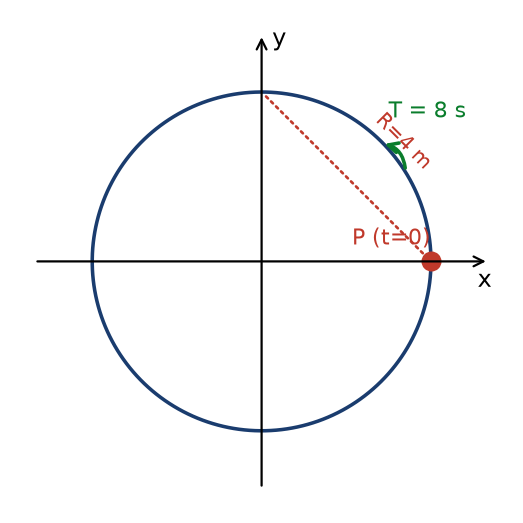
A particle P revolves in a circle as shown in the figure. The radius of the circle, the period of revolution, the initial position and the sense of revolution are indicated. The y-projection of the radius vector of the rotating particle P is
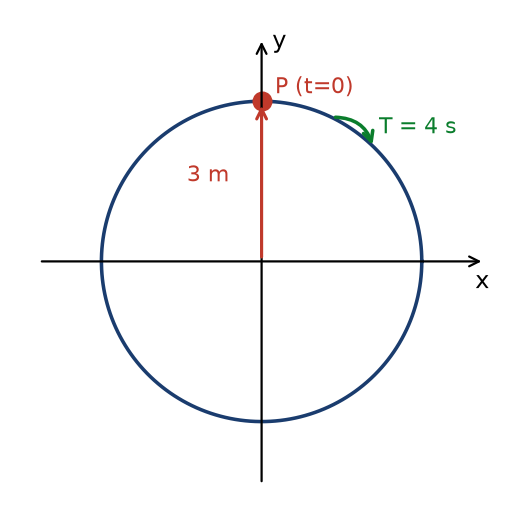
Oscillations NEET PYQ diagram
Q6
NEET 2019

The displacement of a particle executing simple harmonic motion is y = A₀ + A sin ωt + B cos ωt. The amplitude of its oscillation is

Q7
NEET 2019

The average velocity of a particle executing SHM over one complete vibration is

Q8
NEET 2019 Odisha

The distance covered by a particle undergoing SHM in one time period is (amplitude = A)

Q9
NEET 2019 Odisha

A mass falls from a height h and its time of fall t is recorded in terms of the time period T of a simple pendulum. On the surface of the earth it is found that t = 2T. The entire set-up is taken to another planet whose mass is half that of the earth and whose radius is the same. The experiment is repeated and the corresponding times are t′ and T′. Then

Q10
NEET 2020

The phase difference between displacement and acceleration of a particle in simple harmonic motion is

Q11
NEET 2021

A body executes simple harmonic motion with frequency n. The frequency of variation of its potential energy is

Q12
NEET 2021

A spring is stretched by 5 cm under a force of 10 N. The time period of oscillation when a mass of 2 kg is suspended from it is

Q13
NEET 2022

Two pendulums of lengths 121 cm and 100 cm start swinging in phase, both at their mean position in the same phase. The minimum number of vibrations of the shorter pendulum after which the two are again in phase at the mean position is

Q14
NEET 2023 Phase 1

The x–t graph of a particle performing simple harmonic motion is shown in the figure. The acceleration of the particle at t = 2 s is
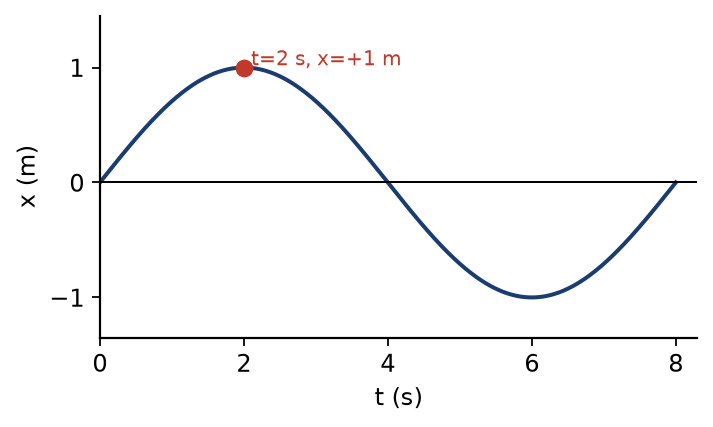
Oscillations NEET PYQ diagram
Q15
NEET 2023 Phase 2

A simple pendulum oscillating in air has a period of √3 s. If it is completely immersed in a non-viscous liquid whose density is one-fourth that of the material of the bob, the new period is

Q16
NEET 2024

If x = 5 sin(πt + π/3) m represents the motion of a particle executing simple harmonic motion, then the amplitude and time period of the motion, respectively, are

Q17
NEET 2024

If the mass of the bob of a simple pendulum is increased to thrice its original mass and its length is made half its original length, then the new time period of oscillation is (x/2) times its original time period. The value of x is

Q18
NEET 2025

Two identical point masses P and Q, suspended from two separate massless springs of spring constants k₁ and k₂ respectively, oscillate vertically. If their maximum speeds are the same, the ratio A_Q/A_P of the amplitude of mass Q to that of mass P is

Q19
NEET 2025

In an oscillating spring-mass system, a spring is connected to a box filled with sand. As the box oscillates, sand leaks slowly out of the box vertically, so the average angular frequency ω(t) and the average amplitude A(t) of the system change with time t. Which option correctly and schematically depicts these changes?
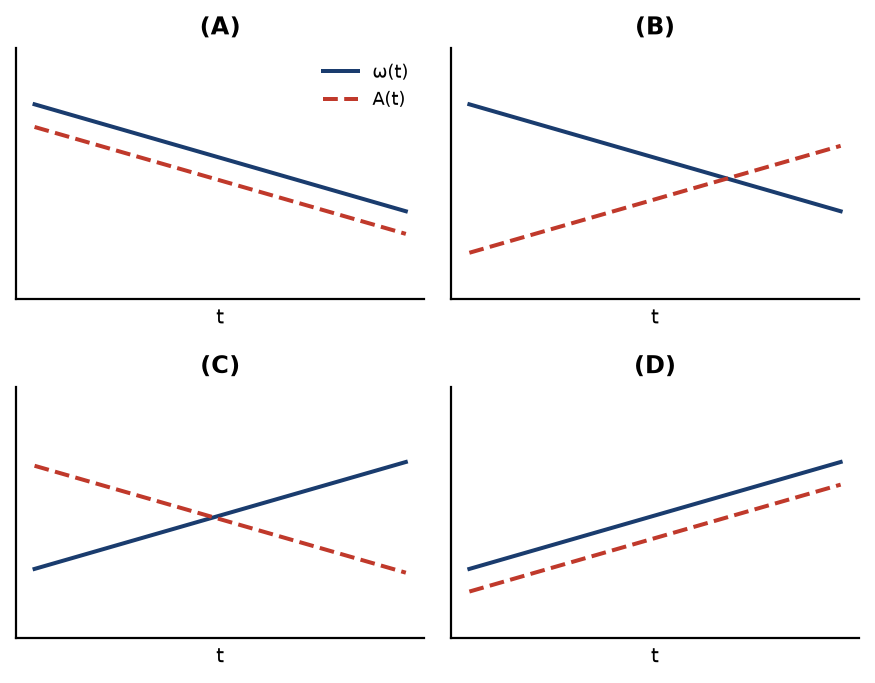
Oscillations NEET PYQ diagram
Q20
ReNEET 2026

Consider a spring-mass simple harmonic oscillator in one dimension. The mass of the particle is $m\,$kg and the spring constant is $k\,\text{Nm}^{-1}$. At a given instant the extension of the spring is $x$ m and the speed of the particle is $v\,\text{ms}^{-1}$. On the $x$–$v$ plane, if the graph of $v$ as a function of $x$ is a circle, then the correct option is:

Q21
ReNEET 2026

A cylindrical cork of uniform density floats in a liquid of density $\rho_1$. When depressed slightly and released it oscillates harmonically with time period $T$. If the same cork floats in another liquid of density $\rho_2$, the oscillation has period $2T$. The value of $\dfrac{\rho_2}{\rho_1}$ is:

Q22
NEET 2026 (1)

For a simple pendulum having time period T, the variation of kinetic energy (K.E.) with time (t) is represented by
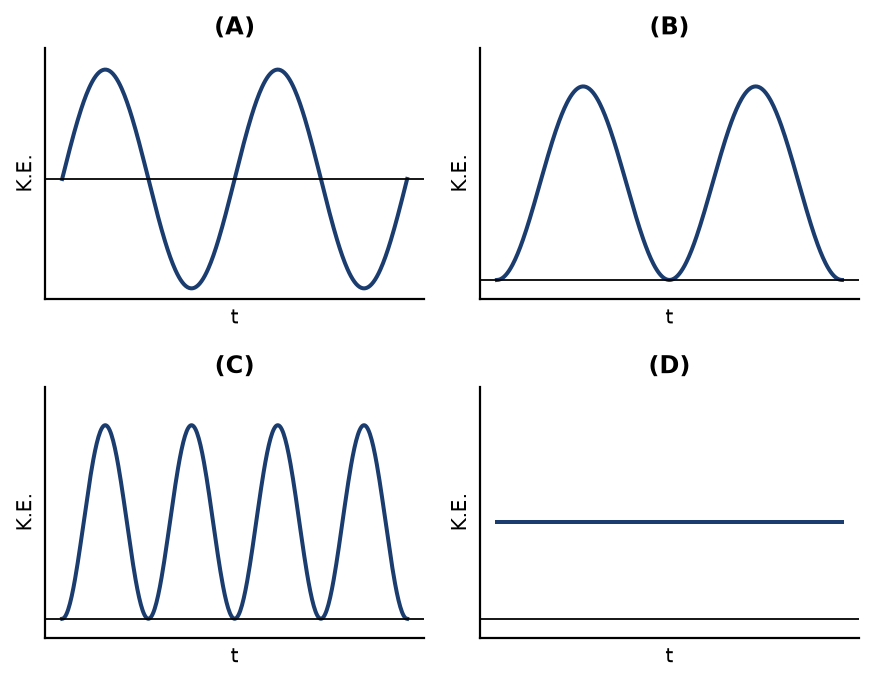
Oscillations NEET PYQ diagram
Q23
NEET 2026 (1)

The sum of the kinetic energy and potential energy of a simple pendulum bob is 0.02 J. The speed of the bob at its equilibrium position is approximately (mass of the bob = 20 g)

Q24
NEET 2026 (1)

Savitha, a Class XI student, performs an experiment to find the effective length L of a simple pendulum. She records the time for 30 oscillations as 60 s. The length she calculates is (take π² = 9.8 and g = 9.8 m/s²)

Want more Oscillations questions?

MedicNEET has 14,000+ NEET-style Biology questions with detailed NCERT-based explanations — including long, tricky questions that actually come in the exam.

Download MedicNEET App — Free
Practise Oscillations MCQs — Free

Beyond the PYQs above — every Physics question format NEET now uses, starting with the newest ReNEET 2026-style reasoning MCQs. Tap an option for the answer and a worked solution. Free, no login.

🔢 OscillationsNumericals — PYQ-Based

Exam-style numericals seeded from real NEET previous-year questions, kept inside the NEET syllabus boundary. Each with a worked solution.

  1. Q1. A simple pendulum is suspended from the roof of a cart that moves horizontally with a constant acceleration a = g. The effective gravity is g_eff = √(g² + a²). The ratio of the new time period to the original (cart at rest) period, T'/T, is:
  2. Q2. A particle moves anticlockwise in a circle of radius R = 4 m with period T = 8 s. At t = 0 it is at the rightmost point on the +x-axis. The x-projection of its position, x(t), is given by:
    NEET question diagram
  3. Q3. A particle starts from the mean position and executes SHM with period T. What is the time taken by it to reach a displacement equal to half the amplitude (x = A/2)?
  4. Q4. A particle executes simple harmonic motion with amplitude 10 cm. At what displacement from the mean position is the kinetic energy three times the potential energy?
  5. Q5. A spring of force constant k is cut into two parts in the ratio 2:3. These two parts are connected in series to form a system with effective spring constant k_s. When the same two parts are connected in parallel, the effective spring constant is k_p. The ratio k_s : k_p is:
  6. Q6. A mass M is suspended from a vertical spring and oscillates with a time period of 2 s. When an additional mass of 3 kg is attached to M, the system oscillates with a time period of 4 s. Now, if the original mass M alone is suspended and the spring is cut into two equal halves, and M is suspended from one half, the new time period of oscillation will be:
  7. Q7. A uniform spring of force constant k and natural length L is suspended vertically from a rigid support. A mass M is attached to its lower end, causing an extension x₀. The spring is now cut at a point one-third from the top while the mass remains attached to the lower portion. The system is then placed horizontally on a frictionless table and the mass is displaced slightly. If the time period of vertical oscillation with the uncut spring was T, what is the time period of horizontal oscillation with the cut spring?
  8. Q8. Two particles P and Q execute simple harmonic motions along the x-axis and y-axis respectively. Their displacements are given by x = 3 sin(2πt) cm and y = 4 cos(2πt) cm, where t is in seconds. At t = 0, particle P starts from mean position moving in positive x-direction. What is the shape of the trajectory of the resultant motion when both motions are superposed, and what is its area?
  9. Q9. The displacement of a particle in simple harmonic motion is given by y = 2 + 6 sin(4πt) + 8 cos(4πt), where y is in cm and t is in seconds. The amplitude and angular frequency of oscillation are respectively:
  10. Q10. A particle executing simple harmonic motion is described by the displacement equation x(t) = A cos(ωt + φ), where ω = 4π rad/s. At t = 0, the particle is at position x₀ = −2.5 cm with velocity v₀ = +10π√3 cm/s. When the particle next reaches its maximum positive displacement from the mean position, what is the time elapsed and the maximum displacement?

You’ve practised 10 of 56 Oscillations questions in this set.

Practise all 56 + every chapter — free app →

📘 OscillationsConceptual Theory MCQs

Theory MCQs — assertion-reason, statement and standard — for the part of the physics paper that isn't numericals.

  1. Q1. A particle moves in a circle of radius R with constant angular speed ω. Consider the projection of this particle on the diameter of the circle. Which statement about the motion of the projection is correct?
  2. Q2. A particle starts SHM from its mean position at t = 0 and moves towards the positive extreme. The amplitude is A and the period is T. Which of the following correctly describes its displacement-time graph in the interval 0 ≤ t ≤ T?
  3. Q3. Which of the following statements about a simple pendulum is INCORRECT?
  4. Q4. Given below are two statements about resonance in forced oscillations of a damped system: Statement I: Resonance occurs when the driving frequency equals the natural frequency of the oscillator. Statement II: At resonance, the amplitude of forced oscillation becomes infinite for any non-zero damping coefficient. In the light of the above statements, choose the correct answer from the options given below.
  5. Q5. The potential energy U of a particle of mass m executing SHM with angular frequency ω and amplitude A is plotted as a function of its displacement x from the mean position. Which of the following correctly describes this U vs x graph?
  6. Q6. Given below are two statements concerning the simple pendulum (small-angle approximation): Statement I: The time period of a simple pendulum is independent of the mass of the bob. Statement II: The time period of a simple pendulum is independent of the amplitude, provided the angular amplitude is small. In the light of the above statements, choose the correct answer from the options given below.
  7. Q7. A block of mass m is attached to one end of a horizontal spring of force constant k, with the other end fixed. The block can slide on a frictionless surface and is released from a small displacement. If the mass m is quadrupled and the spring constant k is kept unchanged, how does the time period of oscillation change?
  8. Q8. A simple pendulum is suspended from the ceiling of a lift. In which of the following situations does the pendulum NOT oscillate at all (its time period effectively becomes infinite)?
  9. Q9. A particle of mass m executes simple harmonic motion of amplitude A and angular frequency ω about x = 0. Match the physical quantity in Column I with its value/expression in Column II. | Column I | Column II | |---|---| | (a) Maximum speed | (i) (1/2)mω²A² | | (b) Maximum acceleration | (ii) ω²A | | (c) Total mechanical energy | (iii) ωA | | (d) Speed of the particle at x = A/2 | (iv) (√3/2) · ωA |
  10. Q10. Which of the following statements about SHM and uniform circular motion is correct?

You’ve practised 10 of 28 Oscillations questions in this set.

Practise all 28 + every chapter — free app →

Oscillations — NEET PYQ Analysis

Oscillations is a Class 11 NEET Physics chapter consistently tested from 2016 to ReNEET 2026. This page has all 24 authentic previous year questions from real NEET papers — with answers and detailed solutions, not model questions.

For full chapter-wise practice in timed test mode, download the MedicNEET app — 22,000+ questions across the full NEET syllabus. Back to the NEET Physics PYQ index.