Ohm's Law Questions for NEET 2027All 69 problems — MCQs, numericals & ReNEET 2026-style reasoning, with worked solutions
Every Ohm's Law question NEET has asked and the newest exam-style ones — free, no login. Tap an option for an instant worked solution.
✨ Practise all 69 Ohm's Law Questions
Ohm's Law is a high-yield part of Current Electricity. This is the complete set — real NEET PYQs plus ReNEET 2026-style reasoning, each with an instant worked solution.
- Q1. A wire of resistance R is first stretched (constant volume) to three times its length, and then this long wire is folded into three equal parts joined in parallel. The final resistance is:
- Q2. Two resistors 6 and 12 can give a maximum and minimum equivalent resistance of:
- Q3. The equivalent resistance of three resistors 2 , 3 and 6 all in parallel is:
- Q4. Two wires of the same material have lengths in ratio 1:2 and radii in ratio 2:1. The ratio of their resistances is:
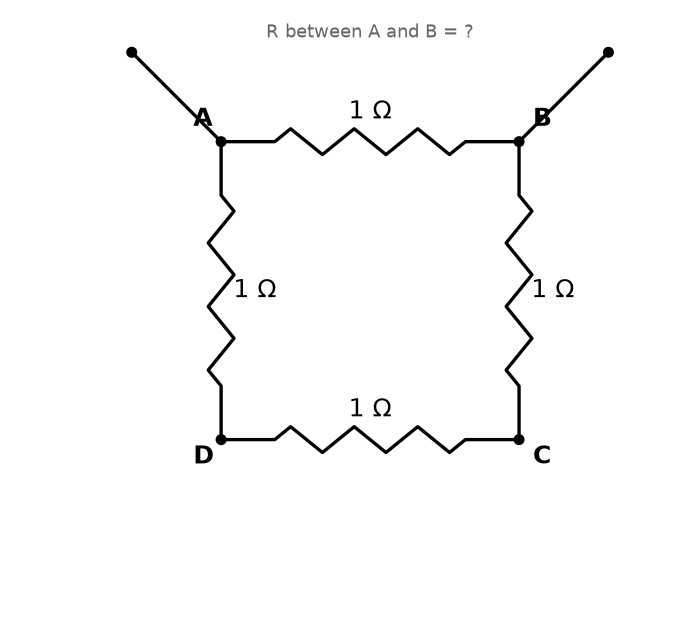
- Q5. A uniform wire of total resistance 4 is bent into a square ABCD (each side 1 ). The equivalent resistance between two ADJACENT corners A and B is:
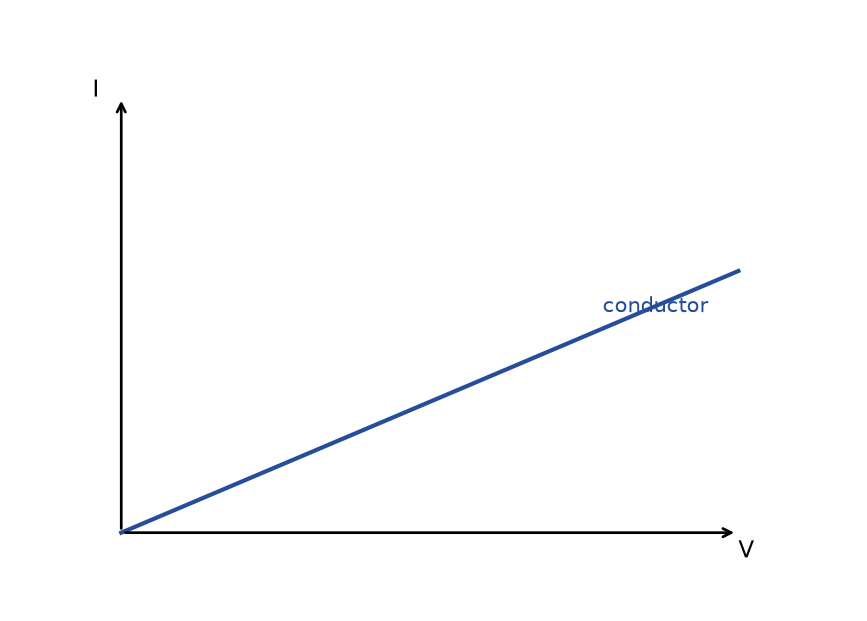
- Q6. The V–I graph of a conductor is a straight line through the origin. The resistance equals:
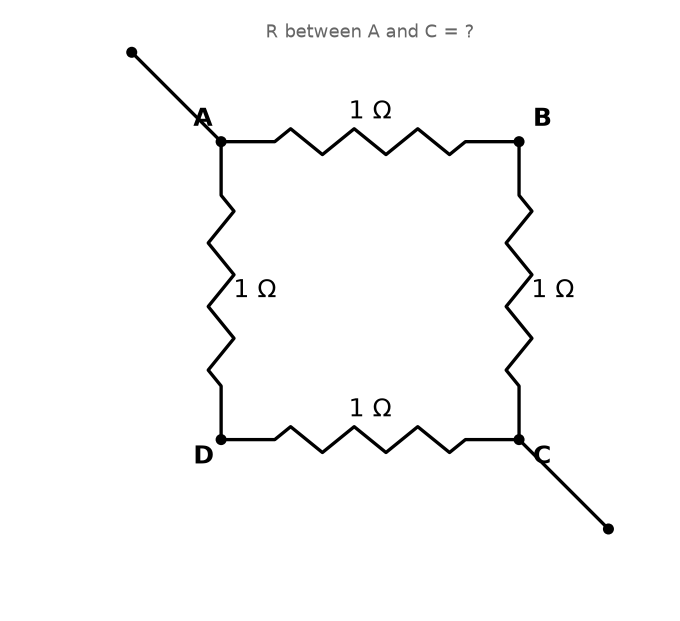
- Q7. For the same square (each side 1 ), the equivalent resistance between DIAGONAL corners A and C is:
- Q8. A wire of length 2 m and area 110 m has resistivity 510 m. Its resistance is:
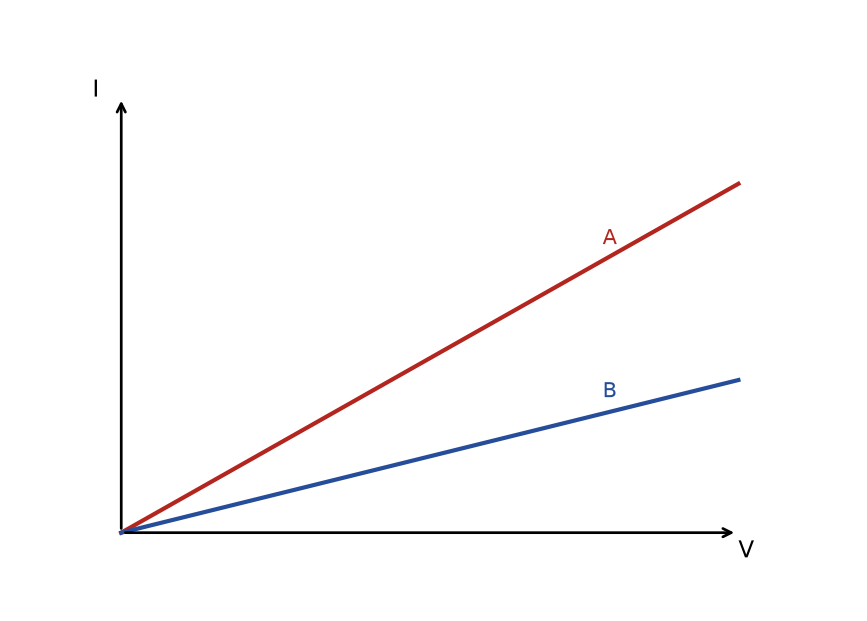
- Q9. In the I–V graph two conductors A and B are straight lines from the origin; A is steeper than B. Then:
- Q10. Which of the following is a non-ohmic device?
- Q11. From a conductor's V–I data, a point reads V = 6 V, I = 0.5 A. Its resistance is:
- Q12. In a network between A and B: a top path of two 2 resistors in series is in parallel with a 6 resistor; this parallel section is in series with a 1.6 resistor. The equivalent resistance R_AB is:
- Q13. A cylindrical wire of length 2 m and cross-sectional area 2 × 10⁻⁶ m² has a resistance of 4 Ω. If the wire is stretched uniformly to double its length while keeping its volume constant, what will be the new resistance?
- Q14. A uniform wire of length 120 cm and resistance 180 Ω is cut into 6 equal parts. The first 3 parts are connected in parallel, the next 3 parts are connected in series, and these two combinations are then connected in series. The total resistance of this final combination is:
- Q15. A wire of resistance R and length L is stretched uniformly to double its original length. If the volume of the wire remains constant during stretching, what is the new resistance of the wire?
- Q16. Three identical wires of equal length, equal area of cross-section and same material are first connected in parallel giving an effective resistance of 2 Ω. If these three wires are now connected in series, what will be the effective resistance of the combination?
- Q17. A wire of resistance 60 Ω is bent to form a square loop. The equivalent resistance between two diagonally opposite corners of the square is:
- Q18. A wire of length 2 m and cross-sectional area 0.5 mm² has a resistance of 0.4 Ω. The wire is stretched uniformly to a length of 4 m. What is the new resistance of the wire?
- Q19. A uniform wire of length 10 m and resistance 50 Ω is cut into 5 equal parts. Three of these parts are connected in series and the remaining two parts are connected in parallel. These two combinations are then connected in series with each other. What is the total resistance of the final combination?
- Q20. A cylindrical wire of resistivity ρ, length L, and cross-sectional area A is stretched uniformly to twice its original length while maintaining constant volume. The wire is then cut into two equal parts, and these parts are connected in parallel between two terminals. If the original resistance of the wire was R₀, what is the equivalent resistance of this final parallel combination?
- Q21. A wire of resistivity ρ and length L is drawn uniformly to increase its length to 3L. If the initial resistance of the wire was R, what is the final resistance of the wire?
- Q22. A cylindrical wire of resistance 12 Ω is drawn out uniformly to three times its original length by a stretching machine. What is the resistance of the wire after this process?
- Q23. Two cylindrical conductors A and B are made of the same material. Conductor A has length 2l and radius r, while conductor B has length l and radius 2r. If the resistance of conductor A is 64 Ω, what is the resistance of conductor B?
- Q24. A wire of resistance 20 Ω is uniformly stretched to 3 times its original length. What is the new resistance of the wire?
- Q25. Three wires P, Q, and R are made of the same material. Wire P has length L and cross-sectional area A. Wire Q has length 2L and cross-sectional area 2A. Wire R has length 3L and cross-sectional area 3A. If the resistance of wire P is 12 Ω, what is the resistance of wire R?
- Q26. A uniform resistance wire of length 30 cm and total resistance 60 Ω is stretched uniformly to a new length of 60 cm. The stretched wire is then bent to form a circular loop. What is the equivalent resistance between two diametrically opposite points on this circular loop?
- Q27. A nichrome wire of length 2 m and cross-sectional area 0.5 mm² has a resistance of 8 Ω at room temperature. When this wire is uniformly stretched to 3 times its original length, its new resistance becomes:
- Q28. A nichrome wire of resistivity 1.0 × 10⁻⁶ Ω·m is stretched uniformly to twice its original length. If the original resistance was 20 Ω, what is the new resistance of the stretched wire?
- Q29. A wire of resistance 12 Ω is melted and recast into a wire of half its original length. The resistance of the new wire will be:
- Q30. A cylindrical wire of resistivity ρ, length L and radius r has a resistance of 20 Ω. Another wire of the same material is made with length 2L and radius 2r. What is the resistance of the second wire?
- Q31. A cylindrical conductor of resistance 6 Ω is drawn into a wire of half its original diameter. Assuming no change in the volume and resistivity of the material, the new resistance of the wire will be:
- Q32. Two resistors are made of the same material. Resistor P is a wire of length 100 cm and cross-sectional area 2 mm². Resistor Q is made from the same wire but stretched to a length of 200 cm. If the resistance of P is 10 Ω, what is the resistance of Q? (Assume volume remains constant during stretching)
- Q33. A uniform wire of total length 24 cm and resistance 48 Ω is bent into a square ABCD with each side 6 cm. The resistance is measured between different pairs of vertices: (i) R_AB between adjacent vertices A and B via the direct side AB, (ii) R_AC between opposite vertices A and C via one semicircular path (either ABC or ADC), and (iii) R_AD between adjacent vertices A and D via the direct side AD. The ratio R_AB : R_AC : R_AD is:
- Q34. A wire of resistance 90 Ω and length 3.6 m is divided into 6 equal parts. The first 3 parts are connected in series while the remaining 3 parts are connected in parallel. These two combinations are then connected in series. What is the total resistance of this final combination?
- Q35. A uniform wire of resistance 36 Ω is bent to form an equilateral triangle ABC. A battery of negligible internal resistance is connected across one side AB of the triangle. The equivalent resistance between points A and B is:
- Q36. A nichrome wire of length 8 m and cross-sectional area 4 × 10⁻⁶ m² has a resistance of 16 Ω. When this wire is stretched uniformly to twice its original length, what is the new resistance of the wire?
- Q37. A uniform wire of resistance 12 Ω is stretched uniformly until its length becomes three times its original length. What is the new resistance of the wire?
- Q38. Two wires A and B are made of the same material and have the same length. Wire A has twice the diameter of wire B. If the resistance of wire B is 40 Ω, what is the resistance of wire A?
- Q39. A wire of uniform cross-section and resistance 100 Ω is cut into 5 equal parts. Four of these parts are connected in parallel, and this combination is connected in series with the fifth part. What is the total resistance of the arrangement?
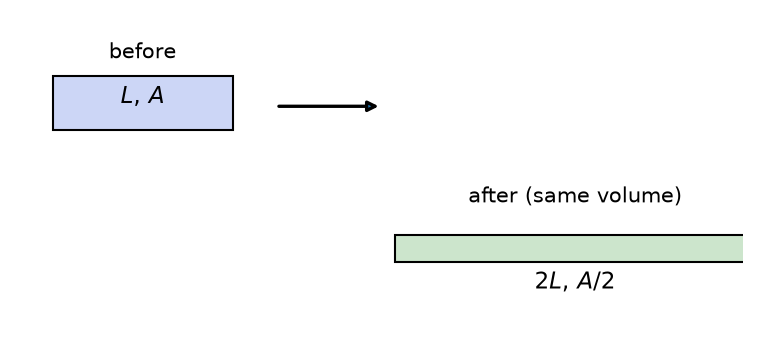
- Q40. A wire of resistance is stretched uniformly so that its length doubles while its volume stays the same. Its new resistance is:
- Q41. A wire of resistance is cut into 4 equal pieces, and the four pieces are joined in parallel. The resistance of the combination is:
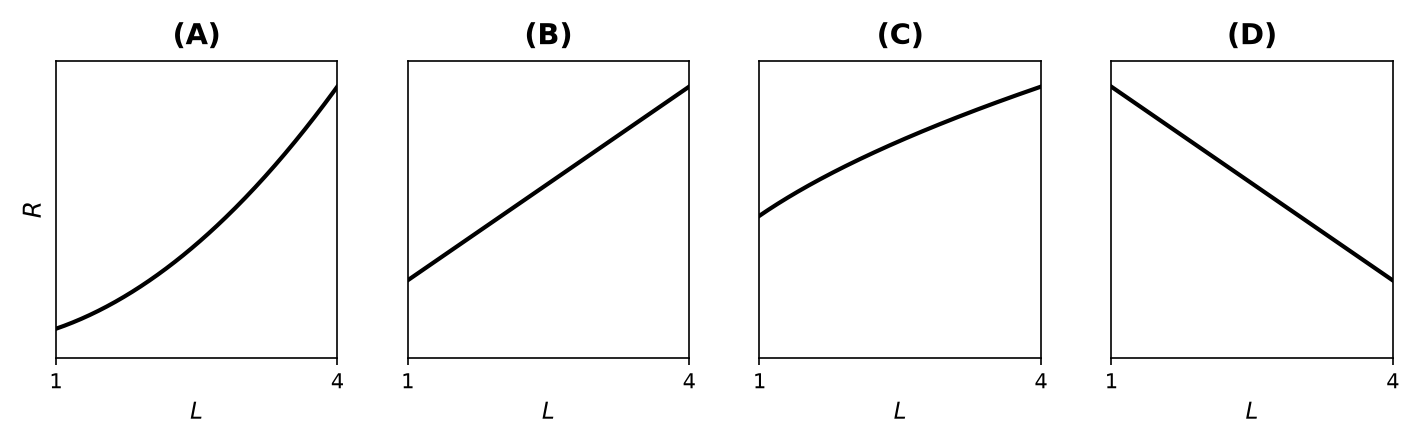
- Q42. Several wires are made from a fixed volume of the same material, each drawn to a different length . Which graph correctly shows how the resistance varies with ?
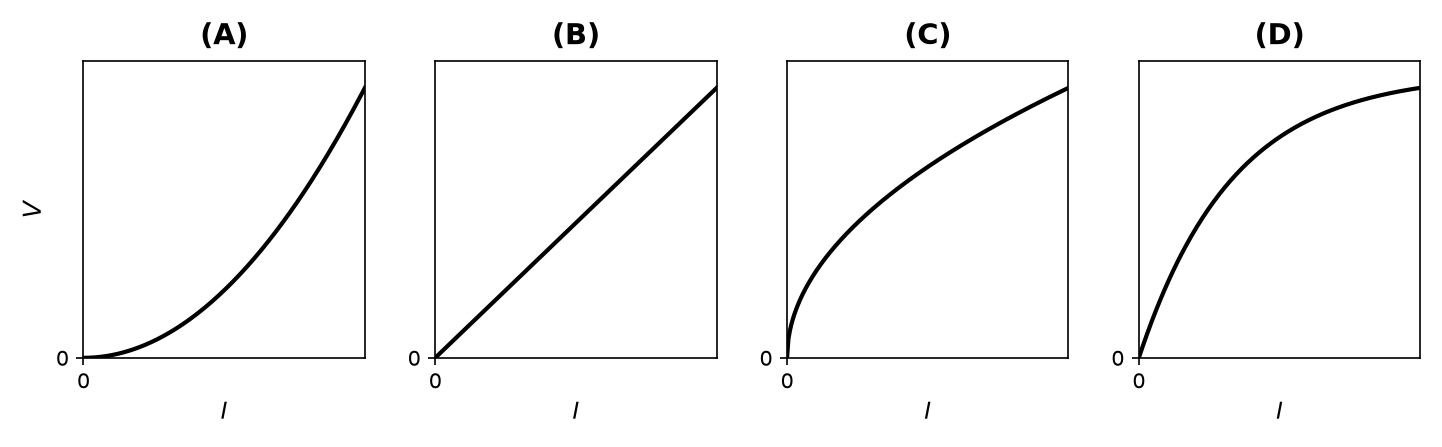
- Q43. The graphs show versus for four devices kept at constant temperature. Which one is a metallic conductor that obeys Ohm's law?
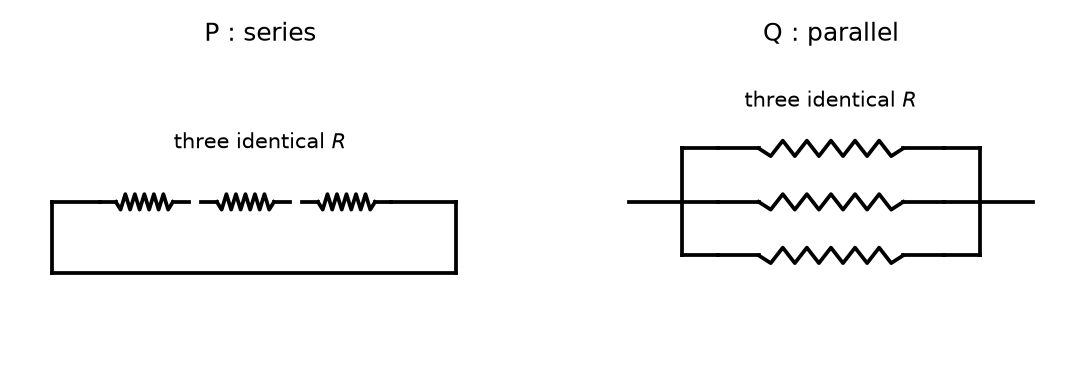
- Q44. Three identical resistors are connected first all in series (P) and then all in parallel (Q). The ratio of the equivalent resistances is:
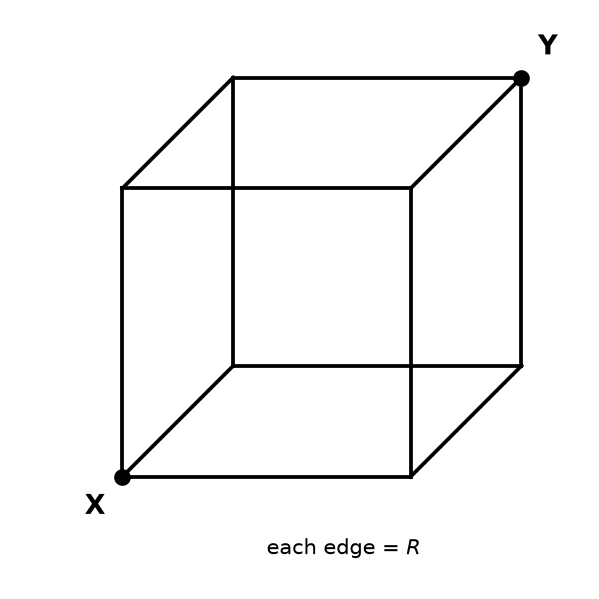
- Q45. Twelve identical resistors, each of resistance , form the edges of a cube. The equivalent resistance between two diagonally opposite corners and (the body diagonal) is:
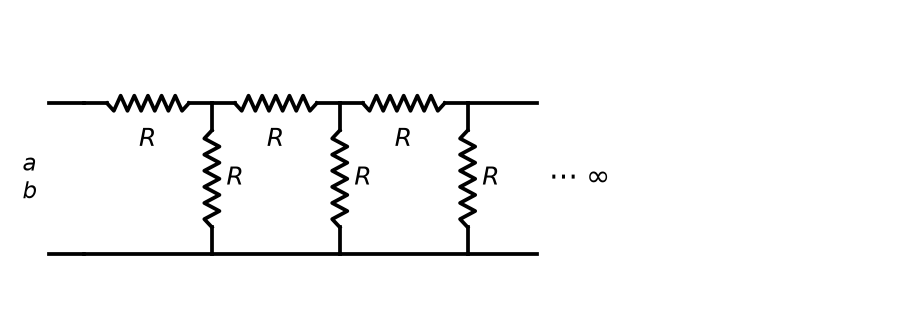
- Q46. In the infinite ladder network shown, every resistor has resistance . The equivalent resistance between the input terminals and is:
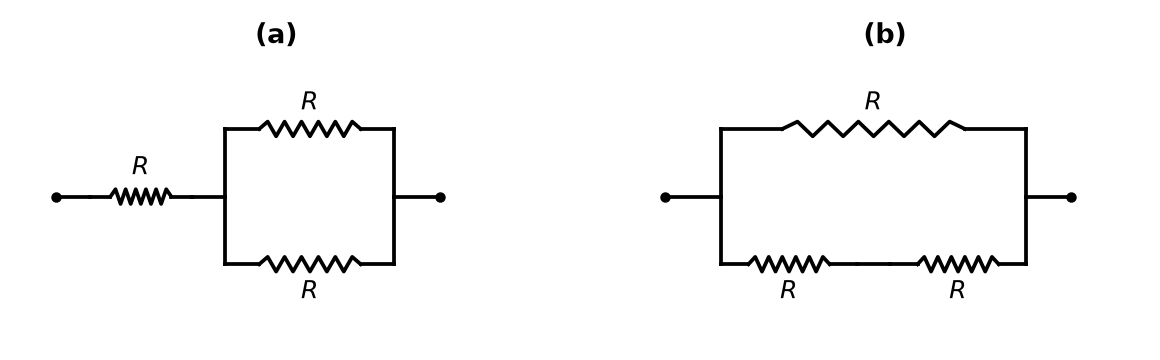
- Q47. The figure shows two networks (a) and (b), each made from three identical resistors . The ratio of the equivalent resistance of network (a) to that of network (b) is:
- Q48. The resistance of a uniform wire depends on its length and cross-sectional area as:
- Q49. A wire has resistivity m, length m and area m. Its resistance is:
- Q50. A conductor that obeys Ohm's law (constant resistance) is called:
Struggling with the tough-level Ohm's Law questions? The ReNEET 2026 question paper changed — it’s harder than ever. Download the free MedicNEET app to climb from the easiest level to the toughest in Ohm's Law and every concept.
Download the app — climb every level →Ohm's Law — FAQs
How many Ohm's Law questions are on this page?
All 69 — this is a complete Ohm's Law question set for NEET 2027, covering MCQs, numericals and problems drawn from real previous-year questions and ReNEET 2026-style reasoning. Every question shows a worked solution the moment you answer.
Are these Ohm's Law questions free?
Yes — practise all 69 here free, no login. Ohm's Law is part of the Current Electricity chapter; the free MedicNEET app then lets you practise it the way it actually raises your score — adaptively.
What is the best way to master Ohm's Law for NEET?
Practising every Ohm's Law problem once (as you can here) fixes the patterns; retaining them till the exam needs spaced repetition. The MedicNEET app's Predicted Batch schedules Ohm's Law and every other topic one step ahead of where you are, so you revise exactly when you're about to forget — that's what converts practice into marks.