Projectile Motion Questions for NEET 2027All 41 problems — MCQs, numericals & ReNEET 2026-style reasoning, with worked solutions
Every Projectile Motion question NEET has asked and the newest exam-style ones — free, no login. Tap an option for an instant worked solution.
✨ Practise all 41 Projectile Motion Questions
Projectile Motion is a high-yield part of Motion in a Plane. This is the complete set — real NEET PYQs plus ReNEET 2026-style reasoning, each with an instant worked solution.
- Q1. A stone is thrown horizontally with a speed of 15 m/s from the top of a tower 80 m high. The horizontal distance from the foot of the tower where it lands is (g = 10 m/s):
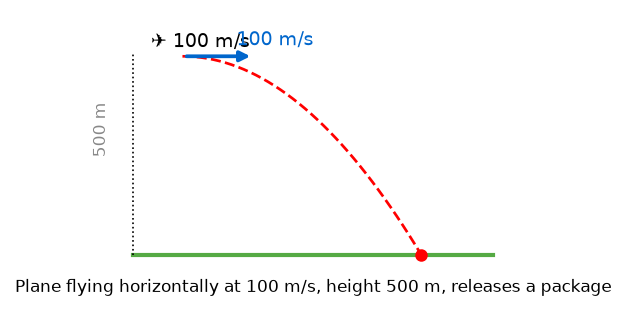
- Q2. An aeroplane flying horizontally at 100 m/s at a height of 500 m releases a package. The horizontal distance travelled by the package before hitting the ground is (g = 10 m/s):
- Q3. A stone is thrown from the ground with a velocity of 40 m/s at an angle of 60° above the horizontal. What is the maximum height reached by the stone? (Take g = 10 m/s², sin 60° = √3/2 ≈ 0.866)
- Q4. A projectile is launched from ground level at an angle of 30° above the horizontal with an initial speed of 40 m/s. At the instant when the projectile reaches its maximum height, it is observed that its velocity makes an angle θ with the horizontal. Simultaneously, another projectile is launched from the same point at angle 60° above the horizontal. If both projectiles have the same horizontal range, what is the ratio of the maximum heights achieved by the first projectile to the second projectile? (Take g = 10 m/s²)
- Q5. A projectile is launched from ground level with a velocity of 40 m/s at an angle of 30° with the horizontal. Exactly 1 second after launch, a second projectile is launched from the same point with the same initial velocity and angle. What is the vertical separation between the two projectiles when the first projectile reaches its maximum height? (Take g = 10 m/s²)
- Q6. Two projectiles are launched simultaneously from ground level with the same initial speed of 40 m/s. The first projectile is launched at 60° to the horizontal, and the second at 30° to the horizontal. What is the ratio of their maximum heights H₁ : H₂? (Take g = 10 m/s²)
- Q7. A ball is thrown up a smooth inclined plane at angle 30° with horizontal from its bottom with initial speed 20 m/s. When the same ball is thrown with the same speed up the plane when its inclination is changed to 60°, the ratio of maximum distances traveled along the plane in the two cases is:
- Q8. A stone is projected from ground level with a velocity of 40 m/s at an angle of 30° above the horizontal. What is the maximum height (in meters) attained by the stone? (Take g = 10 m/s²)
- Q9. A projectile is launched from the ground at an angle of 30° above the horizontal with a speed of 20 m/s. What is the maximum height reached by the projectile? (Take g = 10 m/s²)
- Q10. A stone is thrown horizontally from the top of a tower 80 m high with a speed of 30 m/s. Taking g = 10 m/s², what is the magnitude of velocity of the stone when it hits the ground?
- Q11. From the same height, two balls are thrown horizontally with speeds and over level ground. The ratio of the times they take to reach the ground is:
- Q12. Two projectiles are launched with the same speed at angles and above the horizontal. Which statement is correct?
- Q13. Two projectiles are thrown with the same speed at complementary angles and , so they have the same range. The ratio of their times of flight () is:
- Q14. For a projectile, the horizontal range equals times the maximum height . The angle of projection is:
- Q15. A projectile launched at a fixed angle has range on Earth. On a planet where the acceleration due to gravity is one-third of Earth's, the same projectile (same launch speed and angle) has a range of:
- Q16. A projectile thrown at has a horizontal range . Its maximum height is:
- Q17. Two balls are projected with the same speed at angles and . The ratio of their maximum heights () is:
- Q18. For a projectile launched at a fixed angle, the launch speed is doubled. The maximum height and the time of flight respectively become:
- Q19. A projectile has time of flight and maximum height . The relation between and (independent of the launch speed and angle) is:
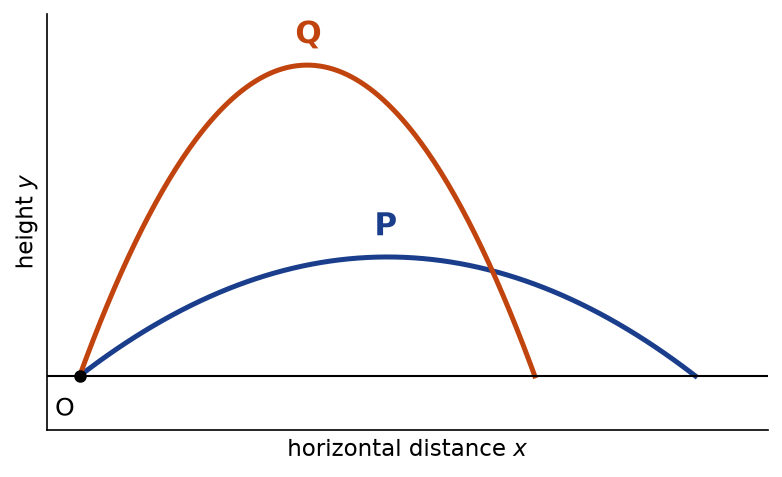
- Q20. Two projectiles are launched from the origin with the same speed but at different angles. Their paths are shown as curves and in the figure. Which curve corresponds to the LARGER angle of projection?
- Q21. The path of a projectile is (all in SI units, ). The angle of projection satisfies:
- Q22. The path of a projectile is (SI units, ). The speed of projection is:
- Q23. For a projectile (ignoring air resistance), the horizontal component of velocity:
- Q24. For a given launch speed, the horizontal range of a projectile is maximum when the angle of projection is:
- Q25. A projectile is thrown with speed at to the horizontal (). Its horizontal range is:
- Q26. For a projectile launched with speed at angle , the total time of flight (over level ground) is:
- Q27. A ball is thrown with speed at to the horizontal (). Its maximum height is:
- Q28. The path (trajectory) of a projectile thrown at an angle to the horizontal is:
- Q29. An aeroplane flying horizontally with a constant velocity releases a package. Neglecting air resistance, at the moment the package strikes the ground it is located:
- Q30. A footballer kicks a ball from level ground so that it leaves the foot at directed above the horizontal (). The horizontal distance from the kick at which the ball lands is:
- Q31. At a given launch speed a projectile has its maximum possible range when fired at . If it is fired at instead, with the same speed, its horizontal range is:
- Q32. The total time of flight of a projectile launched over level ground is . Its maximum height above the launch point is:
- Q33. A projectile is fired at an angle to the horizontal near the Earth's surface. Neglecting air resistance, the path traced by the projectile is:
- Q34. At the highest point of its parabolic trajectory, the direction of the velocity of a projectile is:
- Q35. The trajectory of a projectile in the vertical – plane is (all distances in metres). The maximum height reached by the projectile is:
- Q36. A projectile moves under gravity alone (no air resistance) in the vertical – plane, launched from the origin. Which of the following can NOT represent its trajectory (all quantities in SI units)?
- Q37. The trajectory of a projectile launched from the origin is , where and are positive constants. The ratio of its maximum height to its horizontal range, , is:
- Q38. The graph shows the variation of horizontal range (R) of a projectile with its angle of projection (θ), for a fixed initial speed. Using the information given in the graph, determine the maximum horizontal range (R_max) of the projectile.
- Q39. A ball is dropped from a certain height. At the same instant, a second ball is projected horizontally from the same height. Neglecting air resistance, which of the following statements is correct regarding their motion?
- Q40. Given below are two statements: Statement I: The horizontal range of a projectile is maximum when it is projected at an angle of 45° with the horizontal. Statement II: The formula for the maximum horizontal range of a projectile is given by R_max = v₀²/g, where v₀ is the initial speed. In the light of the above statements, choose the correct answer from the options given below.
- Q41. A particle moves in the x-y plane with a constant acceleration directed along the y-axis. Which statement best describes the particle's motion along the x-axis?
Struggling with the tough-level Projectile Motion questions? The ReNEET 2026 question paper changed — it’s harder than ever. Download the free MedicNEET app to climb from the easiest level to the toughest in Projectile Motion and every concept.
Download the app — climb every level →Projectile Motion — FAQs
How many Projectile Motion questions are on this page?
All 41 — this is a complete Projectile Motion question set for NEET 2027, covering MCQs, numericals and problems drawn from real previous-year questions and ReNEET 2026-style reasoning. Every question shows a worked solution the moment you answer.
Are these Projectile Motion questions free?
Yes — practise all 41 here free, no login. Projectile Motion is part of the Motion in a Plane chapter; the free MedicNEET app then lets you practise it the way it actually raises your score — adaptively.
What is the best way to master Projectile Motion for NEET?
Practising every Projectile Motion problem once (as you can here) fixes the patterns; retaining them till the exam needs spaced repetition. The MedicNEET app's Predicted Batch schedules Projectile Motion and every other topic one step ahead of where you are, so you revise exactly when you're about to forget — that's what converts practice into marks.