
Vascular Cambium — Open vs Closed Bundles, Secondary Xylem and Phloem
✅ Asked in NEET 2018Secondary xylem and phloem in dicot stem are produced by: (NEET 2018)
Secondary xylem and phloem in dicot stem are produced by: (NEET 2018)
The vascular cambium normally gives rise to: (NEET 2017)
Answer & NCERT explanation
Correct answer: B — Vascular cambium
Vascular cambium is the lateral meristem responsible for secondary growth in dicot stems. It produces secondary xylem inwards and secondary phloem outwards. Apical meristems cause primary growth, phellogen forms cork, and axillary meristems form lateral shoots. NCERT Chapter 6 explains secondary growth mechanisms.
Read more NCERT concept on the PYQ
The vascular system consists of complex tissues, the phloem and the xylem.The xylem and phloem together constitute vascular bundles. In dicotyledonous stems, cambium is present between phloem and xylem. Such vascular bundles because of the presence of cambium possess the ability to form secondary xylem and phloem tissues, and hence are called open vascular bundles. In the monocotyledons, the vascular bundles have no cambium present in them. Hence, since they do not form secondary tissues they are referred to as closed. When xylem and phloem within a vascular bundle are arranged in an alternate manner along the different radii, the arrangement is called radial such as in roots. In conjoint type of vascular bundles, the xylem and phloem are jointly situated along the same radius of vascular bundles. Such vascular bundles are common in stems and leaves. The conjoint vascular bundles usually have the phloem located only on the outer side of xylem.
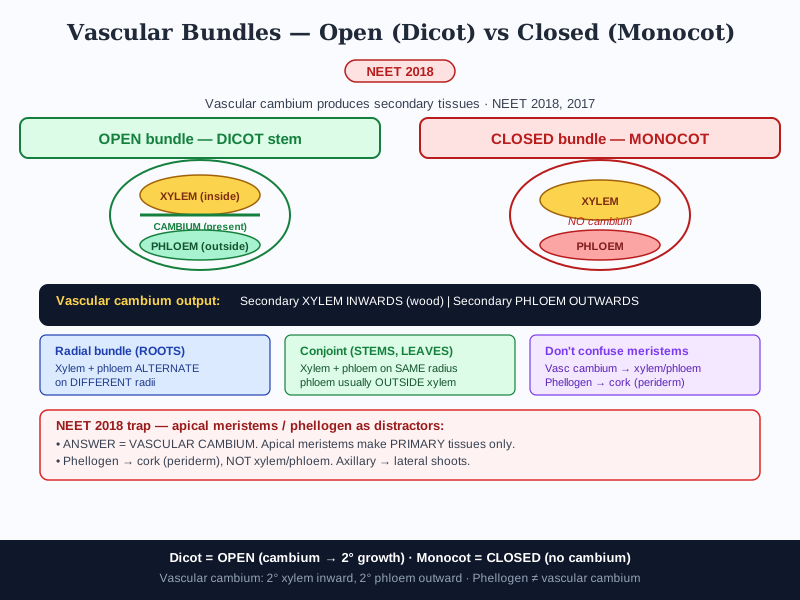
The vascular system is made of XYLEM and PHLOEM, which together form VASCULAR BUNDLES. In DICOTYLEDONOUS STEMS, a CAMBIUM is present between phloem and xylem — these bundles are called OPEN because the cambium can form SECONDARY xylem and phloem (secondary growth, the thickening of woody stems). In MONOCOTYLEDONS, vascular bundles have NO CAMBIUM and thus form NO SECONDARY TISSUES — they are called CLOSED. Bundle arrangement types: RADIAL (xylem and phloem alternate along different radii — typical of ROOTS) and CONJOINT (xylem and phloem on the same radius — typical of STEMS AND LEAVES). In conjoint bundles, the PHLOEM is usually on the OUTER side of the xylem.
Two NEET-tested points: (1) SECONDARY XYLEM AND PHLOEM in dicot stems are produced by the VASCULAR CAMBIUM (NEET 2018, 2017) — NOT apical meristems (which make primary tissue), NOT phellogen (which makes cork/periderm), NOT axillary meristems. (2) Vascular cambium produces SECONDARY XYLEM INWARDS (towards the centre, forming wood) and SECONDARY PHLOEM OUTWARDS (towards the periphery). Phellogen is a DIFFERENT lateral meristem that makes the cork (periderm). Don't confuse vascular cambium (xylem/phloem) with phellogen/cork cambium (periderm).
Secondary xylem and phloem in a dicot stem are produced by apical meristems or phellogen.
Secondary xylem and phloem are produced by the VASCULAR CAMBIUM — a LATERAL meristem. Apical meristems make primary tissues; phellogen makes cork (periderm).
Vascular cambium → secondary xylem (inward) + secondary phloem (outward). Phellogen → cork (periderm). Apical → primary only.
- Dicot stems = OPEN vascular bundles (cambium present, secondary growth possible).
- Monocot stems = CLOSED vascular bundles (no cambium, no secondary growth).
- Vascular cambium produces SECONDARY XYLEM INWARDS (wood) and SECONDARY PHLOEM OUTWARDS.
- Radial bundles (xylem/phloem alternate along different radii) = roots. Conjoint bundles (same radius, phloem outside xylem) = stems and leaves.
Consider the following statements about vascular bundles and secondary growth: S1: Secondary xylem and phloem in dicot stems are produced by the vascular cambium. S2: Monocot vascular bundles are open and possess cambium for secondary growth. S3: Vascular cambium produces secondary xylem inwards (towards the centre) and secondary phloem outwards. S4: Radial vascular bundles (xylem and phloem on different radii) are typical of dicot stems. S5: In conjoint vascular bundles, phloem is usually located on the outer side of xylem.
View bonus solution & explanation
Correct answer: B — S1, S3 and S5
S1 CORRECT: NEET 2018 answer — vascular cambium produces secondary xylem and phloem in dicot stems. S2 WRONG: Monocots have CLOSED bundles with NO cambium — no secondary growth. (Dicots have open bundles.) S3 CORRECT: Secondary xylem forms inward (wood), secondary phloem outward — NEET 2017 confirms. S4 WRONG: RADIAL bundles are typical of ROOTS, not dicot stems. Dicot stems have CONJOINT bundles. S5 CORRECT: Conjoint bundles have phloem outside xylem (NCERT exact).
What is Vascular Cambium?
What did NEET 2018 ask on Vascular Cambium?
What is the most common NEET trap on Vascular Cambium?
How do you remember Vascular Cambium for NEET?
What are the key components of Vascular Cambium?
Through deep analysis of NEET and NTA, 176 of the 180 ReNEET 2026 (June 21) questions were already in the MedicNEET question bank before the exam.
176/180MedicNEET's Biology question bank is built from the same NCERT lines NTA picks repeatedly. Not random MCQs — questions crafted exactly like NTA crafts them.
You just learned this concept. The free app turns it into a daily goal built from your weak topics and brings it back just before you forget it — using active recall and spaced repetition — so it stays till exam day.