
Aquatic Mammals — Whales, Dolphins, Seals vs Fish
✅ Asked in NEET 2017Which among these is the correct combination of aquatic mammals? NEET Year: NEET 2017
Which among these is the correct combination of aquatic mammals? NEET Year: NEET 2017
Answer & NCERT explanation
Correct answer: B — Whales, Dolphins, Seals
Whales, dolphins, and seals are all aquatic mammals that have adapted to marine life while retaining mammalian characteristics like warm-bloodedness and milk production. Trygon is a cartilaginous fish (stingray) and sharks are also fish, not mammals, making other combinations incorrect according to NCERT classification.
Read more NCERT concept on the PYQ
Examples: Oviparous-Ornithorhynchus (Platypus); Viviparous - Macropus (Kangaroo), Pteropus (Flying fox), Camelus (Camel), Macaca (Monkey), Rattus (Rat), Canis (Dog), Felis (Cat), Elephas (Elephant), Equus (Horse), Delphinus (Common dolphin), Balaenoptera (Blue whale), Panthera tigris (Tiger), Panthera leo (Lion).
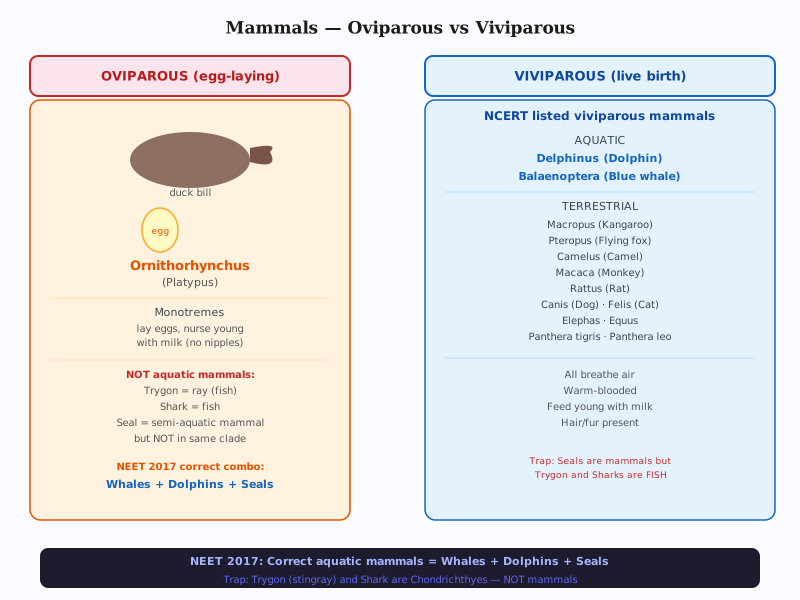
Class Mammalia is divided into oviparous and viviparous groups. The only oviparous mammal in the NCERT list is Ornithorhynchus (Platypus) — an egg-laying mammal that nurses young with milk from skin pores (no nipples). All other NCERT mammals are viviparous, including two fully aquatic species: Delphinus (common dolphin) and Balaenoptera (blue whale). The NEET 2017 question asks which combination represents aquatic mammals — the correct answer is Whales, Dolphins, and Seals. The trap options include Trygon (a stingray — Chondrichthyes fish, not a mammal) and Sharks (also fish), which students confuse with aquatic mammals.
NCERT lists the mammals but does not explicitly separate aquatic from terrestrial. The NTA tests whether students know that Trygon is a cartilaginous fish (ray) belonging to class Chondrichthyes, not Mammalia. Seals are semi-aquatic placental mammals (order Carnivora, family Phocidae) that breathe air, are warm-blooded, and nurse young with milk — all defining mammalian characters. Whales and dolphins are fully aquatic but evolved from terrestrial ancestors — vestigial pelvic bones are still present in some whale species.
Trygon (stingray) is an aquatic animal therefore it must be an aquatic mammal.
Trygon is a cartilaginous fish (Chondrichthyes). Aquatic mammals must have mammary glands, be warm-blooded, and breathe air.
WDS = Whales Dolphins Seals = correct aquatic mammals. Trygon = Chondrichthyes = FISH
- Ornithorhynchus (Platypus) is the ONLY oviparous mammal in the NCERT list — all others are viviparous.
- Balaenoptera musculus (Blue whale) is the largest animal ever known to exist — a fully aquatic mammal.
- Delphinus (Common dolphin) uses echolocation — a mammalian adaptation, not seen in fish.
- Seals (order Carnivora) are semi-aquatic; they return to land for breeding — distinguishing them from whales/dolphins.
Consider the following statements about Class Mammalia: S1: Ornithorhynchus is viviparous and feeds young with milk from specialised nipples. S2: Delphinus and Balaenoptera are fully aquatic viviparous mammals listed in NCERT. S3: Trygon is an aquatic mammal belonging to Order Carnivora. S4: Pteropus (Flying fox) is a viviparous mammal capable of powered flight. S5: The correct combination of aquatic mammals in NEET 2017 answer was Whales, Dolphins, Seals. Which statements are CORRECT?
View bonus solution & explanation
Correct answer: B — S2, S4 and S5
S1 WRONG: Ornithorhynchus is OVIPAROUS (egg-laying), not viviparous; it has no nipples — milk oozes from skin pores. S2 CORRECT: Delphinus (dolphin) and Balaenoptera (blue whale) are fully aquatic viviparous mammals in NCERT. S3 WRONG: Trygon is a stingray — Chondrichthyes fish, NOT a mammal. S4 CORRECT: Pteropus (Flying fox) is a bat — viviparous mammal with powered flight. S5 CORRECT: NEET 2017 answer = Whales, Dolphins, Seals.
What is Aquatic Mammals?
What did NEET 2017 ask on Aquatic Mammals?
What is the most common NEET trap on Aquatic Mammals?
How do you remember Aquatic Mammals for NEET?
What are the key components of Aquatic Mammals?
Through deep analysis of NEET and NTA, 176 of the 180 ReNEET 2026 (June 21) questions were already in the MedicNEET question bank before the exam.
176/180MedicNEET's Biology question bank is built from the same NCERT lines NTA picks repeatedly. Not random MCQs — questions crafted exactly like NTA crafts them.
You just learned this concept. The free app turns it into a daily goal built from your weak topics and brings it back just before you forget it — using active recall and spaced repetition — so it stays till exam day.