
Species-Area Z Value — 0.1-0.2 for Small Areas, 0.6-1.2 for Continents
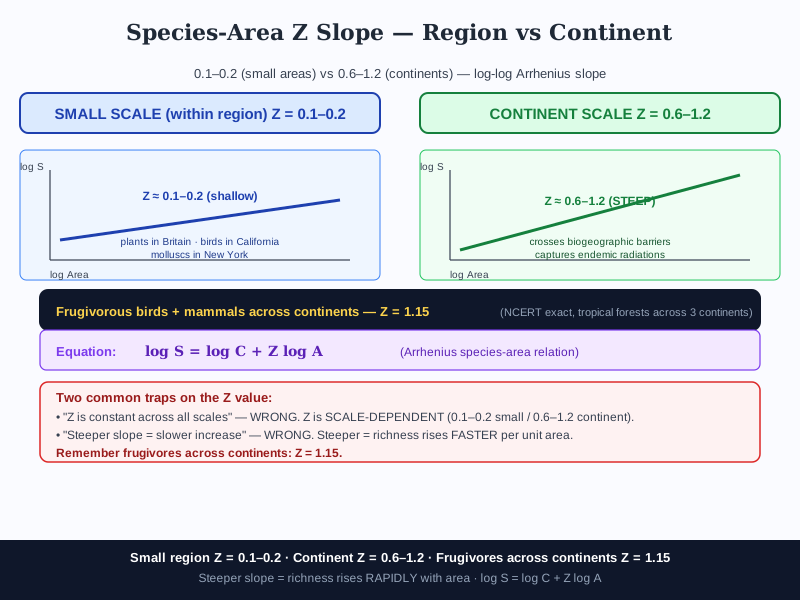
📚 Practice ConceptEcologists have discovered that the value of Z lies in the range of 0.1 to 0.2, regardless of the taxonomic group or the region (whether it is the plants in Britain, birds in California or molluscs in New York state, the slopes of the regression line are amazingly similar). But, if you analyse the species-area relationships among very large areas like the entire continents, you will find that the slope of the line to be much steeper (Z values in the range of 0.6 to 1.2). For example, for frugivorous (fruit-eating) birds and mammals in the tropical forests of different continents, the slope is found to be 1.15. What do steeper slopes mean in this context?
The Z value is constant at around 0.6-1.2 across all spatial scales, regardless of whether the area is small or continental.
Z = 0.1-0.2 for SMALL areas within a region. Z = 0.6-1.2 for CONTINENTAL scales. Z is SCALE-DEPENDENT, not constant.
Small scale = small slope (0.1-0.2). Continent scale = steep slope (0.6-1.2). Frugivores across continents = 1.15.
- Z range for small areas (within a region) = 0.1 to 0.2 — uniform across taxa and regions.
- Z range for continental scale = 0.6 to 1.2 — much steeper.
- Frugivorous birds and mammals across continents: Z = 1.15 (NCERT exact).
- Steeper slope = species richness rises RAPIDLY with area; captures endemic radiations across biogeographic barriers.
Consider the following statements about the species-area Z value: S1: Within a region, the Z value lies in the range 0.1 to 0.2 regardless of taxonomic group. S2: At continental scales, the Z value is in the range 0.6 to 1.2. S3: For frugivorous birds and mammals in tropical forests of different continents, Z = 1.15. S4: A steeper slope (higher Z) means species richness increases more slowly with area. S5: The Z value is the same at all spatial scales — small areas and continents share identical slopes.
View bonus solution & explanation
Correct answer: A — S1, S2 and S3
S1 CORRECT: Small-scale Z = 0.1-0.2 (NCERT, uniform across taxa). S2 CORRECT: Continental Z = 0.6-1.2. S3 CORRECT: Frugivorous birds/mammals across continents Z = 1.15 (NCERT exact). S4 WRONG: Steeper slope = species richness rises MORE RAPIDLY with area, not more slowly. S5 WRONG: Z is SCALE-DEPENDENT — small scales give 0.1-0.2, continental scales give 0.6-1.2. Not the same.
What is Species-Area Z Value?
What did NEET previous years ask on Species-Area Z Value?
What is the most common NEET trap on Species-Area Z Value?
How do you remember Species-Area Z Value for NEET?
What are the key components of Species-Area Z Value?
Through deep analysis of NEET and NTA, 176 of the 180 ReNEET 2026 (June 21) questions were already in the MedicNEET question bank before the exam.
176/180MedicNEET's Biology question bank is built from the same NCERT lines NTA picks repeatedly. Not random MCQs — questions crafted exactly like NTA crafts them.
You just learned this concept. The free app turns it into a daily goal built from your weak topics and brings it back just before you forget it — using active recall and spaced repetition — so it stays till exam day.