
Ciliated Protozoans — Paramoecium Uses Cilia to Steer Food into Gullet
📚 Practice ConceptCiliated protozoans: These are aquatic, actively moving organisms because of the presence of thousands of cilia. They have a cavity (gullet) that opens to the outside of the cell surface. The coordinated movement of rows of cilia causes the water laden with food to be steered into the gullet. Example: Paramoecium.
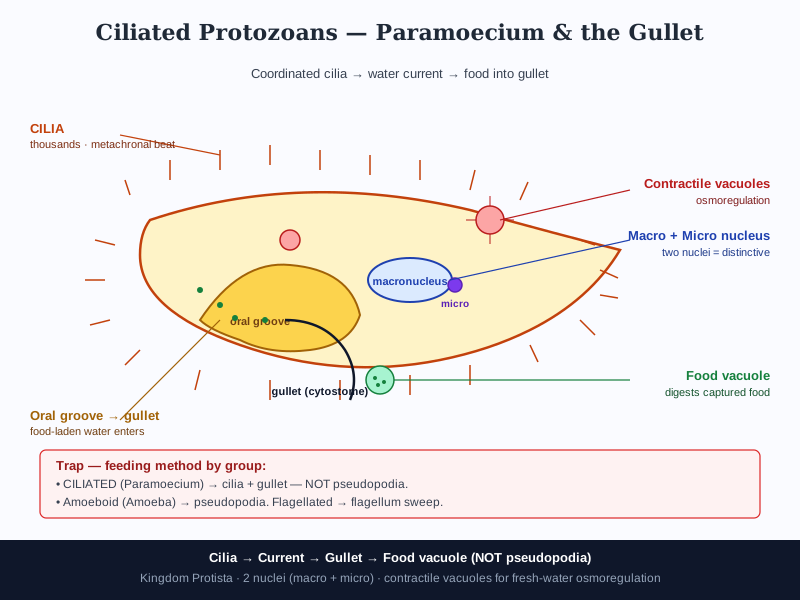
Ciliated protozoans use pseudopodia to capture food particles from the environment.
Ciliated protozoans use CILIA to create water currents that steer food into the GULLET. Pseudopodia are used by amoeboid protozoans, not ciliated ones.
Cilia → Current → Gullet → Food capture. Pseudopodia = amoeba. Cilia = Paramoecium.
- Paramoecium: aquatic, two nuclei (macronucleus + micronucleus), contractile vacuoles for osmoregulation.
- Gullet: a cavity opening to cell surface — food-laden water enters here via coordinated ciliary current.
- Cilia = thousands on cell surface — active motility AND feeding, not just movement.
- Kingdom Protista: diverse unicellular eukaryotes — includes ciliated, flagellated, and amoeboid protozoans.
Regarding ciliated protozoans, evaluate: Assertion (A): Ciliated protozoans can capture food particles from their aquatic environment. Reason (R): The coordinated movement of rows of cilia creates water currents that steer food-laden water into the gullet. Additional statements: S1: The gullet in ciliated protozoans is a membrane-bound food storage organelle. S2: Paramoecium is an example of a ciliated protozoan belonging to Kingdom Protista. S3: Cilia in protozoans serve both for movement and for feeding.
View bonus solution & explanation
Correct answer: A — A and R both true; R explains A. S2 and S3 correct.
Assertion TRUE: Ciliated protozoans capture food — NCERT confirmed. Reason TRUE: Coordinated cilia movement steers food-laden water into gullet — NCERT exact wording. R explains A (the mechanism of capture). Therefore A is the answer for the A-R. S1 WRONG: Gullet is NOT membrane-bound — it is a cavity/invagination of the cell surface. S2 CORRECT: Paramoecium is the example from NCERT. S3 CORRECT: Cilia serve both motility and feeding in ciliated protozoans.
What is Ciliated Protozoans?
What did NEET previous years ask on Ciliated Protozoans?
What is the most common NEET trap on Ciliated Protozoans?
How do you remember Ciliated Protozoans for NEET?
What are the key components of Ciliated Protozoans?
Through deep analysis of NEET and NTA, 176 of the 180 ReNEET 2026 (June 21) questions were already in the MedicNEET question bank before the exam.
176/180MedicNEET's Biology question bank is built from the same NCERT lines NTA picks repeatedly. Not random MCQs — questions crafted exactly like NTA crafts them.
You just learned this concept. The free app turns it into a daily goal built from your weak topics and brings it back just before you forget it — using active recall and spaced repetition — so it stays till exam day.