
Lichens — Algae-Fungi Symbiosis and Pollution Indicators
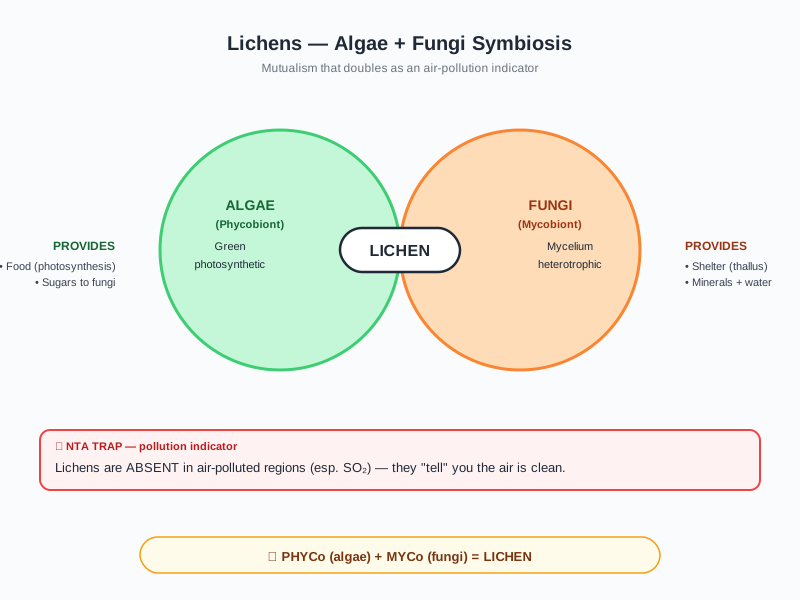
🔥 Predicted for NEET 2027Lichens: Lichens are symbiotic associations i.e. mutually useful associations, between algae and fungi. The algal component is known as phycobiont and fungal component as mycobiont. Most members of ascomycetes and basidiomycetes form lichens. The lichens are able to thrive in hostile environments like bare rock surfaces. The fungal partner provide shelter and absorb mineral nutrients and water for its partner. So there is their association that if one saw a lichen in nature one would never imagine that they had two different organisms within them. Lichens are very good pollution indicators - they do not grow in polluted areas.
Adjacent to a frequently-asked paragraph in the same chapter.
NCERT mentions pollution indication briefly. Deeper: Lichens are exquisitely sensitive to sulphur dioxide (SO2) — the primary air pollutant from burning fossil fuels. SO2 disrupts the phycobiont's chlorophyll and photosynthesis, starving the lichen. This makes lichens BIOLOGICAL INDICATORS — their presence confirms clean air, their absence indicates pollution. City centres typically have no lichens; countryside areas have abundant lichen communities. Lichenometry (measuring lichen growth rates) is used to date ancient rock surfaces in geology. Lichens are also pioneer species in primary succession — they secrete acids that weather rock, beginning soil formation.
PHYCo = photosynthesiser | MYCo = mycelium provider | ABSENT = pollution
Which of the following statements about lichens is/are true? 1. They are symbiotic associations of algae and fungi. 2. Fungal component is phycobiont, and algal is mycobiont. 3. Fungi absorb water and nutrients; algae prepare food. 4. Lichens grow abundantly in polluted areas.
View solution & NCERT explanation
Correct answer: A — 1 and 3 only
Statement 2 is incorrect as algae is the phycobiont, fungi is the mycobiont. Statement 4 is incorrect as lichens do not grow in polluted areas.
What is Lichens?
How do you remember Lichens for NEET?
Why is Lichens important for NEET Biology?
Through deep analysis of NEET and NTA, 176 of the 180 ReNEET 2026 (June 21) questions were already in the MedicNEET question bank before the exam.
176/180MedicNEET's Biology question bank is built from the same NCERT lines NTA picks repeatedly. Not random MCQs — questions crafted exactly like NTA crafts them.
You just learned this concept. The free app turns it into a daily goal built from your weak topics and brings it back just before you forget it — using active recall and spaced repetition — so it stays till exam day.