
Blue-White Screening — Identifying Recombinant Bacteria Visually
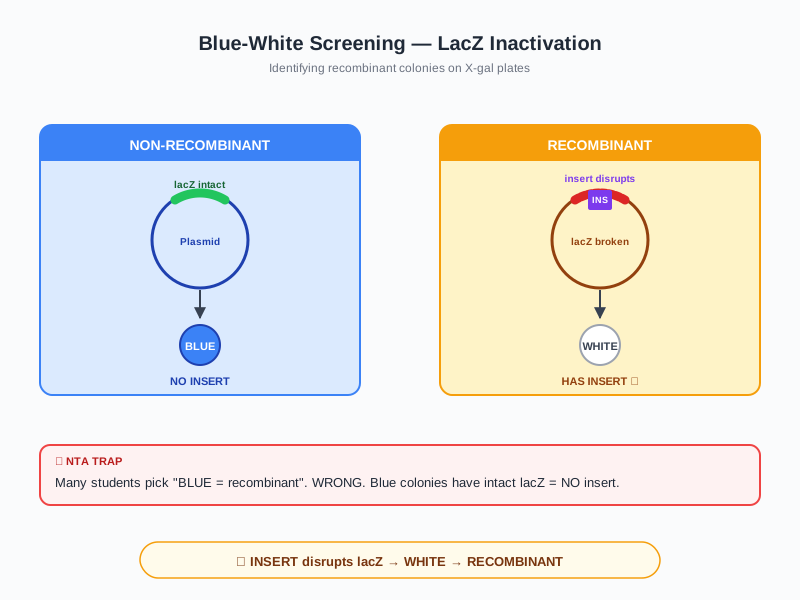
🔥 Predicted for NEET 2027Selection of recombinants due to inactivation of antibiotics is a cumbersome procedure because it requires simultaneous plating on two plates having different antibiotics. Therefore, alternative selectable markers have been developed which differentiate recombinants from non-recombinants on the basis of their ability to produce colour in the presence of a chromogenic substrate. In this, a recombinant DNA is inserted within the coding sequence of an enzyme, β-galactosidase. This results into inactivation of the gene for synthesis of this enzyme, which is referred to as insertional inactivation. The presence of a chromogenic substrate gives blue coloured colonies if the plasmid in the bacteria does not have an insert. Presence of insert results into insertional inactivation of the β-galactosidase gene and the colonies do not produce any colour, these are identified as recombinant colonies.
Adjacent to a frequently-asked paragraph in the same chapter.
NCERT explains the colour outcome but not WHY the insert disrupts gene function. Deeper: The multiple cloning site (MCS or polylinker) is specifically designed within the lacZ gene so that inserting DNA at this site disrupts the gene's reading frame. However, the lacZ alpha fragment (not the whole gene) is typically used. X-gal (5-bromo-4-chloro-3-indolyl-β-D-galactopyranoside) is the chromogenic substrate. IPTG is needed to induce lacZ expression. This technique is called 'alpha-complementation' in molecular biology.
Blue colonies = recombinant (has the insert)
WHITE colonies = recombinant. Blue = non-recombinant (intact lacZ, no insert)
INSERT disrupts lacZ = no colour = WHITE = RECOMBINANT. Blue = boring, no insert.
Q17. Why must chromogenic substrates be included in blue-white screening?
View solution & NCERT explanation
Correct answer: C — To differentiate recombinants based on β-galactosidase activity
Only non-recombinants produce functional enzyme, giving blue colour.
What is Blue-White Screening?
What is the most common NEET trap on Blue-White Screening?
How do you remember Blue-White Screening for NEET?
Through deep analysis of NEET and NTA, 176 of the 180 ReNEET 2026 (June 21) questions were already in the MedicNEET question bank before the exam.
176/180MedicNEET's Biology question bank is built from the same NCERT lines NTA picks repeatedly. Not random MCQs — questions crafted exactly like NTA crafts them.
You just learned this concept. The free app turns it into a daily goal built from your weak topics and brings it back just before you forget it — using active recall and spaced repetition — so it stays till exam day.