
Selectable Markers — Antibiotic Resistance Genes for E. coli Transformation
✅ Asked in NEET 2026Insertion of foreign DNA at the BamHI site in pBR322 results in the loss of antibiotic resistance towards:
Insertion of foreign DNA at the BamHI site in pBR322 results in the loss of antibiotic resistance towards:
Given below are two statements: Statement I: The selectable marker helps in identifying the recombinant from the non-recombinant. Statement II: Ampicillin resistance gene can be used as a selectable marker. In light of the above statements, choose the most appropriate answer: (NEET 2025)
Which of the following is not a selectable marker of cloning vectors? (NEET 2024)
A gene whose expression helps to identify transformed cell is known as: (NEET 2017)
Answer & NCERT explanation
Correct answer: C — Tetracycline
BamHI site lies within the tetracycline-resistance gene of pBR322, so inserting foreign DNA there inactivates that gene (insertional inactivation), and the recombinant plasmid loses tetracycline resistance.
Read more NCERT concept on the PYQ
Selectable marker: In addition to 'ori', the vector requires a selectable marker, which helps in identifying and eliminating non-transformants and selectively permitting the growth of the transformants. Transformation is a procedure through which a piece of DNA is introduced in a host bacterium (you will study the process in subsequent section). Normally, the genes encoding resistance to antibiotics such as ampicillin, chloramphenicol, tetracycline or kanamycin, etc., are considered useful selectable markers for E. coli. The normal E. coli cells do not carry resistance against any of these antibiotics.
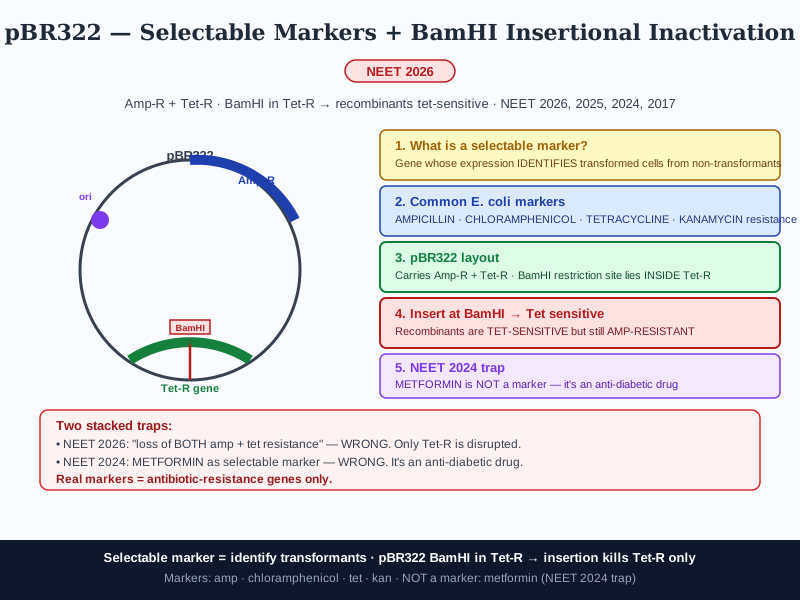
A cloning vector requires a SELECTABLE MARKER in addition to its 'ori' (origin of replication). The selectable marker helps IDENTIFY and ELIMINATE non-transformants while selectively permitting the GROWTH of transformants. TRANSFORMATION is the process of introducing foreign DNA into a host bacterium. Normal E. coli cells are SENSITIVE to all standard selection antibiotics. Genes encoding RESISTANCE to antibiotics such as AMPICILLIN, CHLORAMPHENICOL, TETRACYCLINE, and KANAMYCIN are commonly used as selectable markers — cells that pick up the vector survive on antibiotic-containing media; cells that didn't are killed. In pBR322, the BamHI restriction site lies within the TETRACYCLINE resistance gene; inserting foreign DNA at BamHI INACTIVATES tetracycline resistance (INSERTIONAL INACTIVATION) — recombinants are tet-sensitive but still amp-resistant.
NEET tested this four years: 2026, 2025, 2024, 2017. Selectable markers commonly used: AMPICILLIN, CHLORAMPHENICOL, TETRACYCLINE, KANAMYCIN. NOT a selectable marker: METFORMIN (NEET 2024 trap — metformin is an anti-diabetic drug, not an antibiotic resistance). pBR322 BamHI site lies in TETRACYCLINE-RESISTANCE gene — insertion at BamHI = LOSS of tetracycline resistance (NEET 2026 answer). The ampicillin-resistance gene of pBR322 stays intact, so recombinants are still amp-resistant. Insertional inactivation = the basis of blue-white screening and tetracycline screening.
Insertion of foreign DNA at the BamHI site in pBR322 results in loss of both ampicillin and tetracycline resistance.
Insertion at BamHI in pBR322 inactivates ONLY the TETRACYCLINE-resistance gene (insertional inactivation). Ampicillin resistance remains INTACT.
pBR322 BamHI = inside TET-R gene → insertion kills TET-R only. AMP-R stays. Selectable markers = amp, chloramphenicol, tet, kan (NOT metformin).
- Selectable markers identify transformants and eliminate non-transformants in selective media.
- Common selectable markers for E. coli: ampicillin, chloramphenicol, tetracycline, kanamycin resistance genes.
- NEET 2024 trap: Metformin is NOT a selectable marker (it's an anti-diabetic drug, not an antibiotic).
- pBR322 BamHI site is in the TET-resistance gene → insertion inactivates tet-resistance only (insertional inactivation).
Consider the following statements about selectable markers and pBR322: S1: Selectable markers help identify recombinants and eliminate non-transformants. S2: Ampicillin resistance is a commonly used selectable marker in cloning vectors. S3: Insertion of foreign DNA at the BamHI site in pBR322 results in loss of tetracycline resistance. S4: Insertion of foreign DNA at the BamHI site in pBR322 also abolishes ampicillin resistance. S5: Metformin is one of the commonly used selectable markers in E. coli cloning vectors.
View bonus solution & explanation
Correct answer: A — S1, S2 and S3
S1 CORRECT: NEET 2025 explicit — selectable markers identify recombinants. S2 CORRECT: NEET 2025 confirms ampicillin resistance is a standard selectable marker. S3 CORRECT: NEET 2026 — BamHI site lies in tet-R gene; insertion causes loss of tetracycline resistance (insertional inactivation). S4 WRONG: Only TETRACYCLINE resistance is lost at the BamHI insertion. AMPICILLIN resistance is encoded by a separate gene that is NOT disrupted by BamHI insertion. S5 WRONG: NEET 2024 explicit — Metformin is an anti-diabetic drug, NOT a selectable marker. Real markers = amp, chloramphenicol, tet, kan.
What is Selectable Markers?
What did NEET 2026 ask on Selectable Markers?
What is the most common NEET trap on Selectable Markers?
How do you remember Selectable Markers for NEET?
What are the key components of Selectable Markers?
Through deep analysis of NEET and NTA, 176 of the 180 ReNEET 2026 (June 21) questions were already in the MedicNEET question bank before the exam.
176/180MedicNEET's Biology question bank is built from the same NCERT lines NTA picks repeatedly. Not random MCQs — questions crafted exactly like NTA crafts them.
You just learned this concept. The free app turns it into a daily goal built from your weak topics and brings it back just before you forget it — using active recall and spaced repetition — so it stays till exam day.