
Plant Cell Wall — Non-Living Rigid Cellulose Structure with Pectins and Hemicellulose
📚 Practice ConceptAs you may recall, a non-living rigid structure called the cell wall forms an outer covering for the plasma membrane of fungi and plants. Cell wall not only gives shape to the cell and protects the cell from mechanical damage and infection, it also helps in cell-to-cell interaction and provides barrier to undesirable macromolecules. Algae have cell wall, made of cellulose, galactans, mannans and minerals like calcium carbonate, while in other plants it consists of cellulose, hemicellulose, pectins and proteins. The cell wall of a young plant cell, the primary wall is capable of growth, which gradually diminishes as the cell matures and the secondary wall is formed on the inner (towards membrane) side of the cell.
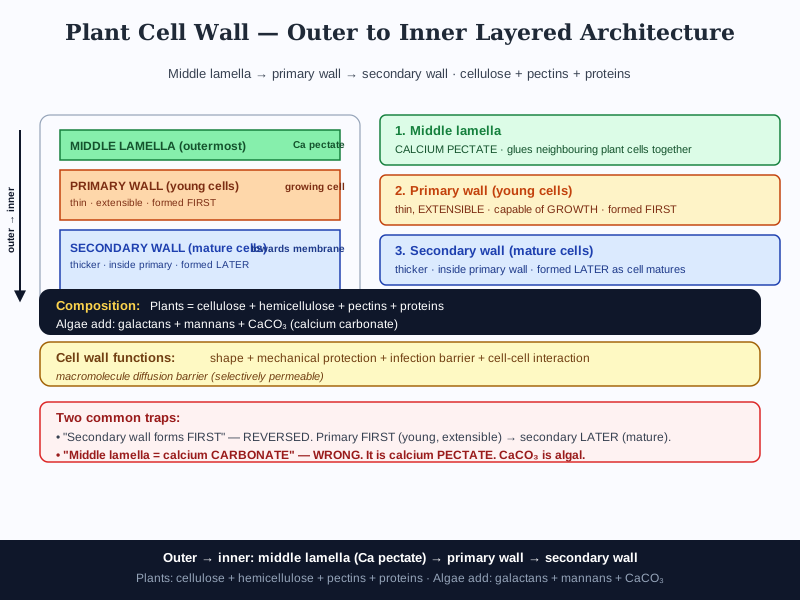
The middle lamella is mainly composed of calcium carbonate, and the primary wall is formed after the secondary wall in plant cells.
Middle lamella = CALCIUM PECTATE (not carbonate). Primary wall forms FIRST in young cells; secondary wall forms LATER on the inner side as cell matures.
Order outer → inner: middle lamella (Ca pectate) → primary wall (young, growing) → secondary wall (mature, inner side). Algae = cellulose + galactans + mannans + CaCO₃.
- Plant + fungal cell walls = non-living, rigid; provide shape, protection, cell-cell interaction, barrier function.
- Algae cell walls: cellulose + galactans + mannans + minerals (e.g., calcium carbonate).
- Other plants: cellulose + hemicellulose + pectins + proteins.
- Primary wall forms first (young, growing, extensible); secondary wall forms later on inner side (mature cells).
Which of the following statements accurately describe the plant cell wall and its related structures? S1: The primary cell wall of a young plant cell is formed AFTER the secondary wall and is capable of extensive growth. S2: The middle lamella, primarily composed of calcium carbonate, forms the outer covering of individual plant cells. S3: Plant cell walls are non-living rigid structures that provide mechanical support and protection from infection. S4: Plasmodesmata are intercellular junctions that connect the cytoplasm of neighbouring plant cells through openings in the cell wall and middle lamella. S5: The cell walls of algae are exclusively composed of cellulose, unlike other plants which contain additional components like hemicellulose and pectins.
View bonus solution & explanation
Correct answer: C — S3 and S4 are correct
S1 WRONG: Primary wall forms FIRST in young cells (capable of growth); secondary wall forms LATER on the inner side as the cell matures. REVERSED order. S2 WRONG: Middle lamella = CALCIUM PECTATE (not calcium carbonate). S3 CORRECT: Plant cell walls are non-living rigid structures providing mechanical support and infection protection (NCERT exact). S4 CORRECT: Plasmodesmata connect cytoplasms of neighbouring plant cells through openings in the wall and middle lamella. S5 WRONG: Algae walls have cellulose + galactans + mannans + minerals — NOT exclusively cellulose. Correct: S3, S4 → option C.
What is Plant Cell Wall?
What did NEET previous years ask on Plant Cell Wall?
What is the most common NEET trap on Plant Cell Wall?
How do you remember Plant Cell Wall for NEET?
What are the key components of Plant Cell Wall?
Through deep analysis of NEET and NTA, 176 of the 180 ReNEET 2026 (June 21) questions were already in the MedicNEET question bank before the exam.
176/180MedicNEET's Biology question bank is built from the same NCERT lines NTA picks repeatedly. Not random MCQs — questions crafted exactly like NTA crafts them.
You just learned this concept. The free app turns it into a daily goal built from your weak topics and brings it back just before you forget it — using active recall and spaced repetition — so it stays till exam day.