
Middle Lamella — Calcium Pectate Glue, Plasmodesmata Connect Neighbouring Cells
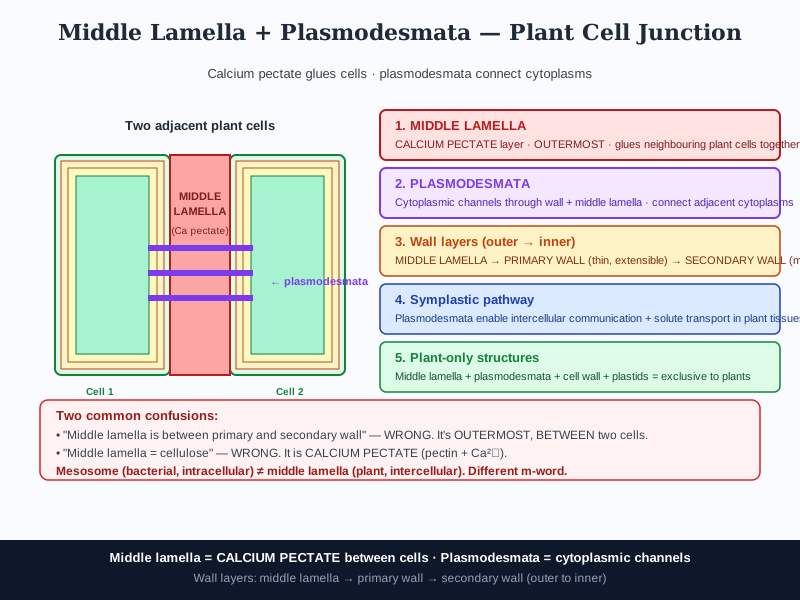
🔥 Predicted for NEET 2027The middle lamella is a layer mainly of calcium pectate which holds or glues the different neighbouring cells together. The cell wall and middle lamella may be traversed by plasmodesmata which connect the cytoplasm of neighbouring cells.
Adjacent to a frequently-asked paragraph in the same chapter.
Two NEET-relevant facts: (1) Middle lamella = CALCIUM PECTATE — the 'glue' between plant cells. (2) Plasmodesmata = cytoplasmic CONNECTIONS through cell wall + middle lamella → symplastic transport. Plant-cell-only structures (NEET match traps): cell wall, middle lamella, plasmodesmata, plastids. Mesosomes are bacterial (NOT plant). Thylakoids are chloroplast (light-dependent reactions). Ribosomes are universal (70S prokaryote, 80S eukaryote). Memory: calcium pectate = middle lamella; plasmodesmata = plant cell intercellular channels.
The middle lamella is made of cellulose and lies between the primary and secondary cell walls.
Middle lamella is made of CALCIUM PECTATE and is the OUTERMOST layer, BETWEEN two neighbouring cells (not between primary and secondary walls).
Middle lamella = calcium pectate GLUE between cells. Plasmodesmata = cytoplasmic channels through cell walls.
- Middle lamella = CALCIUM PECTATE layer; glues neighbouring plant cells together.
- Plasmodesmata = fine cytoplasmic channels through cell wall + middle lamella → symplastic communication.
- Cell wall layers (outer to inner): MIDDLE LAMELLA → PRIMARY WALL → SECONDARY WALL.
- Removing calcium (e.g., chelators) loosens the middle lamella, causing cells to separate.
Match the following: Column I A. Mesosome B. Chloroplast thylakoid C. Ribosomes D. Middle lamella Column II i. Site of light-dependent reactions ii. Infoldings of plasma membrane helping DNA replication and respiration iii. Holds neighbouring plant cells together iv. Present in prokaryotes (70S) and eukaryotes (80S) for protein synthesis
View solution & NCERT explanation
Correct answer: A — A–ii, B–i, C–iv, D–iii
Mesosomes help in respiration/DNA replication, thylakoids carry out light reactions, ribosomes are universal for protein synthesis, and middle lamella glues plant cells together.
What is Middle Lamella?
What did NEET previous years ask on Middle Lamella?
What is the most common NEET trap on Middle Lamella?
How do you remember Middle Lamella for NEET?
What are the key components of Middle Lamella?
Through deep analysis of NEET and NTA, 176 of the 180 ReNEET 2026 (June 21) questions were already in the MedicNEET question bank before the exam.
176/180MedicNEET's Biology question bank is built from the same NCERT lines NTA picks repeatedly. Not random MCQs — questions crafted exactly like NTA crafts them.
You just learned this concept. The free app turns it into a daily goal built from your weak topics and brings it back just before you forget it — using active recall and spaced repetition — so it stays till exam day.