
Ribosomes — 70S Prokaryote vs 80S Eukaryote, Subunit Composition
✅ Asked in NEET 2025From the statements given below choose the correct option: Statement A: The eukaryotic ribosomes are 80S and prokaryotic ribosomes are 70S. Statement B: Each ribosome has two sub-units. Statement C: The two sub-units of 80S ribosomes are 60S and 40S while that of 70S are 50S and 30S. Statement D: The two sub-units of 80S ribosomes are 60S and 20S and that of 70S are 50S and 20S. Statement E: The two sub-units of 80S are 60S and 30S and that of 70S are 50S and 30S. (NEET 2025)
From the statements given below choose the correct option: Statement A: The eukaryotic ribosomes are 80S and prokaryotic ribosomes are 70S. Statement B: Each ribosome has two sub-units. Statement C: The two sub-units of 80S ribosomes are 60S and 40S while that of 70S are 50S and 30S. Statement D: The two sub-units of 80S ribosomes are 60S and 20S and that of 70S are 50S and 20S. Statement E: The two sub-units of 80S are 60S and 30S and that of 70S are 50S and 30S. (NEET 2025)
Answer & NCERT explanation
Correct answer: C — A, B and C are true
Statement A is correct - eukaryotic ribosomes are 80S, prokaryotic are 70S. Statement B is correct - each ribosome has two subunits. Statement C is correct - 80S has 60S and 40S subunits, 70S has 50S and 30S subunits. Statements D and E give wrong subunit compositions.
Read more NCERT concept on the PYQ
Ribosomes are the granular structures first observed under the electron microscope as dense particles by George Palade (1953). They are composed of ribonucleic acid (RNA) and proteins and are not surrounded by any membrane. The eukaryotic ribosomes are 80S while the prokaryotic ribosomes are 70S. Each ribosome has two subunits, larger and smaller subunits. The two subunits of 80S ribosomes are 60S and 40S while that of 70S ribosomes are 50S and 30S. Here 'S' (Svedberg's Unit) stands for the sedimentation coefficient; it is indirectly a measure of density and size. Both 70S and 80S ribosomes are composed of two subunits.
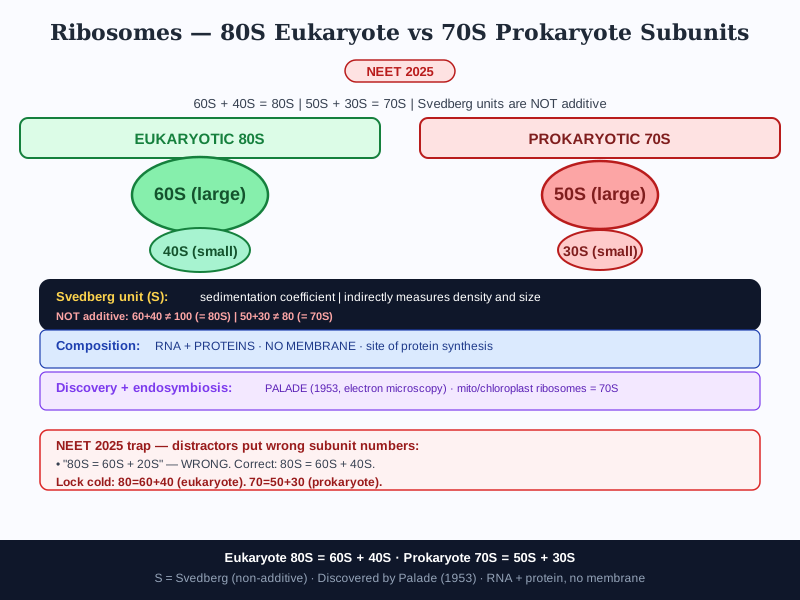
RIBOSOMES are GRANULAR structures FIRST OBSERVED under the electron microscope as DENSE PARTICLES by GEORGE PALADE (1953). They are composed of RIBONUCLEIC ACID (RNA) and PROTEINS and are NOT SURROUNDED BY ANY MEMBRANE. EUKARYOTIC ribosomes are 80S, while PROKARYOTIC ribosomes are 70S. EACH RIBOSOME HAS TWO SUBUNITS — larger and smaller. The two subunits of 80S ribosomes are 60S + 40S; the two subunits of 70S ribosomes are 50S + 30S. Here 'S' stands for SVEDBERG UNIT (sedimentation coefficient) — indirectly a measure of density and size. Note: Svedberg values are NOT additive (50S + 30S = 70S, not 80S) because sedimentation is non-linear with mass.
Memory cold: 80S = 60S + 40S (eukaryotic). 70S = 50S + 30S (prokaryotic). Don't reverse these. Svedberg non-additivity (50+30 = 70, not 80) is a high-yield trap. Mitochondrial and chloroplast ribosomes are 70S (prokaryote-like) — supports the endosymbiotic theory. Palade was a Romanian-American who won the 1974 Nobel Prize for cell biology work, including ribosome discovery. NEET 2025 explicitly tested the subunit pairing 60+40 / 50+30.
The two subunits of 80S ribosomes are 60S and 20S, while those of 70S ribosomes are 50S and 20S.
80S ribosomes = 60S + 40S (eukaryotic). 70S ribosomes = 50S + 30S (prokaryotic). NEET 2025 confirmed these exact numbers.
80S = 60 + 40 (eukaryote). 70S = 50 + 30 (prokaryote). S = Svedberg unit (sedimentation, non-additive).
- Ribosomes are NOT membrane-bound; composed of RNA + proteins.
- Discovered by GEORGE PALADE (1953) using electron microscopy as dense particles.
- Eukaryotic ribosomes = 80S (60S + 40S subunits). Prokaryotic ribosomes = 70S (50S + 30S subunits).
- 'S' = Svedberg unit (sedimentation coefficient); indirectly measures density and size. Mitochondrial/chloroplast ribosomes = 70S (endosymbiosis support).
What is Ribosomes?
What did NEET 2025 ask on Ribosomes?
What is the most common NEET trap on Ribosomes?
How do you remember Ribosomes for NEET?
What are the key components of Ribosomes?
Through deep analysis of NEET and NTA, 176 of the 180 ReNEET 2026 (June 21) questions were already in the MedicNEET question bank before the exam.
176/180MedicNEET's Biology question bank is built from the same NCERT lines NTA picks repeatedly. Not random MCQs — questions crafted exactly like NTA crafts them.
You just learned this concept. The free app turns it into a daily goal built from your weak topics and brings it back just before you forget it — using active recall and spaced repetition — so it stays till exam day.