
Organelle-Feature Matching — Cilia Axoneme, ER Ribosomes, Mitochondria Cristae, Kinetochore Spindle
✅ Asked in NEET 2024Match List I with List II. List-I A. Cilia B. Endoplasmic Reticulum C. Mitochondria D. Kinetochore List-II I. Spindle fibres II. Cristae III. Axoneme IV. Ribosomes
Match List I with List II. List-I A. Cilia B. Endoplasmic Reticulum C. Mitochondria D. Kinetochore List-II I. Spindle fibres II. Cristae III. Axoneme IV. Ribosomes
Answer & NCERT explanation
Correct answer: B — A–III, B–IV, C–II, D–I
Cilia have axoneme structure (A-III), ER has ribosomes attached (B-IV), mitochondria have cristae infoldings (C-II), and kinetochore connects to spindle fibers during cell division (D-I). Each structure is characteristic of its respective cellular component.
Read more NCERT concept on the PYQ
The electron microscopic study of a cilium or the flagellum show that they are covered with plasma membrane. Their core called the axoneme, possesses a number of microtubules running parallel to the long axis. The axoneme usually has nine doublets of radially arranged peripheral microtubules, and a pair of centrally located microtubules. Such an arrangement of axonemal microtubules is referred to as the 9+2 array. The central tubules are connected by bridges and is also enclosed by a central sheath, which is connected to one of the tubules of each peripheral doublets by a radial spoke. Thus, there are nine radial spokes. The peripheral doublets are also interconnected by linkers. Both the cilium and flagellum emerge from centriole-like structure called the basal bodies.
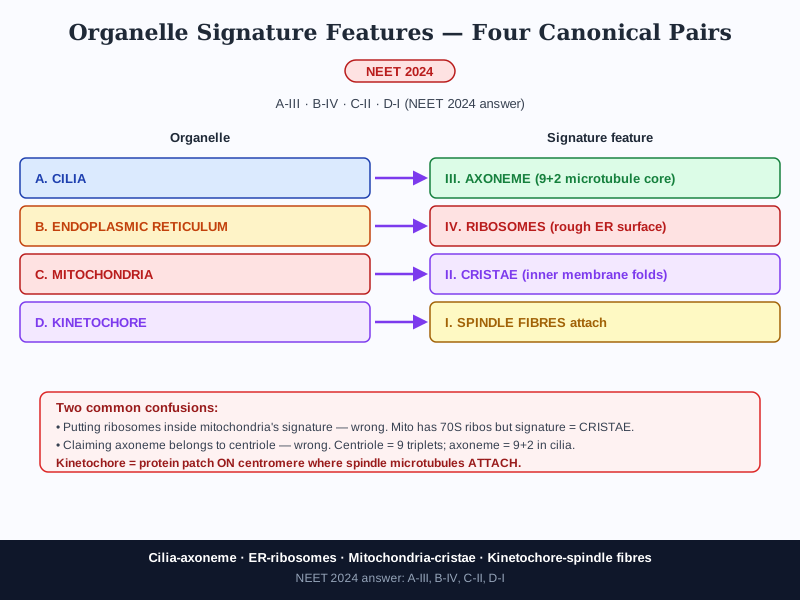
Each cellular organelle has a SIGNATURE structural feature that NEET tests in matching questions. CILIA (and flagella) have an AXONEME — the 9+2 microtubule core. The ENDOPLASMIC RETICULUM bears RIBOSOMES on its cytoplasmic surface (rough ER); ribosomes are also free in cytoplasm. MITOCHONDRIA have CRISTAE — infoldings of the inner mitochondrial membrane that house ETC enzymes for ATP synthesis. The KINETOCHORE is a protein structure on the centromere where SPINDLE FIBRES attach during cell division; it links chromosomes to spindle microtubules. So the canonical matches: Cilia → axoneme; ER → ribosomes; Mitochondria → cristae; Kinetochore → spindle fibres. Memorising this set unlocks a frequent NEET matching question.
NEET 2024 matched all four: Cilia-Axoneme (A-III), ER-Ribosomes (B-IV), Mitochondria-Cristae (C-II), Kinetochore-Spindle fibres (D-I). Common confusions: putting ribosomes inside mitochondria's signature (mitochondria have ribosomes too — 70S — but their SIGNATURE structure is cristae); claiming the axoneme belongs to centrioles (no — centriole = 9 triplets, axoneme = 9+2 in cilia/flagella). Kinetochore is the LINK BETWEEN chromosomes AND spindle fibres — it sits on the centromere.
Cilia have ribosomes attached to their core; mitochondria have axoneme; kinetochore is connected to cristae.
Cilia → AXONEME (9+2). ER → RIBOSOMES. Mitochondria → CRISTAE. Kinetochore → SPINDLE FIBRES.
Cilia-axoneme | ER-ribosomes | Mitochondria-cristae | Kinetochore-spindle. NEET 2024 match: A-III, B-IV, C-II, D-I.
- Cilia (and flagella) have an AXONEME core = 9 peripheral doublets + 2 central singlets (9+2 array).
- Endoplasmic Reticulum bears RIBOSOMES on its cytoplasmic surface (rough ER).
- Mitochondria have CRISTAE — infoldings of inner membrane that house ETC enzymes.
- Kinetochore = protein structure on centromere where SPINDLE FIBRES attach during cell division.
What is Organelle-Feature Matching?
What did NEET 2024 ask on Organelle-Feature Matching?
What is the most common NEET trap on Organelle-Feature Matching?
How do you remember Organelle-Feature Matching for NEET?
What are the key components of Organelle-Feature Matching?
Through deep analysis of NEET and NTA, 176 of the 180 ReNEET 2026 (June 21) questions were already in the MedicNEET question bank before the exam.
176/180MedicNEET's Biology question bank is built from the same NCERT lines NTA picks repeatedly. Not random MCQs — questions crafted exactly like NTA crafts them.
You just learned this concept. The free app turns it into a daily goal built from your weak topics and brings it back just before you forget it — using active recall and spaced repetition — so it stays till exam day.