
Cell Biology Discoveries — Robert Brown, Flemming, Palade, Golgi
✅ Asked in NEET 2024Match List I with List II. List-I: A. Fleming B. Robert Brown C. George Palade D. Camillo Golgi List-II: I. Disc-shaped sacs near nucleus II. Chromatin III. Ribosomes IV. Nucleus
Match List I with List II. List-I: A. Fleming B. Robert Brown C. George Palade D. Camillo Golgi List-II: I. Disc-shaped sacs near nucleus II. Chromatin III. Ribosomes IV. Nucleus
Answer & NCERT explanation
Correct answer: D — A–II, B–IV, C–III, D–I
Fleming discovered chromatin (A-II), Robert Brown discovered nucleus (B-IV), George Palade discovered ribosomes (C-III), and Camillo Golgi discovered disc-shaped sacs near nucleus - Golgi apparatus (D-I). These are fundamental discoveries in cell biology by respective scientists.
Read more NCERT concept on the PYQ
Nucleus as a cell organelle was first described by Robert Brown as early as 1831. Later the material of the nucleus stained by the basic dyes was given the name chromatin by Flemming.
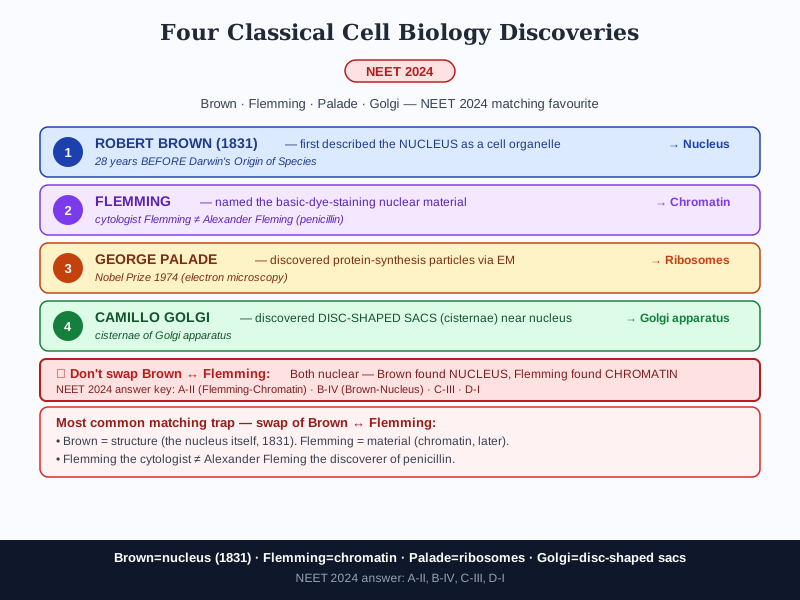
Four classical cell-biology discoveries that NEET matches repeatedly: (1) ROBERT BROWN — first described the NUCLEUS as a cell organelle in 1831. (2) FLEMMING — named the material of the nucleus that stained with basic dyes CHROMATIN. (3) GEORGE PALADE — discovered RIBOSOMES (the protein-synthesis particles) using electron microscopy. (4) CAMILLO GOLGI — discovered the GOLGI APPARATUS, characterised by DISC-SHAPED SACS near the nucleus. These four constitute a NEET-favourite matching set. Memorise the year (Brown 1831), the staining method (Flemming used basic dyes to reveal chromatin), and the organelle-scientist pairings — they appear in nearly every chapter test.
NEET 2024 matched all four: Fleming-Chromatin, Brown-Nucleus, Palade-Ribosomes, Golgi-Discs near nucleus. Common confusion: Fleming the cell biologist (chromatin) ≠ Alexander Fleming the microbiologist (penicillin) — different people, similar names. Brown described the nucleus 28 years BEFORE Darwin's Origin of Species (1859). Palade's electron microscopy work earned a Nobel (1974). Golgi's disc-shaped sacs are also called CISTERNAE (cisternae of Golgi apparatus). Don't swap Brown (nucleus) with Flemming (chromatin) — both are nuclear discoveries, easy to confuse.
Robert Brown discovered chromatin and Flemming first described the nucleus as a cell organelle.
Robert Brown (1831) first described the NUCLEUS. Flemming named the basic-dye-staining material of the nucleus as CHROMATIN (later, after Brown).
Brown = nucleus (1831, FIRST). Flemming = chromatin (named the dye-staining material). Palade = ribosomes. Golgi = disc-shaped sacs.
- Robert Brown (1831) — first described the NUCLEUS as a cell organelle.
- Flemming — named the basic-dye-staining nuclear material CHROMATIN.
- George Palade — discovered RIBOSOMES (electron microscopy; Nobel 1974).
- Camillo Golgi — discovered the GOLGI APPARATUS / disc-shaped sacs (cisternae) near the nucleus.
What is Cell Biology Discoveries?
What did NEET 2024 ask on Cell Biology Discoveries?
What is the most common NEET trap on Cell Biology Discoveries?
How do you remember Cell Biology Discoveries for NEET?
What are the key components of Cell Biology Discoveries?
Through deep analysis of NEET and NTA, 176 of the 180 ReNEET 2026 (June 21) questions were already in the MedicNEET question bank before the exam.
176/180MedicNEET's Biology question bank is built from the same NCERT lines NTA picks repeatedly. Not random MCQs — questions crafted exactly like NTA crafts them.
You just learned this concept. The free app turns it into a daily goal built from your weak topics and brings it back just before you forget it — using active recall and spaced repetition — so it stays till exam day.