
Nucleolus — Site of Active Ribosomal RNA Synthesis, Non-Membrane-Bound
✅ Asked in NEET 2026Which one of the following is the site for active ribosomal RNA synthesis?
Which one of the following is the site for active ribosomal RNA synthesis?
Match List I with List II. List-I A. Nucleolus B. Centriole C. Leucoplasts D. Golgi apparatus List-II I. Site of formation of glycolipid II. Organization like the cartwheel III. Site of active ribosomal RNA synthesis IV. For storing nutrients
Which of the following is true for the nucleolus? NEET 2018
Answer & NCERT explanation
Correct answer: C — Nucleolus
The nucleolus is a non-membrane-bound region within the nucleus where active synthesis of ribosomal RNA (rRNA) occurs.
Read more NCERT concept on the PYQ
The nuclear matrix or the nucleoplasm contains nucleolus and chromatin. The nucleoli are spherical structures present in the nucleoplasm. The content of nucleolus is continuous with the rest of the nucleoplasm as it is not a membrane bound structure. It is a site for active ribosomal RNA synthesis. Larger and more numerous nucleoli are present in cells actively carrying out protein synthesis.
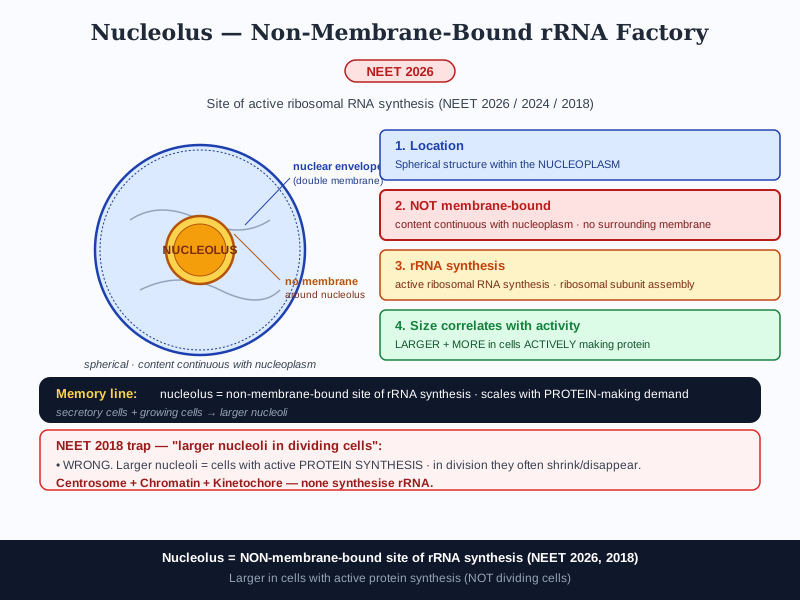
The nuclear matrix or NUCLEOPLASM contains TWO structures: NUCLEOLUS and CHROMATIN. NUCLEOLI are SPHERICAL structures present in the nucleoplasm. The content of the nucleolus is CONTINUOUS with the rest of the nucleoplasm because IT IS NOT A MEMBRANE-BOUND STRUCTURE. The nucleolus is the SITE for ACTIVE RIBOSOMAL RNA (rRNA) SYNTHESIS. LARGER and MORE NUMEROUS nucleoli are present in cells ACTIVELY CARRYING OUT PROTEIN SYNTHESIS (such as secretory cells, growing cells) — NOT in dividing cells (where they are smaller or disappear). The nucleolus is also where the rRNA assembles with ribosomal proteins to form the LARGE and SMALL ribosomal subunits, which are then exported to the cytoplasm through nuclear pores.
NEET 2026 and 2018 both directly asked the same fact: NUCLEOLUS = site of rRNA synthesis. NEET 2024 match: Nucleolus = rRNA synthesis (III); Centriole = cartwheel (II); Leucoplasts = nutrient storage (IV); Golgi = glycolipid formation (I). Three NEET-tested facts about nucleolus: (1) NOT membrane-bound; (2) site of rRNA synthesis; (3) LARGER in cells with active protein synthesis (NOT dividing cells). Distractors: centrosome (organises microtubules), chromatin (DNA + histones), kinetochore (spindle attachment).
The nucleolus is a membrane-bound structure where larger nucleoli are present in dividing cells.
The nucleolus is NOT membrane-bound (continuous with nucleoplasm). LARGER nucleoli are present in cells with ACTIVE PROTEIN SYNTHESIS — NOT dividing cells.
Nucleolus = NON-membrane-bound site of rRNA synthesis. Larger in protein-synthesising cells (not dividing). Distractors: centrosome, chromatin, kinetochore.
- Nucleolus = spherical, NON-membrane-bound structure within the nucleoplasm.
- Site of active ribosomal RNA (rRNA) synthesis and ribosomal subunit assembly (NEET 2026, 2018).
- Larger and more numerous nucleoli in cells actively carrying out PROTEIN SYNTHESIS — not in dividing cells.
- Nucleoplasm contains BOTH nucleolus AND chromatin. Both are non-membrane-bound.
What is Nucleolus?
What did NEET 2026 ask on Nucleolus?
What is the most common NEET trap on Nucleolus?
How do you remember Nucleolus for NEET?
What are the key components of Nucleolus?
Through deep analysis of NEET and NTA, 176 of the 180 ReNEET 2026 (June 21) questions were already in the MedicNEET question bank before the exam.
176/180MedicNEET's Biology question bank is built from the same NCERT lines NTA picks repeatedly. Not random MCQs — questions crafted exactly like NTA crafts them.
You just learned this concept. The free app turns it into a daily goal built from your weak topics and brings it back just before you forget it — using active recall and spaced repetition — so it stays till exam day.