
Cilia and Flagella — Hair-like Outgrowths, Oar-like Beating, Cell vs Fluid Movement
📚 Practice ConceptCilia (sing.: cilium) and flagella (sing.: flagellum) are hair-like outgrowths of the cell membrane. Cilia are small structures which work like oars, causing the movement of either the cell or the surrounding fluid. Flagella are comparatively longer and responsible for cell movement. The prokaryotic bacteria also possess flagella but these are structurally different from that of the eukaryotic flagella.
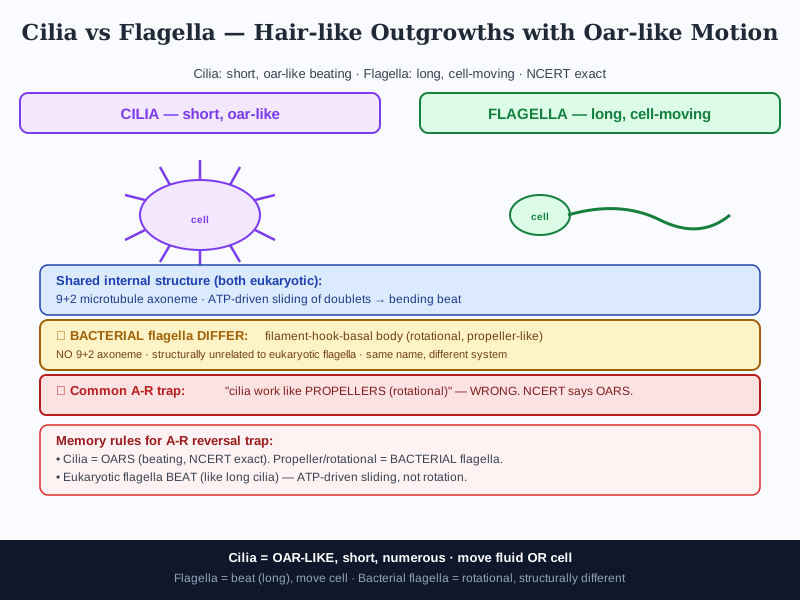
Cilia work like propellers, generating movement through rotational motion of the ciliary axoneme.
Cilia work like OARS (NCERT exact) — beating/bending motion driven by ATP-powered sliding of microtubule doublets. Propeller-like rotation describes BACTERIAL flagella, not cilia.
Cilia = OARS (beating, NCERT). Bacterial flagella = PROPELLER (rotational). Eukaryotic flagella = beat (like long cilia). Cilia short and many; flagella long and few.
- Cilia and flagella are HAIR-LIKE outgrowths of the cell membrane.
- Cilia: SMALL, work like OARS (beating); move cell OR surrounding fluid.
- Flagella: COMPARATIVELY LONGER; mainly move the cell (e.g., sperm).
- Bacterial flagella exist but are structurally different from eukaryotic flagella (no 9+2 axoneme).
Assertion (A): Cilia enable cellular movement and fluid movement around cells. Reason (R): Cilia work like propellers through rotational motion to generate movement.
View bonus solution & explanation
Correct answer: C — Assertion is true but reason is false.
Assertion TRUE: NCERT explicitly states cilia cause 'movement of either the cell or the surrounding fluid'. Reason FALSE: NCERT describes cilia as working 'like OARS' (oar-like beating motion), NOT like propellers (rotational motion). The propeller/rotational description fits BACTERIAL flagella, which are motor-driven rotational structures. Eukaryotic cilia use ATP-driven sliding of microtubule doublets to generate a bending beat. Answer: A true, R false → C.
What is Cilia and Flagella?
What did NEET previous years ask on Cilia and Flagella?
What is the most common NEET trap on Cilia and Flagella?
How do you remember Cilia and Flagella for NEET?
What are the key components of Cilia and Flagella?
Through deep analysis of NEET and NTA, 176 of the 180 ReNEET 2026 (June 21) questions were already in the MedicNEET question bank before the exam.
176/180MedicNEET's Biology question bank is built from the same NCERT lines NTA picks repeatedly. Not random MCQs — questions crafted exactly like NTA crafts them.
You just learned this concept. The free app turns it into a daily goal built from your weak topics and brings it back just before you forget it — using active recall and spaced repetition — so it stays till exam day.