
Colostrum — Antibody-Rich First Milk for Newborn Immunity
✅ Asked in NEET 2024Given below are two statements: Assertion (A): Breastfeeding during initial period of infant growth is recommended by doctors for bringing a healthy baby. Reason (R): Colostrum contains several antibodies absolutely essential to develop resistance for the newborn baby.
Given below are two statements: Assertion (A): Breastfeeding during initial period of infant growth is recommended by doctors for bringing a healthy baby. Reason (R): Colostrum contains several antibodies absolutely essential to develop resistance for the newborn baby.
Match List-I with List-II: List I A. Parturition B. Placenta C. Colostrum D. Fimbriae List II I. Several antibodies for new-born babies II. Collection of ovum after ovulation III. Foetal ejection reflex IV. Secretion of the hormone hCG Choose the correct answer:
Answer & NCERT explanation
Correct answer: A — Both A and R are correct and R is the correct explanation of A
Both statements are correct. Assertion A is true - doctors recommend breastfeeding during initial period for healthy baby development. Reason R is also true - colostrum (first milk) contains several antibodies like IgA, IgG which are essential for developing immunity in newborns. R correctly explains A because the presence of antibodies in colostrum is the main reason why breastfeeding is recommended initially.
Read more NCERT concept on the PYQ
The mammary glands of the female undergo differentiation during pregnancy and starts producing milk towards the end of pregnancy by the process called lactation. This helps the mother in feeding the new-born. The milk produced during the initial few days of lactation is called colostrum which contains several antibodies absolutely essential to develop resistance for the new-born babies. Breast-feeding during the initial period of infant growth is recommended by doctors for bringing up a healthy baby.
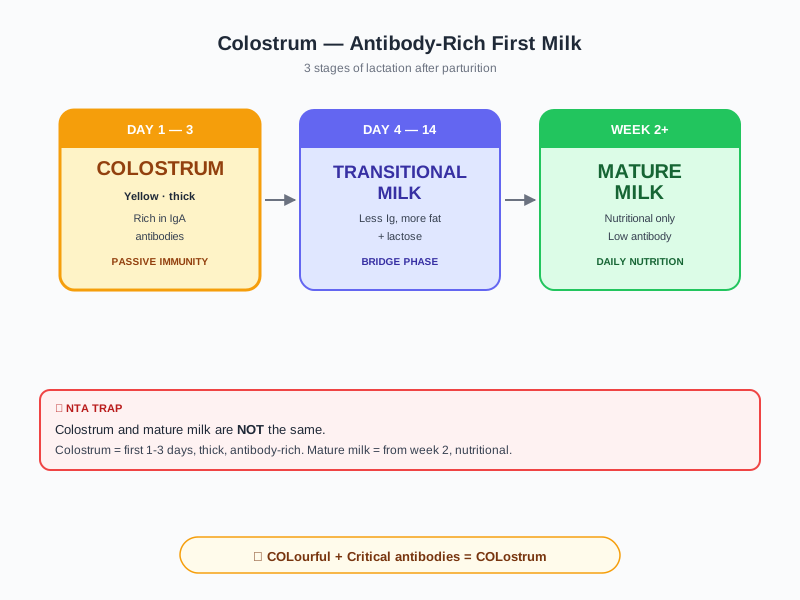
Lactation is initiated towards the end of pregnancy under the influence of prolactin (from anterior pituitary). The FIRST secretion from the mammary glands in the initial days after birth is colostrum — not regular milk. Colostrum is visually distinct: it is thicker, yellowish, and protein-rich compared to mature milk. Its critical function is immunological: colostrum is packed with maternal antibodies, primarily secretory IgA (sIgA), which provide PASSIVE IMMUNITY to the newborn. The newborn's own immune system is immature and cannot yet produce adequate antibodies — colostrum bridges this gap. This is why early breastfeeding is medically essential, not optional.
NCERT mentions antibodies in colostrum but does not specify the immunoglobulin type. Deeper: Colostrum contains secretory IgA (most important), IgG, and IgM. SIgA is specifically resistant to the newborn's digestive enzymes — it survives passage through the gut and lines the intestinal walls, blocking pathogen attachment. This is called mucosal immunity. Colostrum also contains lactoferrin (binds iron, starving bacteria), lysozyme (breaks bacterial cell walls), white blood cells, and growth factors. The transition from colostrum to mature milk takes approximately 2 weeks and is called lactogenesis stage II.
Colostrum and mature milk are the same — just different names for breast milk
Colostrum = first 1-3 days, antibody-rich, thick, yellow. Mature milk = from week 2, nutritionally balanced.
COLostrum = COLourful (yellow) + Critical antibodies for newborn
What is Colostrum?
Has Colostrum been asked in NEET?
What is the most common NEET trap on Colostrum?
How do you remember Colostrum for NEET?
Through deep analysis of NEET and NTA, 176 of the 180 ReNEET 2026 (June 21) questions were already in the MedicNEET question bank before the exam.
176/180MedicNEET's Biology question bank is built from the same NCERT lines NTA picks repeatedly. Not random MCQs — questions crafted exactly like NTA crafts them.
You just learned this concept. The free app turns it into a daily goal built from your weak topics and brings it back just before you forget it — using active recall and spaced repetition — so it stays till exam day.