Identify the correct statement on 'inhibin':
Fertilization in humans is practically feasible only if:
Several hormones like hCG, hPL, estrogen, progesterone are produced by
Which of the following depicts the correct pathway of transport of sperms? (NEET 2016 Phase-2)
Match Column-I with Column-II and select the correct option using the codes given below: Column - I a. Mons pubis b. Antrum c. Trophectoderm d. Nebenkern Column - II (i) Embryo formation (ii) Antrum (iii) Female external genitalia (iv) Graafian follicle (NEET 2016 Phase-2)
Select the incorrect statement:
Two ways to go deeper on this chapter
Choose your next step
Capacitation occurs in
A temporary endocrine gland in the human body is
GnRH, a hypothalamic hormone, needed in reproduction, acts on (NEET 2017)
The difference between spermiogenesis and spermiation is (NEET 2018)
The amnion of mammalian embryo is derived from
Match the items given in Column I with those in Column II and select the correct option given below : Column I a. Proliferative Phase b. Secretory Phase c. Menstruation Column II i. Breakdown of endometrial lining ii. Follicular Phase iii. Luteal Phase (NEET 2018)
Hormones secreted by the placenta to maintain pregnancy are (NEET 2018)
Colostrum the yellowish fluid, secreted by mother during the initial days of lactation is very essential to impart immunity to the new born infants because it contains : (NEET 2019)
Select the correct sequence for transport of sperm cells in male reproductive system.
Which of the following hormones is responsible for both the milk ejection reflex and the foetal ejection reflex ?
No new follicles develop in the luteal phase of the menstrual cycle because
Extrusion of second polar body from egg nucleus occurs :
Meiotic division of the secondary oocyte is completed:
Match the following columns and select the correct option. Column-I (a) Placenta (b) Zona pellucida (c) Bulbourethral Glands (d) Leydig cells Column-II (i) Androgens (ii) Human Chorionic Gonadotropin (HCG) (iii) Layer of the ovum (iv) Lubrication of the penis (NEET 2020)
Which of the following hormone levels will cause release of ovum (ovulation) from the graafian follicle? (NEET 2020)
Which of the following secretes the hormone, relaxin, during the later phase of pregnancy? (NEET 2021)
Receptors for sperm binding in mammals are present on
Which of these is not an important component of initiation of parturition in humans? (NEET 2021)
Which of the following statements are true for spermatogenesis but do not hold true for Oogenesis? (a) It results in the formation of haploid gametes (b) Differentiation of gamete occurs after the completion of meiosis (c) Meiosis occurs continuously in a mitotically dividing stem cell population (d) It is controlled by the Luteinizing hormone (LH) and Follicle Stimulating Hormone (FSH) secreted by the anterior pituitary (e) It is initiated at puberty Choose the most appropriate answer from the options given below: (NEET 2022)
Given below are two statements: Statement I: The release of sperms into the seminiferous tubules is called spermiation. Statement II: Spermiogenesis is the process of formation of sperms from spermatogonia. In the light of the above statements, choose the most appropriate answer from the options given below: (NEET 2022)
At which stage of life the oogenesis process is initiated?
Which of the following statements are correct regarding female reproductive cycle? A. In non-primate mammals cyclical changes during reproduction are called oestrus cycle. B. First menstrual cycle begins at puberty and is called menopause. C. Lack of menstruation may be indicative of pregnancy. D. Cyclic, menstruation extends between menarche and menopause. Choose the most appropriate answer from the options given below: (NEET 2023)
Given below are two statements: Statement I: Vas deferens receives a duct from seminal vesicle and opens into urethra as the ejaculatory duct. Statement II: The cavity of the cervix is called cervical canal which along with vagina forms birth canal. In the light of the above statements, choose the correct answer from the options given below: (NEET 2023)
Given below are two statements: one is labelled as Assertion A and other is labelled as Reason R. Assertion A: Endometrium is necessary for implantation of blastocyst. Reason R: In the absence of fertilization, the corpus luteum degenerates that causes disintegration of endometrium. In the light of the above statements, choose the correct answer from the options given below: (NEET 2023)
Given below are two statements regarding oogenesis. Statement I : The primary follicles get surrounded by more layers of granulosa cells, a theca and shows fluid filled cavity antrum. Now it is called secondary follicle. Statement II : Graafian follicle ruptures to release the secondary oocyte from the ovary by the process called ovulation. In the light of the above statements, choose the correct answer from the options given below: (NEET 2023 Phase-2)
Given below are two statements: one is labelled as Assertion A and the other is labelled as Reason R. Assertion A: Breast-feeding during initial period of infant growth is recommended by doctors for bringing a healthy baby. Reason R: Colostrum contains several antibodies absolutely essential to develop resistance for the new-born baby. In the light of the above statements, choose the most appropriate answer from the options given below: (NEET 2024)
Given below are two statements: one is labelled as Assertion A and the other is labelled as Reason R: Assertion A: FSH acts upon ovarian follicles in female and Leydig cells in male. Reason R: Growing ovarian follicles secrete estrogen in female while interstitial cells secrete androgen in male human being. In the light of the above statements, choose the correct answer from the options given below: (NEET 2024)
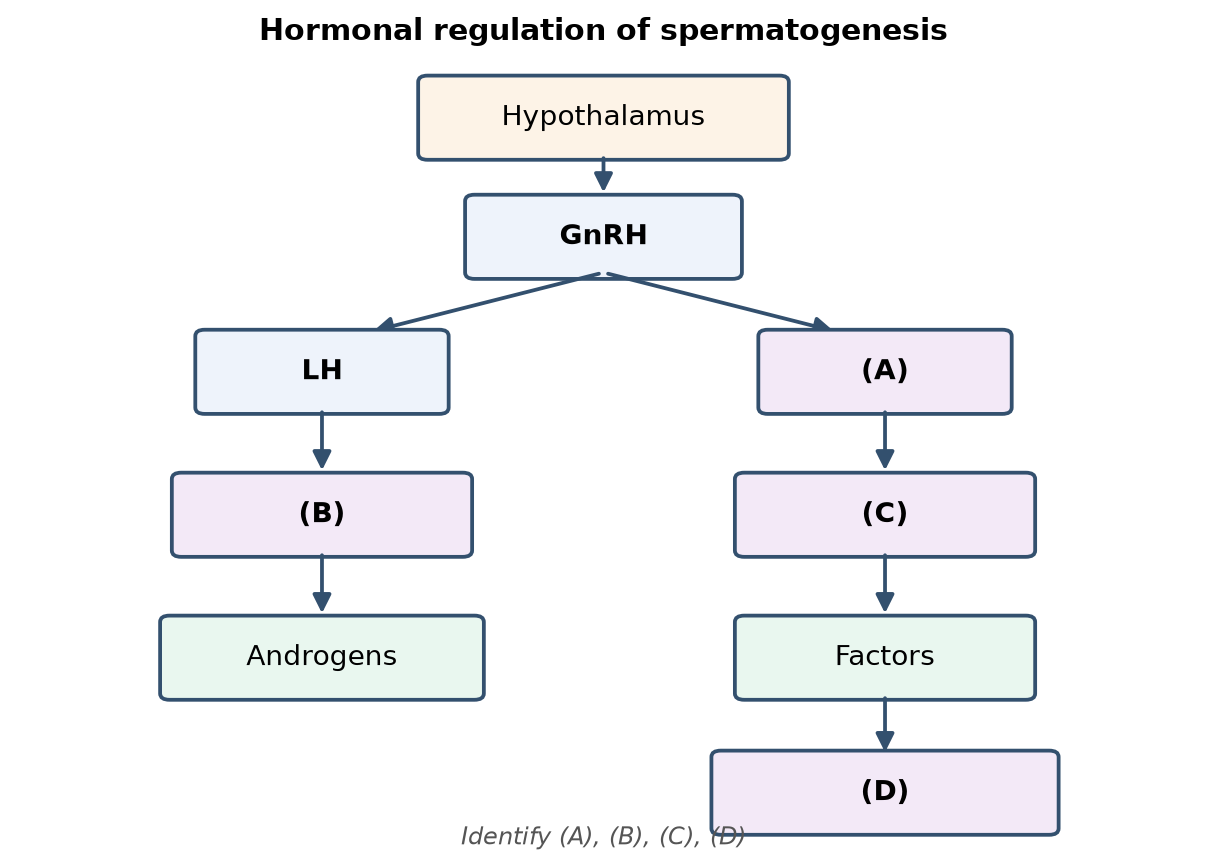
Identify the correct option (A), (B), (C), (D) with respect to spermatogenesis. (NEET 2024)
Match List-I and List-II. List-I (A. Head; B. Middle piece; C. Acrosome; D. Tail) List-II (I. Enzymes; II. Sperm motility; III. Energy; IV. Genetic material) Choose the correct answer from the options given below: (NEET 2025)
The first menstruation is called:
Consider the following: A. The reductive division for the human female gametogenesis starts earlier than that of the male gametogenesis. B. The gap between the first meiotic division and the second meiotic division is much shorter for males compared to females. C. The first polar body is associated with the formation of the primary oocyte. D. Luteinizing Hormone (LH) surge leads to disintegration of the endometrium and onset of menstrual bleeding. Choose the correct answer from the options given below: (NEET 2025)
Find the correct statements: A. In human pregnancy, the major organ systems are formed at the end of 12 weeks. B. In human pregnancy, the major organ systems are formed at the end of 8 weeks. C. In human pregnancy heart is formed after one month of gestation. D. In human pregnancy, limbs and digits develop by the end of second month. E. In human pregnancy the appearance of hair is usually observed in the fifth month. Choose the correct answer from the options given below: (NEET 2025)
Which of the following hormones is not secreted by the human placenta?
Which of the following structures is not a part of the male reproductive system?
Spermatogonia undergo a series of cell divisions to produce sperms. Select the correct statements from the following: A. Spermatogonia always undergo meiotic cell division. B. Primary spermatocytes divide mitotically to produce secondary spermatocytes. C. Secondary spermatocytes, through their second meiotic division, produce haploid spermatids. D. Spermatids produce spermatozoa through mitosis. E. Spermatids transform into spermatozoa by spermiogenesis. Choose the correct answer from the options given below: (NEET 2026)
Arrange the following cell layers/structures around the female gamete, from outer to inner side: A. Zona pellucida B. Perivitelline space C. Corona radiata D. Plasma membrane of ovum Choose the correct answer from the options given below: (NEET 2026)
Match List I with List II related to embryonic development at various months of pregnancy: List-I A. The foetus movement starts and hair appears on the head B. The foetus develops limbs and digits C. The foetus develops external genital organs D. The foetus body is covered with fine hair; eyelids separate and eyelashes are formed List-II (I) 24 weeks of pregnancy (II) 20 weeks of pregnancy (III) 8 weeks of pregnancy (IV) 12 weeks of pregnancy Choose the correct answer from the options given below: (NEET 2026)
Statement I: Ovulation is caused by LH surge leading to rupture of Graafian follicles. Statement II: The Graafian follicle remaining after ovulation transforms into the corpus luteum and secretes a large amount of estrogen. Choose the most appropriate answer:
The covering of the ovum at ovulation is _________.
Want more Human Reproduction questions?
MedicNEET has 43,000+ NEET-style questions across Physics, Chemistry & Biology with detailed NCERT-based explanations — including the long, tricky questions that actually come in the exam.
Download MedicNEET App — Free