
hnRNA Processing — Splicing, Capping and Tailing in Eukaryotes
✅ Asked in NEET 2017Spliceosomes are not found in the cells of: (NEET 2017)
Spliceosomes are not found in the cells of: (NEET 2017)
Answer & NCERT explanation
Correct answer: C — Bacteria
Spliceosomes are not found in bacteria because they are prokaryotes and lack introns in their genes. Spliceosomes are eukaryotic structures made of snRNPs that remove introns from pre-mRNA. Since bacterial genes don't have introns, they don't need splicing machinery. Fungi, animals, and plants are all eukaryotes with introns that require spliceosomes for mRNA processing. This reflects the fundamental difference between prokaryotic and eukaryotic gene organization.
Read more NCERT concept on the PYQ
The second complexity is that the primary transcripts contain both the exons and the introns and are non-functional. Hence, it is subjected to a process called splicing where the introns are removed and exons are joined in a defined order. hnRNA undergoes additional processing called as capping and tailing. In capping an unusual nucleotide (methyl guanosine triphosphate) is added to the 5'-end of hnRNA. In tailing, adenylate residues (200-300) are added at 3'-end in a template independent manner. It is the fully processed hnRNA, now called mRNA, that is transported out of the nucleus for translation.
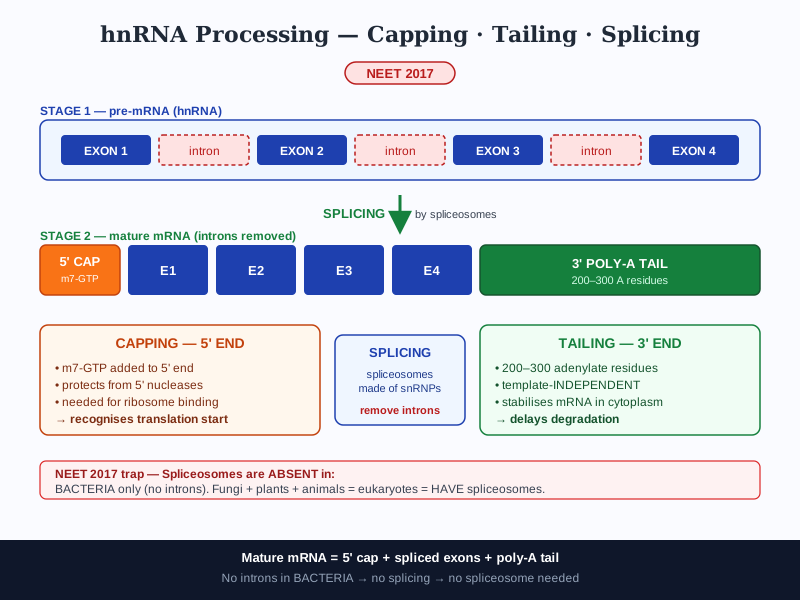
In eukaryotes, primary transcripts (hnRNA or pre-mRNA) contain both coding sequences (exons) and non-coding sequences (introns) and are non-functional. Processing involves three steps: (1) Splicing — introns are removed and exons joined in defined order by spliceosomes; (2) Capping — an unusual methyl guanosine triphosphate is added to the 5' end of hnRNA; (3) Tailing — adenylate residues (200-300) are added at the 3' end in a template-independent manner (poly-A tail). The fully processed hnRNA, now called mRNA, is transported out of the nucleus for translation.
Spliceosomes are made of snRNPs (small nuclear ribonucleoproteins) and catalyse the removal of introns. The critical NEET 2017 point: spliceosomes are found ONLY in eukaryotes — bacteria (prokaryotes) have no introns, therefore no need for splicing, therefore no spliceosomes. Fungi, plants, and animals all have introns and spliceosomes. Capping protects mRNA from degradation by exonucleases. Tailing also stabilises mRNA and signals for its export from the nucleus.
Spliceosomes are absent from fungi because fungi are primitive eukaryotes.
Spliceosomes are absent from BACTERIA — prokaryotes have no introns. Fungi are eukaryotes and DO have spliceosomes.
No introns = no splicing = no spliceosome. Only BACTERIA (prokaryotes) lack introns. All eukaryotes (fungi, plants, animals) have them.
- Capping: methyl guanosine triphosphate added at 5' end of hnRNA — protects from degradation.
- Tailing: 200-300 adenylate residues added at 3' end — template independent (no DNA template used).
- Spliceosomes = snRNPs — found only in eukaryotes. Bacteria lack introns completely.
- Processed mRNA (with cap + poly-A + joined exons) is transported to cytoplasm for translation.
Regarding hnRNA processing in eukaryotes, which of the following are CORRECT? 1. Introns are removed and exons are joined in defined order during splicing. 2. The 5' cap consists of methyl guanosine triphosphate added in a template-dependent manner. 3. The poly-A tail (200-300 adenylate residues) is added to the 3' end template-independently. 4. Spliceosomes are absent from bacteria because bacteria lack introns. 5. After processing, the hnRNA is called mRNA and transported to nucleus for translation.
View bonus solution & explanation
Correct answer: B — 1, 3 and 4
S1 CORRECT: Splicing removes introns and joins exons in defined order. S2 WRONG: Methyl guanosine triphosphate cap is added template-INDEPENDENTLY (like tailing). S3 CORRECT: Poly-A tail = 200-300 adenylate residues, added template-independently. S4 CORRECT: Bacteria lack introns, therefore lack splicing machinery (spliceosomes) — NEET 2017. S5 WRONG: Processed mRNA is transported to CYTOPLASM (not nucleus) for translation.
What is hnRNA Processing?
What did NEET 2017 ask on hnRNA Processing?
What is the most common NEET trap on hnRNA Processing?
How do you remember hnRNA Processing for NEET?
What are the key components of hnRNA Processing?
Through deep analysis of NEET and NTA, 176 of the 180 ReNEET 2026 (June 21) questions were already in the MedicNEET question bank before the exam.
176/180MedicNEET's Biology question bank is built from the same NCERT lines NTA picks repeatedly. Not random MCQs — questions crafted exactly like NTA crafts them.
You just learned this concept. The free app turns it into a daily goal built from your weak topics and brings it back just before you forget it — using active recall and spaced repetition — so it stays till exam day.