
Flower as Modified Shoot — SAM Becomes Floral Meristem, Internodes Condense
✅ Asked in NEET 2023Assertion (A): A flower is defined as modified shoot wherein the shoot apical meristem changes to floral meristem. Reason (R): Internode of the shoot gets condensed to produce different floral appendages laterally at successive node instead of leaves.
Assertion (A): A flower is defined as modified shoot wherein the shoot apical meristem changes to floral meristem. Reason (R): Internode of the shoot gets condensed to produce different floral appendages laterally at successive node instead of leaves.
Answer & NCERT explanation
Correct answer: A — Both A and R are true and R is the correct explanation of A
Both assertion and reason are correct. A flower is indeed a modified shoot where the shoot apical meristem transforms into floral meristem (A is true). The internodes become condensed, bringing nodes closer together, allowing floral parts (sepals, petals, stamens, carpels) to arise at successive nodes instead of leaves (R is true). This condensation is essential for flower formation, making R the correct explanation of A.
Read more NCERT concept on the PYQ
A flower is a modified shoot wherein the shoot apical meristem changes to floral meristem. Internodes do not elongate and the axis gets condensed. The apex produces different kinds of floral appendages laterally at successive nodes instead of leaves. When a shoot tip transforms into a flower, it is always solitary. The arrangement of flowers on the floral axis is termed as inflorescence. Depending on whether the apex gets developed into a flower or continues to grow, two major types of inflorescences are defined – racemose and cymose. In racemose type of inflorescences the main axis continues to grow, the flowers are borne laterally in an acropetal succession.
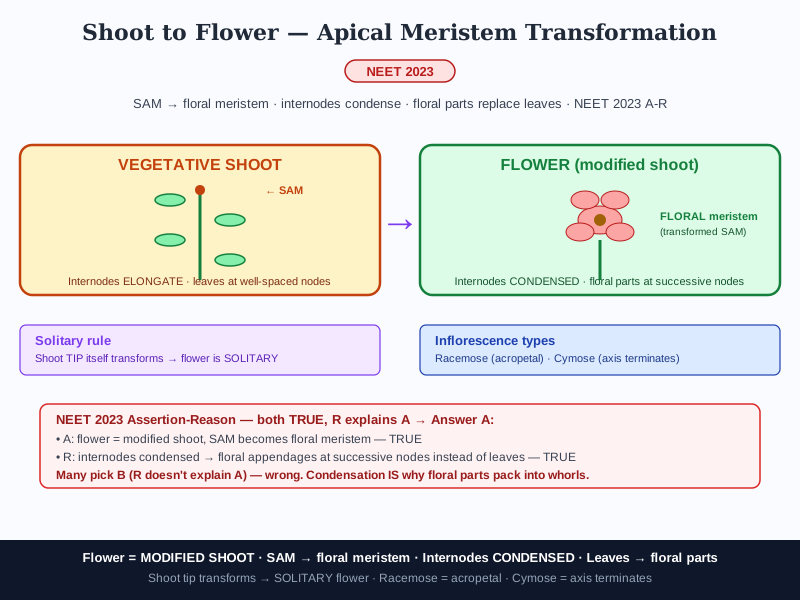
A flower is a modified shoot in which the shoot apical meristem (SAM) changes into a FLORAL meristem. The internodes do NOT elongate, so the axis becomes condensed and the nodes lie close together. At successive nodes, the apex produces different kinds of floral appendages (sepals, petals, stamens, carpels) LATERALLY — instead of producing leaves. When a shoot tip itself transforms into a flower, that flower is always SOLITARY. The arrangement of flowers on the floral axis is called inflorescence. Two major types: racemose (main axis continues to grow, flowers borne laterally in acropetal succession) and cymose (main axis terminates in a flower).
NEET 2023 tested this as a classic Assertion-Reason. The assertion (flower = modified shoot, SAM becomes floral meristem) and the reason (internodes condensed → floral appendages at successive nodes instead of leaves) are BOTH true AND R explains A — Answer A. The mechanistic chain matters: internode condensation is precisely WHY floral parts pack into tight whorls. Racemose = acropetal (older flowers at base, younger at tip). Cymose = basipetal/centrifugal (older at top or centre).
In a flower, the shoot apical meristem continues elongating the internodes to produce floral parts at successive nodes.
SAM becomes floral meristem. Internodes do NOT elongate; the axis is CONDENSED so nodes pack tightly and produce floral appendages instead of leaves.
Flower = compressed shoot. SAM → floral meristem. Internodes SHRINK. Leaves → floral parts. Shoot tip transforms → SOLITARY.
- Shoot apical meristem (SAM) → floral meristem; internodes do NOT elongate.
- Floral appendages (sepals, petals, stamens, carpels) arise LATERALLY at successive nodes instead of leaves.
- When the shoot TIP transforms, the flower is always SOLITARY.
- Inflorescence types: racemose (main axis continues growing, flowers in acropetal succession) and cymose (main axis ends in a flower).
Consider the following statements about a flower as a modified shoot: S1: The shoot apical meristem transforms into a floral meristem during flower development. S2: Internodes elongate to produce floral appendages at well-spaced successive nodes. S3: When the shoot tip itself transforms into a flower, the flower is always solitary. S4: Floral appendages (sepals, petals, stamens, carpels) arise laterally at nodes instead of leaves. S5: In racemose inflorescence, flowers are borne in acropetal succession on a continuously growing main axis.
View bonus solution & explanation
Correct answer: B — S1, S3, S4 and S5
S1 CORRECT: SAM → floral meristem (NCERT exact wording). S2 WRONG: Internodes do NOT elongate — the axis is CONDENSED. This is the reversal trap. S3 CORRECT: A flower formed by transformation of the shoot tip is always solitary (NCERT explicit). S4 CORRECT: Sepals, petals, stamens, carpels arise laterally at successive nodes instead of leaves. S5 CORRECT: Racemose = main axis continues, flowers borne in acropetal succession (older below, younger above).
What is Flower as Modified Shoot?
What did NEET 2023 ask on Flower as Modified Shoot?
What is the most common NEET trap on Flower as Modified Shoot?
How do you remember Flower as Modified Shoot for NEET?
What are the key components of Flower as Modified Shoot?
Through deep analysis of NEET and NTA, 176 of the 180 ReNEET 2026 (June 21) questions were already in the MedicNEET question bank before the exam.
176/180MedicNEET's Biology question bank is built from the same NCERT lines NTA picks repeatedly. Not random MCQs — questions crafted exactly like NTA crafts them.
You just learned this concept. The free app turns it into a daily goal built from your weak topics and brings it back just before you forget it — using active recall and spaced repetition — so it stays till exam day.