
Actinomorphic vs Zygomorphic Flowers — Radial vs Bilateral Symmetry
✅ Asked in NEET 2025Which of the following is an example of a zygomorphic flower?
Which of the following is an example of a zygomorphic flower?
Which of the following is an example of actinomorphic flower?
Match the following flower types with correct examples: (A) Zygomorphic — (B) Hypogynous — (C) Perigynous — (D) Epigynous — (I) Mustard (II) Plum (III) Cassia (IV) Cucumber Select the correct option: [NEET 2023 ]
The flowers are zygomorphic in: a) Mustard b) Gulmohar c) Cassia d) Datura e) Chilly Choose the correct answer from the options given below:
Radial symmetry is found in the flowers of:
Answer & NCERT explanation
Correct answer: C — Pea
Zygomorphic flowers have bilateral symmetry and irregular petal arrangement. Pea (Pisum) belongs to Leguminosae family and shows characteristic papilionaceous corolla with standard, wings, and keel petals arranged irregularly. Petunia, Datura, and Chilli have actinomorphic flowers with radial symmetry and regular petal arrangements that can be divided through multiple planes.
Read more NCERT concept on the PYQ
In symmetry, the flower may be actinomorphic (radial symmetry) or zygomorphic (bilateral symmetry). When a flower can be divided into two equal radial halves in any radial plane passing through the centre, it is said to be actinomorphic, e.g., mustard, datura, chilli. When it can be divided into two similar halves only in one particular vertical plane, it is zygomorphic, e.g., pea, gulmohur, bean, Cassia. A flower is asymmetric (irregular) if it cannot be divided into two similar halves by any vertical plane passing through the centre, as in canna.
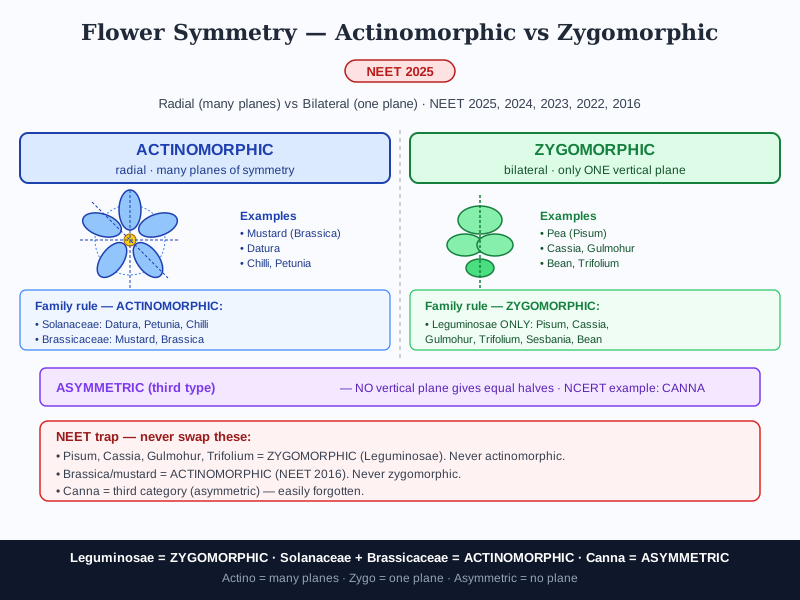
Flower symmetry is classified by how many planes can divide the flower into two equal halves. ACTINOMORPHIC flowers have radial symmetry — divisible into equal halves through ANY radial plane passing through the centre (e.g., mustard, datura, chilli). ZYGOMORPHIC flowers have bilateral symmetry — divisible into two similar halves only in ONE particular vertical plane (e.g., pea, gulmohur, bean, Cassia). ASYMMETRIC (irregular) flowers cannot be divided into similar halves by any vertical plane — canna is the NCERT example. The pea family (Leguminosae — Pisum, Cassia, gulmohur, bean, Sesbania, Trifolium) is consistently zygomorphic.
NEET has tested this five years running (2025, 2024, 2023, 2022, 2016). The trap repeats: NTA pairs Leguminosae members (Pisum/pea, Cassia, gulmohur, Trifolium, Sesbania) as actinomorphic distractors when ALL of these are zygomorphic. Conversely, Brassica/mustard, Datura, Petunia and chilli are ALL actinomorphic. Memorise by family: Leguminosae = zygomorphic (papilionaceous corolla). Asymmetric is a separate third category — canna is the canonical NCERT example.
Pisum sativum (pea) shows actinomorphic symmetry similar to mustard and datura.
Pea is ZYGOMORPHIC (bilateral) — Leguminosae family. Mustard, datura, chilli are actinomorphic (radial).
Pea + Cassia + Gulmohur + Bean = ZYGO (one plane). Mustard + Datura + Chilli = ACTINO (many planes). Canna = ASYMMETRIC.
- Actinomorphic = radial symmetry; many planes of division — mustard, datura, chilli.
- Zygomorphic = bilateral symmetry; only ONE vertical plane — pea, gulmohur, bean, Cassia.
- Asymmetric = NO vertical plane gives equal halves — canna (NCERT example).
- Family rule: Leguminosae (pea family) = always zygomorphic; Solanaceae (datura, chilli, petunia) = actinomorphic.
Consider the following statements about flower symmetry: S1: Pisum sativum (pea) shows zygomorphic (bilateral) symmetry. S2: Datura and chilli show actinomorphic (radial) symmetry. S3: Cassia and gulmohur are zygomorphic with bilateral symmetry. S4: Mustard (Brassica) is zygomorphic with bilateral symmetry. S5: Canna is the NCERT example of an asymmetric flower.
View bonus solution & explanation
Correct answer: B — S1, S2, S3 and S5
S1 CORRECT: Pea is zygomorphic (Leguminosae, papilionaceous corolla) — NEET 2025 answer. S2 CORRECT: Datura and chilli are actinomorphic (Solanaceae, radial). S3 CORRECT: Cassia and gulmohur are zygomorphic — NEET 2022 confirmed b+c (gulmohar, Cassia). S4 WRONG: Mustard (Brassica) is ACTINOMORPHIC, not zygomorphic — NEET 2016 tested radial symmetry in Brassica directly. S5 CORRECT: Canna is the NCERT canonical asymmetric flower.
What is Actinomorphic vs Zygomorphic Flowers?
What did NEET 2025 ask on Actinomorphic vs Zygomorphic Flowers?
What is the most common NEET trap on Actinomorphic vs Zygomorphic Flowers?
How do you remember Actinomorphic vs Zygomorphic Flowers for NEET?
What are the key components of Actinomorphic vs Zygomorphic Flowers?
Through deep analysis of NEET and NTA, 176 of the 180 ReNEET 2026 (June 21) questions were already in the MedicNEET question bank before the exam.
176/180MedicNEET's Biology question bank is built from the same NCERT lines NTA picks repeatedly. Not random MCQs — questions crafted exactly like NTA crafts them.
You just learned this concept. The free app turns it into a daily goal built from your weak topics and brings it back just before you forget it — using active recall and spaced repetition — so it stays till exam day.