The standard petal of papilionaceous corolla is also called: (NEET 2016 (Phase I))
How many plants among Indigofera, Sesbania, Salvia, Allium, Aloe, mustard, groundnut, radish, gram and turnip have stamens with different lengths in their flowers? (NEET 2016 (Phase II))
Radial symmetry is found in the flowers of (NEET 2016 (Phase II))
Proximal end of the filament of stamen is attached to the: (NEET 2016 (Phase I))
Stems modified into flat green organs performing the functions of leaves are known as: (NEET 2016 (Phase I))
Free-central placentation is found in (NEET 2016 (Phase II))
Two ways to go deeper on this chapter
Choose your next step
Cotyledon of maize grain is called: (NEET 2016 (Phase I))
The term 'polyadelphous' is related to (NEET 2016 (Phase II))
Which of the following is not a stem modification? (NEET 2016 (Phase I))
Tricarpellary, syncarpous gynoecium is found in flowers of: (NEET 2016 (Phase I))
Coconut fruit is a
Root hairs develop from the region of
In Bougainvillea thorns are the modifications of
The morphological nature of the edible part of coconut is
Sweet potato is a modified
Pneumatophores occur in
Placentation in which ovules develop on the inner wall of the ovary or in peripheral part, is (NEET 2019)
Which of the following shows whorled phyllotaxy ? (NEET 2023 (Odisha))
Match the placental types (column-I) with their examples (column-II). Column-I: (a) Basal, (b) Axile, (c) Parietal, (d) Free central. Column-II: (i) Mustard, (ii) China rose, (iii) Dianthus, (iv) Sunflower. (NEET 2023 (Odisha))
Bicarpellary ovary with obliquely placed septum is seen in :- (NEET 2023 (Odisha))
Ray florets have
The ovary is half inferior in:
The roots that originate from the base of the stem are:
Match the floral formulae in List I with the families in List II. List I (Floral formula) (a) % ⚥ K(5) C1+2+(2) A(9)+1 G1 (b) ⊕ ⚥ K(5) C(5) A5 G(2) (c) ⊕ ⚥ P(3+3) A(3+3) G(3) (d) ⊕ ⚥ K2+2 C4 A2+4 G(2) List II (Family) (i) Brassicaceae (ii) Liliaceae (iii) Fabaceae (iv) Solanaceae Choose the correct answer from the options given below. (NEET 2021)
Diadelphous stamens are found in:
The flowers are Zygomorphic in: (a) Mustard (b) Gulmohar (c) Cassia (d) Datura (e) Chilli. Choose the correct answer from the options given below: (NEET 2022)
Which one of the following plants shows vexillary aestivation and diadelphous stamens? (NEET 2022)
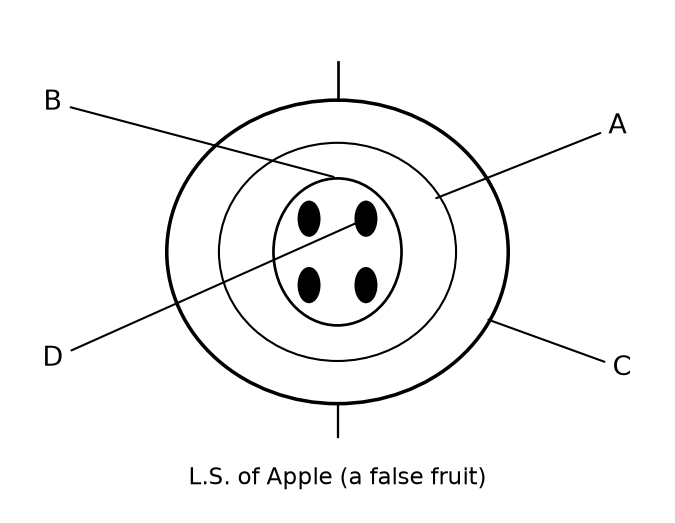
Which part of the fruit, labelled in the given figure makes it a false fruit? (NEET 2022)
Identify the correct set of statements: (a) The leaflets are modified into pointed hard thorns in Citrus and Bougainvillea (b) Axillary buds form slender and spirally coiled tendrils in cucumber and pumpkin (c) Stem is flattened and fleshy on Opuntia and modified to perform the function of leaves (d) Rhizophora shows vertically upward growing roots that help to get oxygen for respiration (e) Subaerially growing stems in grasses and strawberry help in vegetative propagation. Choose the correct answer from the options given below: (NEET 2022)
Axile placentation is observed in (NEET 2023 (Phase 1))
In a pea flower, five petals are arranged in a specialized manner with one posterior, two lateral and two anterior. These are named as ________. ________ and ________ respectively. (NEET 2023 (Phase 2))
Family Fabaceae differs from Solanaceae and Liliaceae. With respect to the stamens, pick out the characteristics specific to family Fabaceae but not found in Solanaceae or Liliaceae. (NEET 2023 (Phase 1))
Match the following : Type of flower -- Example (A) Zygomorphic -- (I) Mustard (B) Hypogynous -- (II) Plum (C) Perigynous -- (III) Cassia (D) Epigynous -- (IV) Cucumber Select the correct option : (NEET 2023 (Phase 2))
In Calotropis, aestivation is : (NEET 2023 (Phase 2))
Which of the following is an example of a zygomorphic flower? (NEET 2025)
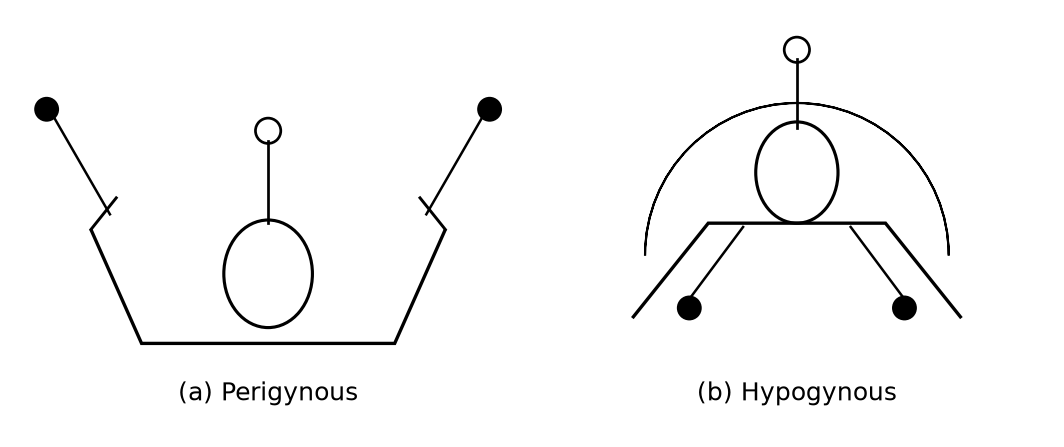
Identify the type of flowers based on the position of calyx, corolla and androecium with respect to the ovary from the given figures (a) and (b). (NEET 2024)
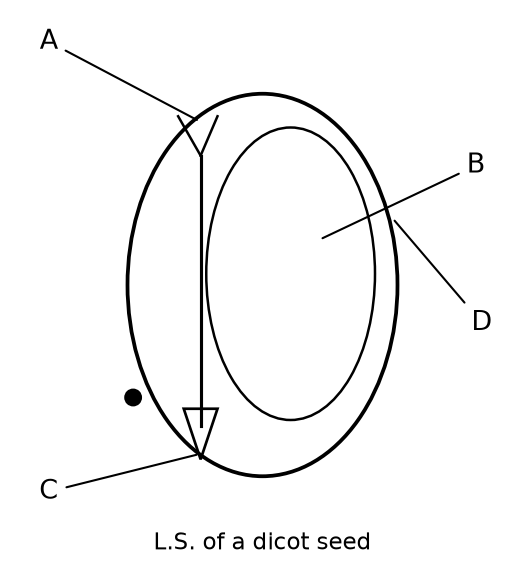
Identify the part of seed from the given figure which is destined to form root when the seed germinates.
Which of the following is an example of actinomorphic flower? (NEET 2024)
Match List I with List II. List I (A. Rose, B. Pea, C. Cotton, D. Mango) List II (I. Twisted aestivation, II. Perigynous flower, III. Drupe, IV. Marginal placentation) Choose the correct answer from the options given below. (NEET 2024)
Match List I with List II. List I (Types of Stamens) (A. Monadelphous, B. Diadelphous, C. Polyadelphous, D. Epiphyllous) List II (Example) (I. Citrus, II. Pea, III. Lily, IV. China-rose) Choose the correct answer from the options given below. (NEET 2024)
In the seeds of cereals, the outer covering of endosperm separates the embryo by a protein-rich layer called : (NEET 2025)
Given below are two statements: Statement I : In a floral formula the symbol [percentage/division-type symbol] stands for zygomorphic nature of the flower, and G with a bar above it stands for inferior ovary. Statement II : In a floral formula the symbol [same symbol] stands for actinomorphic nature of the flower and G with a bar below it stands for superior ovary. In the light of the above statements, choose the correct answer from the options given below: (NEET 2025)
Match List I with List II: List I — A. Scutellum; B. Non-albuminous seed; C. Epiblast; D. Perisperm. List II — I. Persistent nucellus; II. Cotyledon of Monocot seed; III. Groundnut; IV. Rudimentary cotyledon. Choose the option with all correct matches. (NEET 2025)
Which of the following are characteristic features of the Solanaceae family? (a) Flowers are bisexual and actinomorphic; (b) Calyx has five sepals and is united; (c) Androecium has five stamens and is epipetalous; (d) Ovary is inferior.
Match List I (Placentation) with List II (Example): List I (Placentation): A. Marginal; B. Axile; C. Parietal; D. Basal List II (Example): I. Mustard; II. Pea; III. Marigold; IV. Lemon Choose the correct answer from the options given below: (NEET 2026)
Identify the correct floral formula of family Solanaceae. (a) ⊕ ⚥ K5 C5 A5 G(2) (sepals & petals free) (b) ⊕ ⚥ K(5) C(5) A5 G(2) (gamosepalous, gamopetalous, epipetalous, ovary superior bicarpellary) (c) % ⚥ K(5) C1+2+(2) A(9)+1 G1 (d) ⊕ ⚥ P(3+3) A(3+3) G(3) (NEET 2026)
In racemose inflorescence, _________.
Phyllotaxy is the pattern of arrangement of ________.
Want more Morphology of Flowering Plants questions?
MedicNEET has 43,000+ NEET-style questions across Physics, Chemistry & Biology with detailed NCERT-based explanations — including the long, tricky questions that actually come in the exam.
Download MedicNEET App — Free