
Floral Formula Symbols — Br K C P A G, Brackets, Lines
📚 Practice ConceptVarious morphological features are used to describe a flowering plant. The description has to be brief, in a simple and scientific language and presented in a proper sequence. The plant is described beginning with its habit, vegetative characters – roots, stem and leaves and then floral characters inflorescence and flower parts. After describing various parts of plant, a floral diagram and a floral formula are presented. The floral formula is represented by some symbols. In the floral formula, Br stands for bracteate K stands for calyx, C for corolla, P for perianth, A for androecium and G for Gynoecium, G for superior ovary and G for inferior ovary, ♂ for male, ♀ for female, ⚥ for bisexual plants, ⊕ for actinomorphic
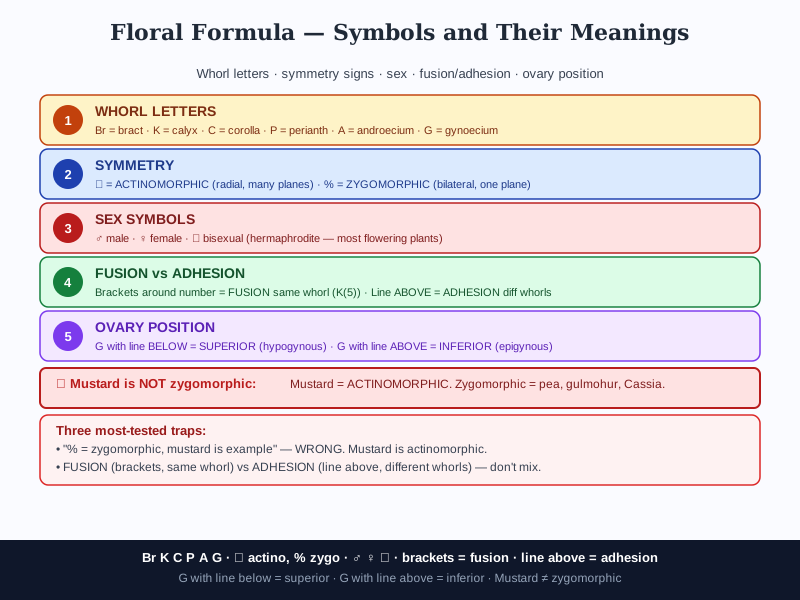
The % symbol indicates a zygomorphic flower, with mustard flowers being a typical example of this symmetry.
% = ZYGOMORPHIC (bilateral, only one plane of symmetry). Mustard is ACTINOMORPHIC (radial), not zygomorphic — examples of zygomorphic include pea, gulmohur, Cassia.
⊕ = actinomorphic (radial). % = zygomorphic (bilateral). Brackets = FUSION same whorl. Line above = ADHESION different whorls.
- Whorl symbols: Br (bract), K (calyx), C (corolla), P (perianth), A (androecium), G (gynoecium).
- Sex/symmetry: ♂ male, ♀ female, ⚥ bisexual, ⊕ actinomorphic, % zygomorphic.
- Ovary position: G with line BELOW = SUPERIOR (hypogynous); G with line ABOVE = INFERIOR (epigynous).
- Fusion within same whorl = brackets around number, e.g., K(5). Adhesion between whorls = line drawn above.
Consider the following statements about symbols used in a floral formula: S1: The symbol '⊕' denotes a flower with actinomorphic (radial) symmetry that can be divided into equal halves in any radial plane. S2: 'K' represents the calyx and 'C' the corolla; fusion of floral parts within a whorl is shown by enclosing the figure in brackets, e.g., K(5). S3: 'A' refers to the androecium and 'G' to the gynoecium; adhesion between different whorls is shown by a line drawn above the symbols. S4: The symbol '%' signifies a zygomorphic flower, and mustard is a typical example of this symmetry. S5: A G with a line drawn above it indicates an inferior ovary, where the thalamus grows upward enclosing the ovary.
View bonus solution & explanation
Correct answer: C — S1, S2, S3 and S5 only
S1 CORRECT: ⊕ = actinomorphic (radial symmetry). S2 CORRECT: K = calyx, C = corolla, brackets denote fusion within a whorl. S3 CORRECT: A = androecium, G = gynoecium, line ABOVE = adhesion between whorls. S4 WRONG: % does mean zygomorphic, BUT mustard is ACTINOMORPHIC, not zygomorphic. Examples of zygomorphic flowers are pea, gulmohur and Cassia — NOT mustard. S5 CORRECT: G with line above = INFERIOR ovary (epigynous), where the thalamus encloses the ovary.
What is Floral Formula Symbols?
What did NEET previous years ask on Floral Formula Symbols?
What is the most common NEET trap on Floral Formula Symbols?
How do you remember Floral Formula Symbols for NEET?
What are the key components of Floral Formula Symbols?
Through deep analysis of NEET and NTA, 176 of the 180 ReNEET 2026 (June 21) questions were already in the MedicNEET question bank before the exam.
176/180MedicNEET's Biology question bank is built from the same NCERT lines NTA picks repeatedly. Not random MCQs — questions crafted exactly like NTA crafts them.
You just learned this concept. The free app turns it into a daily goal built from your weak topics and brings it back just before you forget it — using active recall and spaced repetition — so it stays till exam day.