
Engelmann's Experiment — First Action Spectrum Using Cladophora and Bacteria
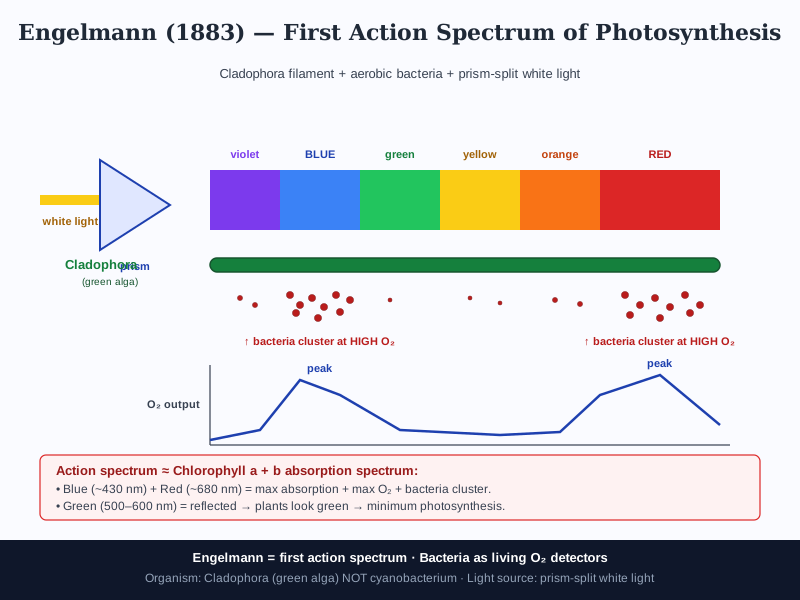
📚 Practice ConceptNow consider the interesting experiments done by T.W Engelmann (1843 – 1909). Using a prism he split light into its spectral components and then illuminated a green alga, Cladophora, placed in a suspension of aerobic bacteria. The bacteria were used to detect the sites of O₂ evolution. He observed that the bacteria accumulated mainly in the region of blue and red light of the split spectrum. A first action spectrum of photosynthesis was thus described. It resembles roughly the absorption spectra of chlorophyll a and b (discussed in section 11.4).
Aerobic bacteria accumulated primarily in regions of the spectrum where oxygen concentration was lowest, and maximum accumulation was in green and yellow light.
Bacteria accumulate where O2 is HIGHEST — in BLUE and RED light regions. Minimum in green light (least photosynthesis).
BLUE + RED = chlorophyll absorption = max photosynthesis = max O2 = bacteria cluster. GREEN = reflected = min photosynthesis.
- Organism used: Cladophora — a filamentous green alga (not a cyanobacterium).
- Bacteria used: aerobic bacteria as O2 indicators — they move toward high O2 concentration.
- Result: bacteria in blue and red regions = action spectrum peaks at these wavelengths.
- Action spectrum resembles chlorophyll a and b absorption spectra — evidence for their role as primary pigments.
Regarding Engelmann's experiment, which of the following statements are CORRECT? S1: He used a prism to split white light into its spectral components. S2: The photosynthetic organism used was Cladophora, a filamentous green alga. S3: Aerobic bacteria accumulated in regions of the spectrum where oxygen concentration was lowest. S4: The experiment produced the first action spectrum of photosynthesis, resembling chlorophyll a and b absorption. S5: Maximum accumulation of bacteria was observed in green and yellow light regions.
View bonus solution & explanation
Correct answer: B — S1, S2 and S4
S1 CORRECT: Prism used to split white light into spectral components — NCERT exact. S2 CORRECT: Cladophora = filamentous green alga used in the experiment. S3 WRONG: Bacteria accumulate where O2 is HIGHEST (not lowest) — bacteria are aerobic and move toward O2. S4 CORRECT: First action spectrum produced, resembling chlorophyll a and b absorption (NCERT exact). S5 WRONG: Maximum bacteria in BLUE and RED light (not green/yellow) — green light is least effective for photosynthesis.
What is Engelmann's Experiment?
What did NEET previous years ask on Engelmann's Experiment?
What is the most common NEET trap on Engelmann's Experiment?
How do you remember Engelmann's Experiment for NEET?
What are the key components of Engelmann's Experiment?
Through deep analysis of NEET and NTA, 176 of the 180 ReNEET 2026 (June 21) questions were already in the MedicNEET question bank before the exam.
176/180MedicNEET's Biology question bank is built from the same NCERT lines NTA picks repeatedly. Not random MCQs — questions crafted exactly like NTA crafts them.
You just learned this concept. The free app turns it into a daily goal built from your weak topics and brings it back just before you forget it — using active recall and spaced repetition — so it stays till exam day.