
Chemiosmosis — Membrane, Proton Pump, Proton Gradient, ATP Synthase
✅ Asked in NEET 2023Which of the following combinations is required for chemiosmosis? (NEET 2023)
Which of the following combinations is required for chemiosmosis? (NEET 2023)
Which one of the following is not true regarding the release of energy during ATP synthesis through chemiosmosis? It involves: (NEET 2022 Phase 1)
Answer & NCERT explanation
Correct answer: B — Membrane, proton pump, proton gradient, ATP synthase
Chemiosmosis requires membrane, proton pump, proton gradient, and ATP synthase. According to NCERT, these four components are essential: membrane provides barrier, proton pump creates gradient by moving protons across membrane, proton gradient stores potential energy, and ATP synthase uses this gradient to synthesize ATP. NADP synthase is not correct terminology.
Read more NCERT concept on the PYQ
Chemiosmosis requires a membrane, a proton pump, a proton gradient and ATP synthase. Energy is used to pump protons across a membrane, to create a gradient or a high concentration of protons within the thylakoid lumen. ATP synthase has a channel that allows diffusion of protons back across the membrane; this releases enough energy to activate ATP synthase enzyme that catalyses the formation of ATP.
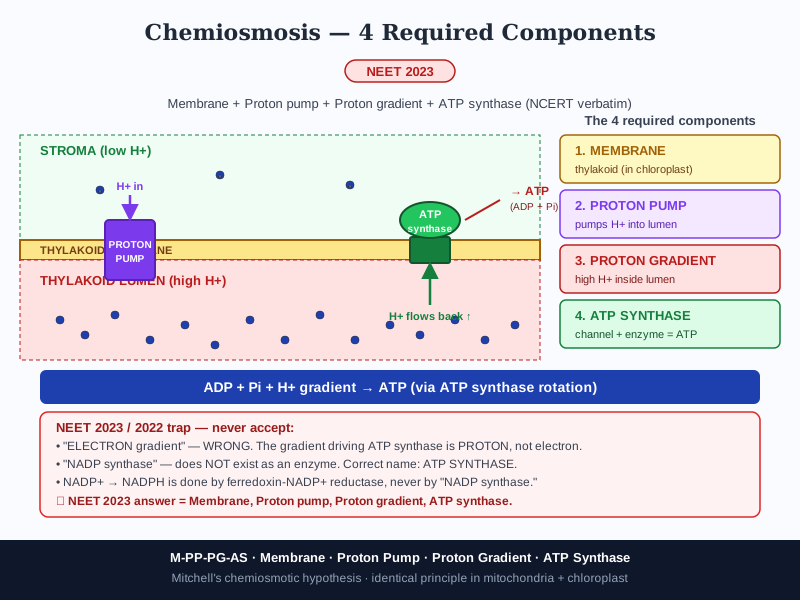
Chemiosmosis is the mechanism by which ATP is synthesised in chloroplasts (and mitochondria). It requires FOUR components working together: (1) a MEMBRANE — the thylakoid membrane in photosynthesis, (2) a PROTON PUMP — moves H+ ions across the membrane using energy from electron transport, (3) a PROTON GRADIENT — high H+ concentration accumulates in the thylakoid lumen, creating an electrochemical gradient, and (4) ATP SYNTHASE — an enzyme with a built-in channel that allows protons to diffuse back across the membrane down their gradient. The energy released by this proton flow activates ATP synthase to catalyse the formation of ATP from ADP and inorganic phosphate (Pi).
The NEET 2023 question (asked again in NEET 2022) is a literal four-word answer pulled verbatim from NCERT: "membrane, proton pump, proton gradient, ATP synthase." Three of the four NEET 2023 distractors contain a SINGLE word swap each that students must catch: "electron gradient" (should be PROTON gradient — electrons travel via ETC, but the gradient driving ATP synthase is PROTON), and "NADP synthase" (does not exist as an enzyme — ATP synthase is the correct name; NADP+ is reduced to NADPH by ferredoxin-NADP+ reductase, not by any "NADP synthase"). The fourth correct option is the verbatim NCERT phrase. This is a pure recall question — get the four-component list locked.
Chemiosmosis requires electron gradient and NADP synthase, or proton pump alone without membrane.
Chemiosmosis requires FOUR components: (1) MEMBRANE, (2) PROTON PUMP, (3) PROTON gradient (NOT electron gradient), (4) ATP SYNTHASE (NOT NADP synthase — no such enzyme).
M-PP-PG-AS: Membrane · Proton Pump · Proton Gradient · ATP Synthase. "NADP synthase" does NOT exist. Gradient is PROTON, never electron.
- Four required components: membrane + proton pump + proton gradient + ATP synthase. NEET 2023 verbatim answer.
- Proton gradient builds INSIDE the thylakoid lumen (high H+) compared to stroma (low H+) — drives ATP synthesis.
- ATP synthase has a built-in proton channel — protons diffuse back across membrane, energy activates the enzyme.
- Same chemiosmotic principle in mitochondrial inner membrane (oxidative phosphorylation) — universal across cells.
What is Chemiosmosis?
What did NEET 2023 and 2022 ask on Chemiosmosis?
What is the most common NEET trap on Chemiosmosis?
How do you remember Chemiosmosis for NEET?
What are the key components of Chemiosmosis?
Through deep analysis of NEET and NTA, 176 of the 180 ReNEET 2026 (June 21) questions were already in the MedicNEET question bank before the exam.
176/180MedicNEET's Biology question bank is built from the same NCERT lines NTA picks repeatedly. Not random MCQs — questions crafted exactly like NTA crafts them.
You just learned this concept. The free app turns it into a daily goal built from your weak topics and brings it back just before you forget it — using active recall and spaced repetition — so it stays till exam day.