
Dark Reactions are Temperature Controlled — C3 vs C4 Plants
✅ Asked in NEET 2017With reference to factors affecting the rate of photosynthesis, which of the following statements is not correct? (NEET 2017)
With reference to factors affecting the rate of photosynthesis, which of the following statements is not correct? (NEET 2017)
Answer & NCERT explanation
Correct answer: B — C₃ plants respond to higher temperature with enhanced photosynthesis while C₄ plants have much lower temperature optimum.
Statement (b) is incorrect. C4 plants actually respond better to higher temperatures and have higher temperature optimum compared to C3 plants. C3 plants show reduced photosynthesis efficiency at high temperatures due to increased photorespiration. The other statements are correct - CO2 enrichment helps photosynthesis, tomatoes benefit from greenhouse CO2 enrichment, and light saturation occurs at relatively low light intensity.
Read more NCERT concept on the PYQ
The dark reactions being enzymatic are temperature controlled. Though the light reactions are also temperature sensitive they are affected to a much lesser extent. The C₄ plants respond to higher temperatures and show higher rate of photosynthesis while C₃ plants have a much lower temperature optimum.
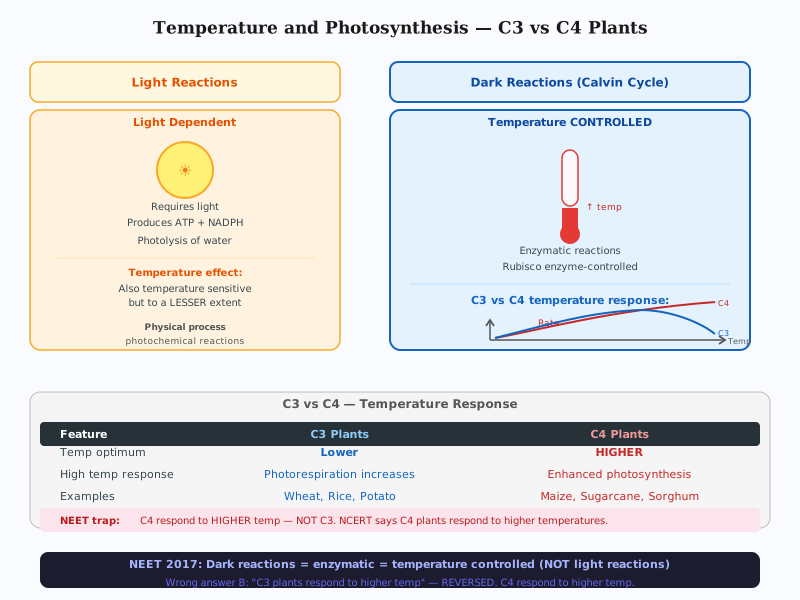
Of the two stages of photosynthesis, dark reactions (Calvin cycle) are enzymatic reactions and therefore temperature-controlled. Light reactions are also temperature sensitive but to a much lesser extent — they are primarily photochemical processes. The C4 plants show a distinct advantage: they respond to higher temperatures with enhanced photosynthesis rates. This is because C4 plants have a CO2 concentrating mechanism (bundle sheath cells with high RuBisCO activity) that reduces photorespiration even at high temperatures. C3 plants, by contrast, have a lower temperature optimum — at higher temperatures, photorespiration increases, reducing net photosynthesis. This physiological difference underlies why C4 crops (maize, sugarcane) are better adapted to tropical climates.
NCERT states that C4 plants 'respond to higher temperatures and show higher rate of photosynthesis while C3 plants have a much lower temperature optimum.' The NEET 2017 wrong statement (Option B) reversed this — stating C3 plants respond to higher temperatures. The mechanism: at high temperatures, O2 solubility increases relative to CO2, driving RuBisCO toward oxygenase activity (photorespiration) in C3 plants. C4 plants avoid this by pre-concentrating CO2 in bundle sheath cells. This is why C4 plants are more productive in hot climates.
C3 plants respond to higher temperatures with enhanced photosynthesis, while C4 plants have lower temperature optimum.
C4 plants respond to HIGHER temperatures. C3 plants have LOWER temperature optimum. NCERT explicitly states this.
C4 = 4 carbons = hot climate = higher temperature optimum. C3 = 3 carbons = temperate = lower optimum.
- Dark reactions are enzymatic and temperature-sensitive; light reactions are photochemical and less temperature-sensitive.
- C4 plants: Maize, Sugarcane, Sorghum — higher temperature optimum, no photorespiration.
- C3 plants: Wheat, Rice, Potato — lower temperature optimum, photorespiration increases at high temperatures.
- Photorespiration increases in C3 plants at high temperature because O2 competes with CO2 at the RuBisCO active site.
Which of the following statements about the effect of temperature on photosynthesis are CORRECT? 1. Dark reactions being enzymatic are affected by temperature to a much greater extent than light reactions. 2. Light reactions are also temperature-sensitive but to a much lesser extent than dark reactions. 3. C3 plants respond to higher temperatures with enhanced rates of photosynthesis. 4. C4 plants show higher rates of photosynthesis at higher temperatures. 5. At high temperatures, photorespiration increases in C3 plants, reducing net photosynthesis.
View bonus solution & explanation
Correct answer: D — 1, 2, 4 and 5
S1 CORRECT: Dark reactions = enzymatic = more temperature-sensitive than photochemical light reactions. S2 CORRECT: Light reactions are temperature-sensitive but to a lesser extent (NCERT exact). S3 WRONG: C3 plants do NOT respond to higher temperatures positively — C4 plants do. S4 CORRECT: C4 plants show higher photosynthesis at higher temperatures (NCERT). S5 CORRECT: At high temperatures, O2 solubility favoured, RuBisCO acts as oxygenase — photorespiration increases in C3 plants.
What is Dark Reactions are Temperature Controlled?
What did NEET 2017 ask on Dark Reactions are Temperature Controlled?
What is the most common NEET trap on Dark Reactions are Temperature Controlled?
How do you remember Dark Reactions are Temperature Controlled for NEET?
What are the key components of Dark Reactions are Temperature Controlled?
Through deep analysis of NEET and NTA, 176 of the 180 ReNEET 2026 (June 21) questions were already in the MedicNEET question bank before the exam.
176/180MedicNEET's Biology question bank is built from the same NCERT lines NTA picks repeatedly. Not random MCQs — questions crafted exactly like NTA crafts them.
You just learned this concept. The free app turns it into a daily goal built from your weak topics and brings it back just before you forget it — using active recall and spaced repetition — so it stays till exam day.