
Plasticity — How Plants Follow Different Developmental Pathways
✅ Asked in NEET 2026Heterophyllous development in response to environment is an example of which phenomenon?
Heterophyllous development in response to environment is an example of which phenomenon?
The ability of plants to follow different pathways in response to environment leading to formation of different kinds of structures is called (NEET 2022 Phase 2)
Which one of the following plants does not show plasticity? (NEET 2022 Phase 1)
Plants follow different pathways in response to environment or phases of life to form different kinds of structures. This ability is called: (NEET 2021)
Answer & NCERT explanation
Correct answer: D — Plasticity
The ability of plants to follow different developmental pathways in response to environment or life phase is called plasticity. Heterophylly in cotton, coriander and larkspur is a classic example.
Read more NCERT concept on the PYQ
Plants follow different pathways in response to environment or phases of life to form different kinds of structures. This ability is called plasticity, e.g., heterophylly in cotton, coriander and larkspur. In such plants, the leaves of the juvenile plant are different in shape from those in mature plants. On the other hand, difference in shapes of leaves produced in air and those produced in water in buttercup also represent the heterophyllous development due to environment. This phenomenon of heterophylly is an example of plasticity.
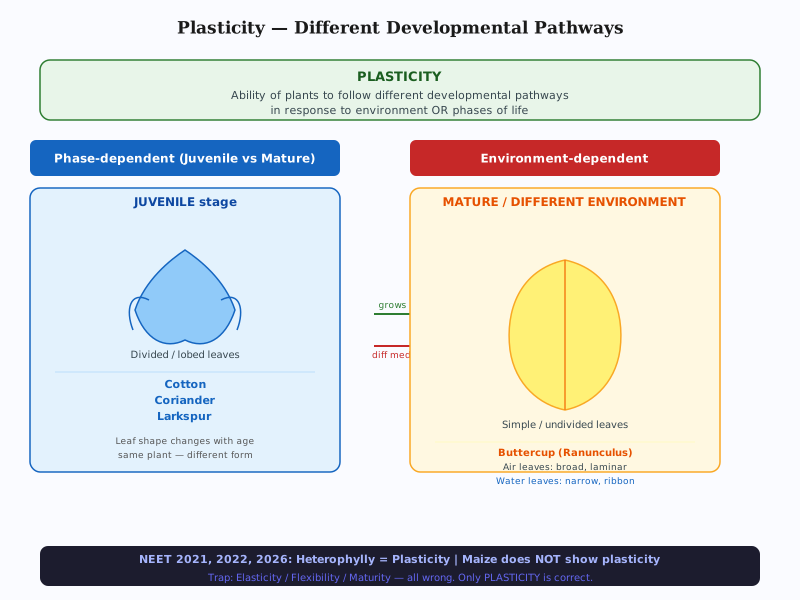
Plasticity is the ability of plants to follow different developmental pathways in response to their environment or stage of life, producing structurally different forms from the same genotype. In cotton, coriander, and larkspur, juvenile plants bear deeply lobed or divided leaves while mature plants produce simpler, undivided leaves — a phenomenon called heterophylly. This phase-dependent plasticity is genetically programmed. Buttercup (Ranunculus) demonstrates environment-dependent plasticity: leaves produced in air are broad and laminar, while those submerged in water are narrow and ribbon-like. Critically, monocots like maize do NOT show plasticity — this is the NEET trap question.
NCERT uses the word plasticity but does not distinguish between phase-dependent and environment-dependent heterophylly clearly. NTA tests the distinction: in cotton/coriander/larkspur, the trigger is the developmental phase (juvenile vs mature). In buttercup, the trigger is the external medium (air vs water). Both are plasticity — but different drivers. Maize is the standard negative example — monocots generally have limited developmental plasticity compared to dicots.
Students confuse plasticity with elasticity, flexibility, or maturity — all of which appear as distractors in NEET questions.
Plasticity specifically refers to developmental pathway switching — not physical flexibility or mechanical properties.
PLASticity = PLAnt shape changes with environment or stage — never confuse with physical terms
- Maize does NOT show plasticity — it is the correct answer for 'which plant does not show plasticity' (NEET 2022 Phase 1).
- Heterophylly can be triggered by developmental phase (cotton) or environment (buttercup) — both are plasticity.
- Plasticity is distinct from differentiation (cell specialisation) and redifferentiation (reversal of specialisation).
- Development is the overall process of growth including differentiation; plasticity is the flexibility within development.
Which of the following statements are CORRECT regarding plasticity in plants? 1. Heterophylly in cotton is an example of environment-dependent plasticity. 2. Buttercup produces different leaf shapes in air and water due to phase-dependent plasticity. 3. Maize does not show plasticity according to NCERT. 4. Plasticity allows the same genotype to produce different phenotypes. 5. Larkspur shows heterophylly between juvenile and mature stages.
View bonus solution & explanation
Correct answer: B — 3, 4 and 5 only
Statement 1 is WRONG — Cotton shows PHASE-dependent (not environment-dependent) plasticity. Statement 2 is WRONG — Buttercup is ENVIRONMENT-dependent (not phase-dependent). Statement 3 is CORRECT — Maize does not show plasticity (NEET 2022). Statement 4 is CORRECT — Plasticity by definition = same genotype, different phenotypes. Statement 5 is CORRECT — Larkspur shows heterophylly between juvenile (divided) and mature (simpler) stages.
What is Plasticity?
What did NEET 2026 ask on Plasticity?
What is the most common NEET trap on Plasticity?
How do you remember Plasticity for NEET?
What are the key components of Plasticity?
Through deep analysis of NEET and NTA, 176 of the 180 ReNEET 2026 (June 21) questions were already in the MedicNEET question bank before the exam.
176/180MedicNEET's Biology question bank is built from the same NCERT lines NTA picks repeatedly. Not random MCQs — questions crafted exactly like NTA crafts them.
You just learned this concept. The free app turns it into a daily goal built from your weak topics and brings it back just before you forget it — using active recall and spaced repetition — so it stays till exam day.