
Ethylene — Functions Including Dormancy Breaking and Deep Water Rice
✅ Asked in NEET 2025Which one of the following is involved in overcoming seed dormancy? [Neet 2025]
Which one of the following is involved in overcoming seed dormancy? [Neet 2025]
Which hormone promotes internode/petiole elongation in deep water rice? (NEET 2023)
The gaseous plant growth regulator is used in plants to: (NEET 2022 Phase 1)
Answer & NCERT explanation
Correct answer: B — Ethylene
Ethylene is involved in overcoming seed dormancy by breaking the dormant state and promoting germination. It counteracts the inhibitory effects of ABA and other dormancy-inducing factors. Ethylene stimulates the production of enzymes that weaken the seed coat and activate metabolic processes required for germination. ABA maintains dormancy, while cytokinins and auxins are not primarily involved in dormancy breaking.
Read more NCERT concept on the PYQ
Ethylene breaks seed and bud dormancy, initiates germination in peanut seeds, sprouting of potato tubers. Ethylene promotes rapid internode/petiole elongation in deep water rice plants. It helps leaves/ upper parts of the shoot to remain above water. Ethylene also promotes root growth and root hair formation, thus helping the plants to increase their absorption surface.
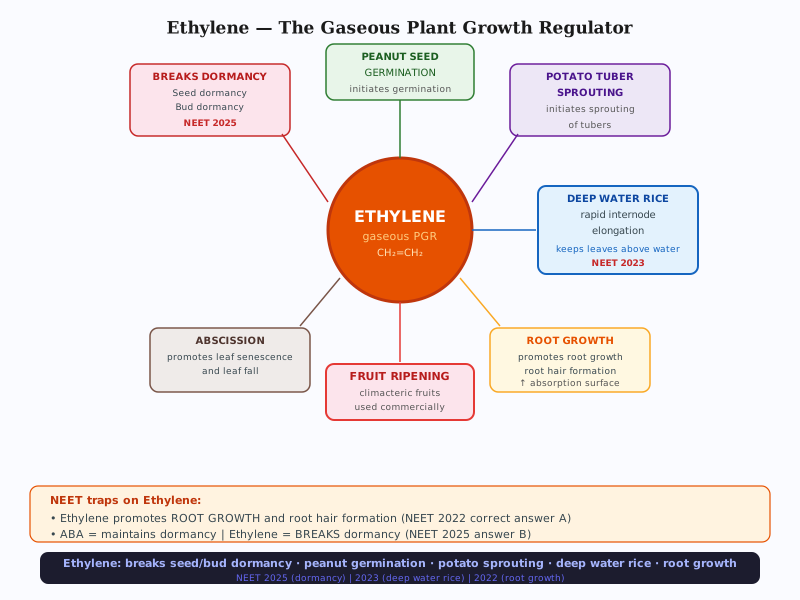
Ethylene is the only gaseous plant growth regulator (PGR). It breaks seed and bud dormancy, initiates germination in peanut seeds, and triggers sprouting of potato tubers. In deep water rice, ethylene promotes rapid internode and petiole elongation, keeping leaves above the water surface — a flood-adaptation response. Ethylene also promotes root growth and root hair formation, thereby increasing the plant's absorption surface. Additional functions include fruit ripening (especially in climacteric fruits), leaf senescence, and abscission. Critically, ethylene BREAKS dormancy — in contrast to ABA which maintains and induces dormancy.
NCERT 2022 question (Tier 1, NEET 2022 Phase 1) listed 'promote root growth and root hair formation to increase absorption surface' as a function of the gaseous PGR (ethylene) — making Option A the correct answer. However the explanation provided in many guides incorrectly attributes this to auxins. NCERT explicitly states ethylene promotes root growth and root hair formation. The deep water rice response (NEET 2023) is the most ecology-relevant ethylene function — it is an adaptive response to submergence, not a general growth effect.
ABA (abscisic acid) breaks seed dormancy and initiates germination in peanut seeds.
ETHYLENE breaks seed and bud dormancy. ABA MAINTAINS dormancy — it is the stress hormone that induces and sustains dormancy.
ABA = Abscission + dormancy (causes leaf fall AND maintains dormancy). Ethylene = BREAKS dormancy.
- Ethylene breaks seed dormancy AND bud dormancy (both) — NEET 2025 tested 'overcoming seed dormancy'.
- Deep water rice elongation = ethylene response to flooding — keeps photosynthetic leaves above water (NEET 2023).
- Ethylene promotes root growth + root hair formation → increases absorption surface (NEET 2022 exact).
- Ethylene is used commercially to ripen fruits (e.g., banana) and promote uniform flowering in mango.
Regarding the gaseous plant growth regulator (ethylene), which of the following statements are CORRECT? 1. Ethylene breaks both seed dormancy and bud dormancy. 2. ABA (abscisic acid) initiates germination in peanut seeds by overcoming dormancy. 3. Ethylene promotes rapid internode elongation in deep water rice plants to keep leaves above water. 4. Ethylene promotes root growth and root hair formation, increasing absorption surface. 5. Ethylene induces flowering in mango and pineapple.
View bonus solution & explanation
Correct answer: D — 1, 3, 4 and 5
S1 CORRECT: Ethylene breaks seed and bud dormancy — NCERT exact (NEET 2025). S2 WRONG: ABA MAINTAINS dormancy — ETHYLENE initiates germination in peanut, not ABA. S3 CORRECT: Deep water rice elongation promoted by ethylene — flood adaptive response (NEET 2023). S4 CORRECT: Ethylene promotes root growth + root hair formation (NEET 2022). S5 CORRECT: Ethylene induces flowering in mango, pineapple, and other plants — used commercially. Therefore 1, 3, 4, 5 are correct = Option D.
What is Ethylene?
What did NEET 2025 ask on Ethylene?
What is the most common NEET trap on Ethylene?
How do you remember Ethylene for NEET?
What are the key components of Ethylene?
Through deep analysis of NEET and NTA, 176 of the 180 ReNEET 2026 (June 21) questions were already in the MedicNEET question bank before the exam.
176/180MedicNEET's Biology question bank is built from the same NCERT lines NTA picks repeatedly. Not random MCQs — questions crafted exactly like NTA crafts them.
You just learned this concept. The free app turns it into a daily goal built from your weak topics and brings it back just before you forget it — using active recall and spaced repetition — so it stays till exam day.