
Klinefelter's Syndrome (47,XXY) — Sex Chromosome Aneuploidy
✅ Asked in NEET 2025A male child with XXY genotype will suffer from which disorder? (NEET 2025)
A male child with XXY genotype will suffer from which disorder? (NEET 2025)
Which of the following statements are correct about Klinefelter’s Syndrome? A. This disorder was first described by Langdon Down (1866). B. Such an individual has overall masculine development. However, the feminine development is also expressed. C. The affected individual is short statured. D. Physical, psychomotor and mental development is retarded. E. Such individuals are sterile. Choose the correct answer from the options given below: (NEET 2022)
Answer & NCERT explanation
Correct answer: C — Klinefelter’s syndrome
XXY genotype represents Klinefelter's syndrome - a male with an extra X chromosome. Turner's is XO (female), Down's is autosomal trisomy 21, and Edward's is trisomy 18. The XXY karyotype specifically characterizes Klinefelter's syndrome.
Read more NCERT concept on the PYQ
Klinefelter's Syndrome: This genetic disorder is also caused due to the presence of an additional copy of X-chromosome resulting into a karyotype of 47, XXY. Such an individual has overall masculine development, however, the feminine development (development of breast, i.e., Gynaecomastia) is also expressed. Such individuals are sterile.
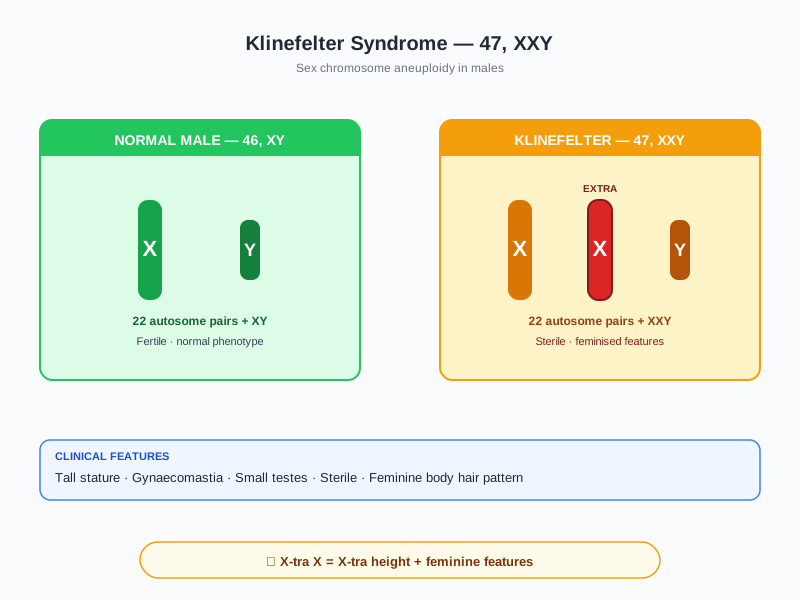
Klinefelter's syndrome results from non-disjunction during meiosis — the failure of sex chromosomes to separate properly. The affected individual receives an extra X chromosome, giving them a 47,XXY karyotype instead of the normal 46,XY. The Y chromosome ensures overall masculine development (testes, male body plan), but the extra X chromosome causes feminising effects — most notably gynaecomastia (breast tissue development). These individuals are sterile because the extra X disrupts spermatogenesis. Importantly, they typically have TALL stature (above average height), not short stature.
NCERT describes the syndrome but does not explain the mechanism clearly. Deeper: Non-disjunction can occur in maternal meiosis I (most common), maternal meiosis II, or paternal meiosis. The extra X originates from the egg or sperm that carried XX or XY instead of just X or Y. Turner syndrome (45,XO) is the FEMALE counterpart — one X chromosome is missing. Turner females are SHORT statured with webbed neck, underdeveloped secondary sexual characters, and are also sterile. Both conditions share sterility but differ in everything else.
XXY = X-tra X = masculine with feminine features | XO = Only one X = incomplete female
What is Klinefelter's Syndrome (47,XXY)?
Has Klinefelter's Syndrome (47,XXY) been asked in NEET?
What is the key NEET fact about Klinefelter's Syndrome (47,XXY)?
How do you remember Klinefelter's Syndrome (47,XXY) for NEET?
Through deep analysis of NEET and NTA, 176 of the 180 ReNEET 2026 (June 21) questions were already in the MedicNEET question bank before the exam.
176/180MedicNEET's Biology question bank is built from the same NCERT lines NTA picks repeatedly. Not random MCQs — questions crafted exactly like NTA crafts them.
You just learned this concept. The free app turns it into a daily goal built from your weak topics and brings it back just before you forget it — using active recall and spaced repetition — so it stays till exam day.