
Barrier Contraceptives — Condoms, Diaphragms, Cervical Caps, Vaults
🔥 Predicted for NEET 2027In barrier methods, ovum and sperms are prevented from physically meeting with the help of barriers. Such methods are available for both males and females. Condoms are barriers made of thin rubber/latex sheath that are used to cover the penis in the male or vagina and cervix in the female, just before coitus so that the ejaculated semen would not enter into the female reproductive tract. This can prevent conception. 'Nirodh' is a popular brand of condom for the male. Use of condoms has increased in recent years due to its additional benefit of protecting the user from contracting STIs and AIDS. Both the male and the female condoms are disposable, can be self-inserted and thereby gives privacy to the user. Diaphragms, cervical caps and vaults are also barriers made of rubber that are inserted into the female reproductive tract to cover the cervix during coitus. They prevent conception by blocking the entry of sperms through the cervix. They are reusable. Spermicidal creams, jellies and foams are usually used alongwith these barriers to increase their contraceptive efficiency.
Adjacent to a frequently-asked paragraph in the same chapter.
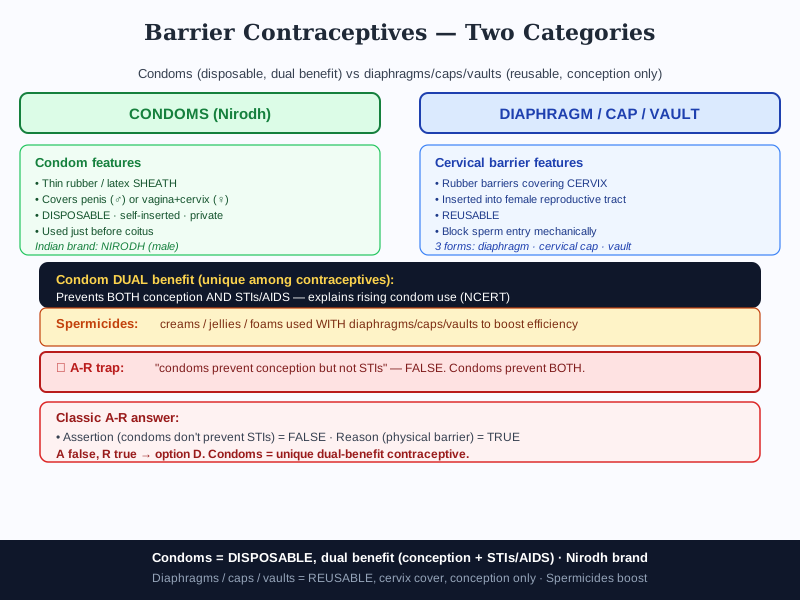
Key distinctions for NEET: condoms = DISPOSABLE, prevent BOTH conception AND STIs/AIDS (dual benefit). Diaphragms/cervical caps/vaults = REUSABLE, prevent ONLY conception (no STI protection). Both male and female condoms exist; both are self-inserted and give privacy. Spermicides BOOST efficiency when paired with diaphragms/caps/vaults. A-R style: Assertion ('condom prevents conception but not STIs') is FALSE — condoms prevent BOTH conception AND STIs. Reason ('creates physical barrier to sperms and pathogens') is TRUE. So A false, R true → option D.
Condoms prevent conception but do not protect against sexually transmitted infections (STIs) or AIDS.
Condoms prevent BOTH conception AND STIs/AIDS — the ADDITIONAL protective benefit against STIs explains why condom use has risen.
Condoms = disposable, dual benefit (conception + STIs). Diaphragm/cap/vault = reusable, cervix-cover, conception only. Spermicides boost barrier efficiency.
- Condoms (Nirodh) = disposable thin rubber/latex sheaths; prevent BOTH conception AND STIs/AIDS.
- Both male and female condoms are self-inserted and give privacy to the user.
- Diaphragms, cervical caps, vaults = reusable rubber barriers covering the cervix during coitus.
- Spermicidal creams/jellies/foams are used WITH diaphragms/caps/vaults to increase contraceptive efficiency.
Q5. Assertion–Reason Assertion (A): Condom usage prevents conception but not STIs. Reason (R): It creates a physical barrier to sperms and pathogens.
View solution & NCERT explanation
Correct answer: D — A false, R true
Condoms prevent conception and protect from STIs like HIV by preventing semen entry.
What is Barrier Contraceptives?
What did NEET previous years ask on Barrier Contraceptives?
What is the most common NEET trap on Barrier Contraceptives?
How do you remember Barrier Contraceptives for NEET?
What are the key components of Barrier Contraceptives?
Through deep analysis of NEET and NTA, 176 of the 180 ReNEET 2026 (June 21) questions were already in the MedicNEET question bank before the exam.
176/180MedicNEET's Biology question bank is built from the same NCERT lines NTA picks repeatedly. Not random MCQs — questions crafted exactly like NTA crafts them.
You just learned this concept. The free app turns it into a daily goal built from your weak topics and brings it back just before you forget it — using active recall and spaced repetition — so it stays till exam day.