
Male Frog Reproductive System — Sperm Passage Through Bidder's Canal
✅ Asked in NEET 2017Select the correct route for the passage of sperms in male frogs.
Select the correct route for the passage of sperms in male frogs.
Answer & NCERT explanation
Correct answer: C — Testes → Vasa of Terentia → Kidney → Bidder’s canal → Urinogenital duct → Cloaca
Correct sperm passage route: Testes → Vasa efferentia → Kidney → Bidder's canal → Urinogenital duct → Cloaca. Sperm produced in testes travel through vasa efferentia (not vasa of Terentia) to kidney, then through Bidder's canal, urinogenital duct, and finally cloaca. NCERT clearly states this pathway for male frog reproductive system where kidney acts as passage for sperm.
Read more NCERT concept on the PYQ
Frogs have well organised male and female reproductive systems. Male reproductive organs consist of a pair of yellowish ovoid testes, which are found adhered to the upper part of kidneys by a double fold of peritoneum called mesorchium. Vasa efferentia are 10-12 in number that arise from testes. They enter the kidneys on their side and open into Bidder's
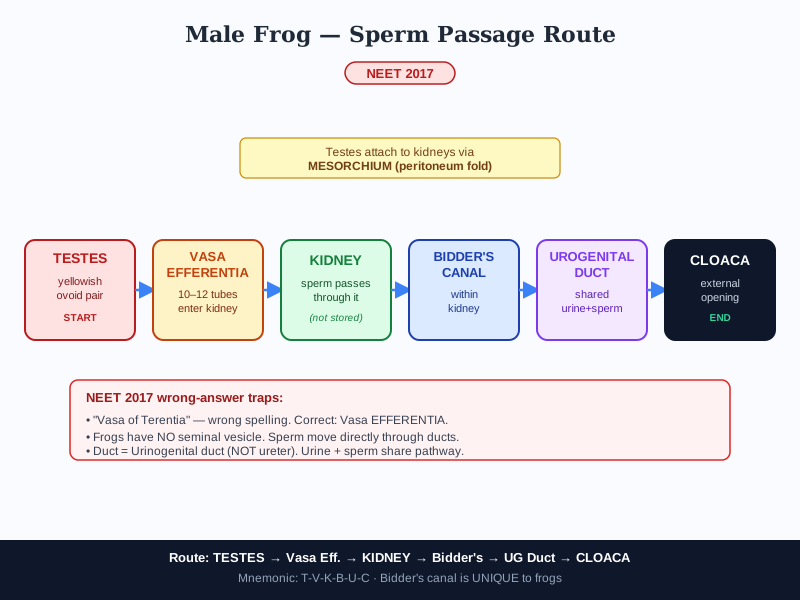
In male frogs, the reproductive organs consist of a pair of yellowish ovoid testes attached to the kidneys by a peritoneum fold called the mesorchium. The correct sperm passage route is: Testes → Vasa efferentia (10-12 tubules) → Kidney → Bidder's canal → Urinogenital duct → Cloaca. The vasa efferentia arise from the testes and enter the kidneys, passing through Bidder's canal — a unique structure within the frog kidney. Sperm then travel via the urinogenital duct (which carries both urine and sperm) before exiting through the cloaca.
The NEET 2017 question requires precise knowledge of both correct terminology and correct sequence. Key terminology traps: 'Vasa of Terentia' is wrong — the correct term is Vasa efferentia. 'Seminal vesicle' does not exist in frogs. 'Ureter' is incorrect — it is the urinogenital duct in frogs (frogs have a urinogenital system, not separate urinary and reproductive systems). The kidney serves dual function — excretory and sperm-passage — via Bidder's canal.
The sperm route includes seminal vesicles, or the correct term is vasa of Terentia, or the duct is called ureter.
Correct: Testes → Vasa efferentia (not 'of Terentia') → Kidney → Bidder's canal → Urinogenital duct → Cloaca. No seminal vesicle in frogs.
TVKBU-C: Testes-Vasa efferentia-Kidney-Bidder's-Urinogenital-Cloaca. Frogs share urine+sperm pathway.
- Vasa efferentia: 10-12 tubules arising from testes, enter kidney on their side.
- Mesorchium: double fold of peritoneum by which testes are attached to kidneys.
- Bidder's canal: structure within the frog kidney that collects sperm — unique to frogs.
- Urinogenital duct: carries both urine and sperm — frogs do not have separate ducts for these.
Which of the following correctly describes the sperm passage route in male frogs? S1: Sperm produced in testes travel through vasa efferentia (10-12 tubules) to enter the kidney. S2: Bidder's canal is a structure located within the frog kidney through which sperm pass. S3: The urinogenital duct carries sperm separately from urine in male frogs. S4: After the urinogenital duct, sperm exit through the cloaca. S5: Male frogs possess seminal vesicles that store sperm before ejaculation.
View bonus solution & explanation
Correct answer: A — S1, S2 and S4
S1 CORRECT: Vasa efferentia (10-12) arise from testes and enter the kidney. S2 CORRECT: Bidder's canal is within the kidney — collects sperm from vasa efferentia. S3 WRONG: Urinogenital duct carries BOTH urine and sperm together — not separately. S4 CORRECT: Final exit is through the cloaca. S5 WRONG: Frogs do NOT have seminal vesicles — this is a trap option from NEET 2017 Option A.
What is Male Frog Reproductive System?
What did NEET 2017 ask on Male Frog Reproductive System?
What is the most common NEET trap on Male Frog Reproductive System?
How do you remember Male Frog Reproductive System for NEET?
What are the key components of Male Frog Reproductive System?
Through deep analysis of NEET and NTA, 176 of the 180 ReNEET 2026 (June 21) questions were already in the MedicNEET question bank before the exam.
176/180MedicNEET's Biology question bank is built from the same NCERT lines NTA picks repeatedly. Not random MCQs — questions crafted exactly like NTA crafts them.
You just learned this concept. The free app turns it into a daily goal built from your weak topics and brings it back just before you forget it — using active recall and spaced repetition — so it stays till exam day.