
NEET 2017 · PhysicsManometerPrevious Year Question
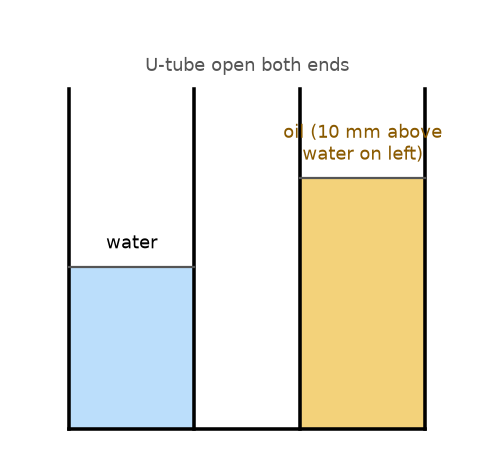
A U-tube with both ends open to the atmosphere is partially filled with water. Oil, which is immiscible with water, is poured into one side until it stands at a distance of 10 mm above the water level on the other side. Meanwhile the water rises by 65 mm from its original level (see figure). The density of the oil is:
Answer: (D) 928 kg m⁻³. Water rises 65 mm on one arm ⇒ it falls 65 mm on the oil arm; level difference of water = 130 mm.
- A.650 kg m⁻³
- B.425 kg m⁻³
- C.800 kg m⁻³
- D.928 kg m⁻³✓
Correct Answer
(D) 928 kg m⁻³
Solution & Explanation
Water rises 65 mm on one arm ⇒ it falls 65 mm on the oil arm; level difference of water = 130 mm. The oil column top is 10 mm above the higher water level ⇒ oil column height = 130 + 10 = 140 mm. Pressure balance at the oil–water interface: ρ_oil·g·(140) = ρ_water·g·(130) ρ_oil = 1000 × 130/140 ≈ 928 kg m⁻³.
🎯
43,000+ questions in हिंदी & English · one-tap toggle
Open →📚Practice all NEET Physics PYQs chapter-wise →💡Don't get it? Learn the Mechanical Properties Of Fluids concepts →Practice NEET 2017 Physics — free, with instant solutions
The app builds a daily goal from your weak topics and brings each question back just before you forget it — so what you solve today turns into marks on exam day.
More NEET PYQ solutions
PhysIn a U-tube, water and oil are in the left and right arms respectively. The heights of the water and oil columns (measured from the bottom) are 15 cm and 20 cm respectively. The density of the oil is: (take ρ_water = 1000 kg m⁻³)PhysAn electric dipole with dipole moment 5 × 10⁻⁶ C·m is aligned with the direction of a uniform electric field of magnitude 4 × 10⁵ N/C. The dipole is then rotated through an angle of 60° with respect to the electric field. The change in the potential energy of the dipole is:PhysTwo identical charged conducting spheres A and B have their centres separated by a certain distance. Charge on each sphere is q and the force of repulsion between them is F. A third identical uncharged conducting sphere is brought in contact with sphere A first and then with B and finally removed from both. New force of repulsion between spheres A and B (radii negligible vs separation, treated as point charges) is best given as:PhysThe plates of a parallel plate capacitor are separated by d. Two slabs of different dielectric constant K1 and K2 with thickness 3d/8 and d/2 respectively are inserted in the capacitor. Due to this, the capacitance becomes two times larger than when there is nothing between the plates. If K1/K2 = 1.25, the value of K1 is:PhysA sphere of radius R is carved out of a uniform solid sphere of radius 2R (internally tangent, so its centre is at distance R from the big centre). The ratio of the moment of inertia of the small sphere to that of the remaining part, both about the Y-axis through the big sphere's centre, is:PhysThe Sun rotates once in 27 days. If it expanded to twice its present radius (uniform-density sphere, no external influence), its new period would be about:PhysA uniform rod of mass 20 kg and length 5 m leans against a smooth vertical wall, making 60° with the wall; its lower end rests on a rough horizontal floor. The friction force exerted by the floor is: (g = 10 m/s²)PhysA bob of mass m is suspended by a light string of length l and given a horizontal velocity v₀ at the lowest point. The string goes slack at a point P where it makes an angle θ above the horizontal. The ratio of the speed v at P to the initial speed v₀ is: