
NEET 2021 · PhysicsDipole potentialPrevious Year Question
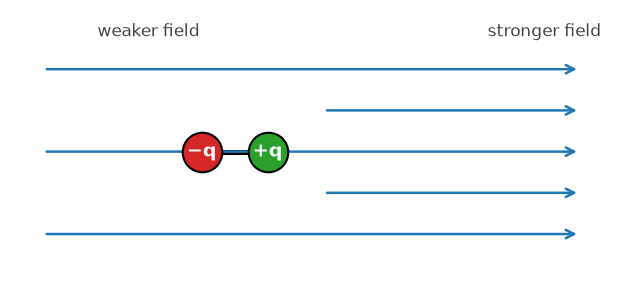
A dipole is placed in an electric field as shown. In which direction will it move?
Answer: (D) Towards the right as its potential energy will decrease. Answer: (d) Solution: A dipole in a non-uniform field experiences a net force toward the region of stronger field, moving so that its potential energy U = -p·E decreases.
- A.Towards the left as its potential energy will decrease
- B.Towards the right as its potential energy will increase
- C.Towards the left as its potential energy will increase
- D.Towards the right as its potential energy will decrease✓
Correct Answer
(D) Towards the right as its potential energy will decrease
Solution & Explanation
Answer: (d) Solution: A dipole in a non-uniform field experiences a net force toward the region of stronger field, moving so that its potential energy U = -p·E decreases. Per the figure this is toward the right. → option (d).
🎯
43,000+ questions in हिंदी & English · one-tap toggle
Open →📚Practice all NEET Physics PYQs chapter-wise →💡Don't get it? Learn the Electrostatic Potential And Capacitance concepts →Practice NEET 2021 Physics — free, with instant solutions
The app builds a daily goal from your weak topics and brings each question back just before you forget it — so what you solve today turns into marks on exam day.
More NEET PYQ solutions
PhysAn electric dipole with dipole moment 5 × 10⁻⁶ C·m is aligned with the direction of a uniform electric field of magnitude 4 × 10⁵ N/C. The dipole is then rotated through an angle of 60° with respect to the electric field. The change in the potential energy of the dipole is:PhysAssertion A: The potential (V) at any axial point, at 2m distance (r) from the centre of the dipole of dipole moment vector P of magnitude 4 × 10⁻⁶ Cm, is ±9 × 10³ V (Take 1/4πε₀ = 9 × 10⁹ SI units). Reason R: V = ±2P/(4πε₀ r²), where r is the distance of any axial point situated at 2m from the centre of the dipole.PhysAn electric dipole is placed as shown in the figure. The electric potential (in 10² V) at point P due to the dipole is (ε₀ = permittivity of free space and K = 1/(4πε₀)):PhysA short electric dipole has a dipole moment of 16 × 10⁻⁹ Cm. The electric potential due to the dipole at a point at a distance of 0.6 m from the centre of the dipole, situated on a line making an angle of 60 degrees with the dipole axis is: (1/4*π*eps0 = 9 × 10⁹ N M² / C²)PhysTwo identical charged conducting spheres A and B have their centres separated by a certain distance. Charge on each sphere is q and the force of repulsion between them is F. A third identical uncharged conducting sphere is brought in contact with sphere A first and then with B and finally removed from both. New force of repulsion between spheres A and B (radii negligible vs separation, treated as point charges) is best given as:PhysThe plates of a parallel plate capacitor are separated by d. Two slabs of different dielectric constant K1 and K2 with thickness 3d/8 and d/2 respectively are inserted in the capacitor. Due to this, the capacitance becomes two times larger than when there is nothing between the plates. If K1/K2 = 1.25, the value of K1 is:PhysA sphere of radius R is carved out of a uniform solid sphere of radius 2R (internally tangent, so its centre is at distance R from the big centre). The ratio of the moment of inertia of the small sphere to that of the remaining part, both about the Y-axis through the big sphere's centre, is:PhysThe Sun rotates once in 27 days. If it expanded to twice its present radius (uniform-density sphere, no external influence), its new period would be about: