
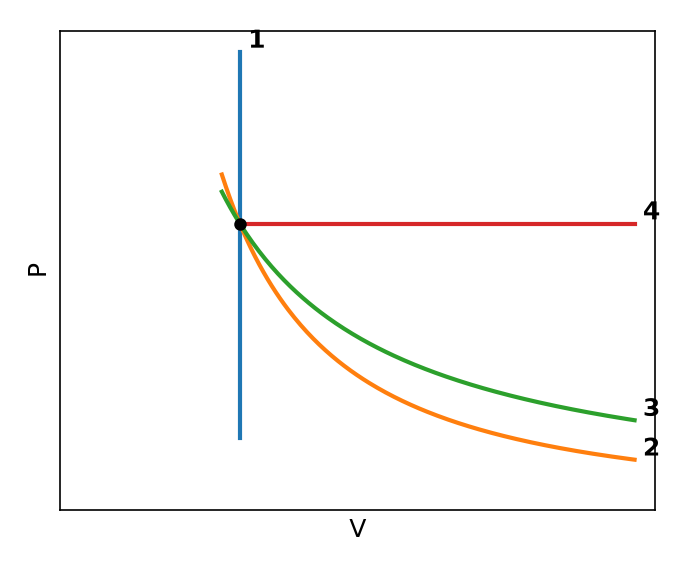
An ideal gas undergoes four different processes from the same initial state (see figure). The processes are adiabatic, isothermal, isobaric and isochoric. The curve which represents the adiabatic process among is
Answer: (B) . \textbf{Answer:} (b) \textbf{Solution:} From the common initial point on the - diagram, the four processes are distinguished by their slopes: Curve 1 is vertical (constant volume) isochoric.
- A.
- B.✓
- C.
- D.
Correct Answer
(B)
Solution & Explanation
\textbf{Answer:} (b) \textbf{Solution:} From the common initial point on the - diagram, the four processes are distinguished by their slopes: Curve 1 is vertical (constant volume) isochoric. Curve 4 is horizontal (constant pressure) isobaric. Curves 2 and 3 are falling curves. The isothermal follows const (slope ), while the adiabatic follows const (slope ). Since , the adiabatic curve is steeper than the isothermal. Therefore the steeper of the two falling curves, curve 2, is the \textbf{adiabatic} process, and curve 3 is isothermal. The answer is option (b).