
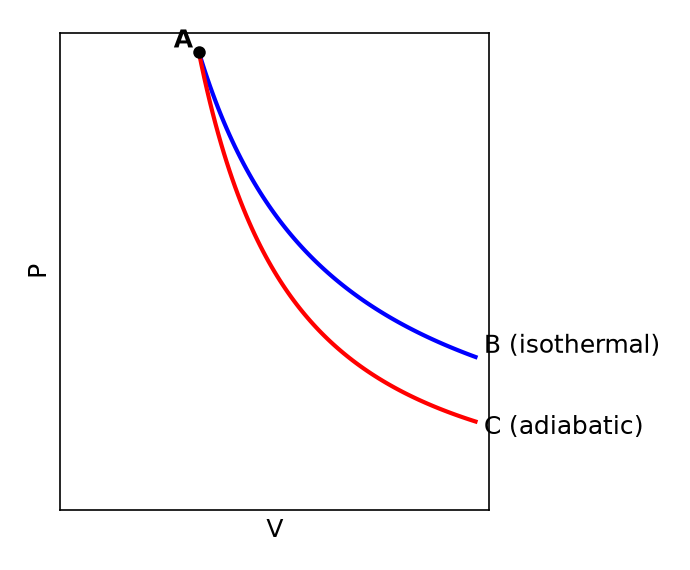
Reversible expansion of an ideal gas under isothermal and adiabatic conditions is shown in the figure, where is the isothermal expansion and is the adiabatic expansion, both starting from the common state . Which of the following options is NOT correct?
Answer: (D) . \textbf{Answer:} (d) \textbf{Solution:} Analyse each statement for the two reversible expansions starting from : (a) In a reversible isothermal expansion the gas absorbs heat, so entropy increases (); in a reversible adiabatic expansion .
- A.
- B.
- C.
- D.✓
Correct Answer
(D)
Solution & Explanation
\textbf{Answer:} (d) \textbf{Solution:} Analyse each statement for the two reversible expansions starting from : (a) In a reversible isothermal expansion the gas absorbs heat, so entropy increases (); in a reversible adiabatic expansion . Hence the entropy change in the isothermal case is greater: \textbf{correct}. (b) is isothermal, so the temperature is constant: : \textbf{correct}. (c) On the - diagram the adiabat is steeper and lies below the isotherm , so the area under (work in isothermal) is greater than the area under (work in adiabatic): : \textbf{correct}. (d) During an adiabatic \emph{expansion}, the gas does work at the expense of its internal energy, so its temperature \emph{falls}: . Therefore is \textbf{incorrect}. The statement that is NOT correct is (d).