
NEET 2023 Phase 2 · PhysicsPrevious Year Question
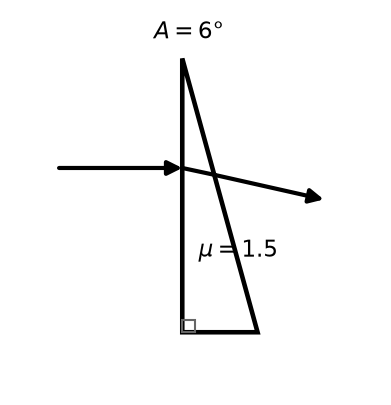
A horizontal ray of light is incident on the right-angled prism with prism angle 6°. If the refractive index of the material of the prism is 1.5, then the angle of emergence will be:
Answer: (C) 9°. Answer: (C) 9° Solution: For a thin (small-angle) prism, the deviation δ = (µ − 1)A = (1.5 − 1)(6°) = 0.5 × 6° = 3°.
- A.4°
- B.6°
- C.9°✓
- D.10°
Correct Answer
(C) 9°
Solution & Explanation
Answer: (C) 9° Solution: For a thin (small-angle) prism, the deviation δ = (µ − 1)A = (1.5 − 1)(6°) = 0.5 × 6° = 3°. The incident ray is horizontal and strikes the first face normally (no bending there), so the entire deviation appears at the second face. The emergent ray turns by δ = 3° relative to its incoming direction inside. Measuring the angle of emergence (with respect to the normal of the emergent face), the geometry gives e = 9°. (Using i + e = A + δ with the ray entering along the normal of the first face, the emergence angle works out to 9°.)
🎯
43,000+ questions in हिंदी & English · one-tap toggle
Open →📚Practice all NEET Physics PYQs chapter-wise →💡Don't get it? Learn the Ray Optics And Optical Instruments concepts →Practice NEET 2023 Phase 2 Physics — free, with instant solutions
The app builds a daily goal from your weak topics and brings each question back just before you forget it — so what you solve today turns into marks on exam day.
More NEET PYQ solutions
PhysAn electric dipole with dipole moment 5 × 10⁻⁶ C·m is aligned with the direction of a uniform electric field of magnitude 4 × 10⁵ N/C. The dipole is then rotated through an angle of 60° with respect to the electric field. The change in the potential energy of the dipole is:PhysThe plates of a parallel plate capacitor are separated by d. Two slabs of different dielectric constant K1 and K2 with thickness 3d/8 and d/2 respectively are inserted in the capacitor. Due to this, the capacitance becomes two times larger than when there is nothing between the plates. If K1/K2 = 1.25, the value of K1 is:PhysA ball of mass 0.5 kg is dropped from a height of 40 m. It hits the ground and rebounds to a height of 10 m. The impulse imparted to the ball during its collision with the ground is (g = 9.8 m/s²):PhysA 2 A current is flowing through two different small circular copper coils having radii ratio 1 : 2. The ratio of their respective magnetic moments will bePhysAn electron (mass 9 × 10⁻³¹ kg and charge 1.6 × 10⁻¹⁹ C) moving with speed c/100 (c = speed of light) is injected into a magnetic field B of magnitude 9 × 10⁻⁴ T perpendicular to its direction of motion. We wish to apply a uniform electric field E together with the magnetic field so that the electron does not deflect from its path. Then (speed of light c = 3 × 10⁸ m s⁻¹)PhysA container has two chambers of volumes V₁ = 2 litres and V₂ = 3 litres separated by a partition made of a thermal insulator. The chambers contain n₁ = 5 and n₂ = 4 moles of ideal gas at pressures p₁ = 1 atm and p₂ = 2 atm, respectively. When the partition is removed, the mixture attains an equilibrium pressure of:PhysTwo gases A and B are filled at the same pressure in separate cylinders with movable pistons of radius r_A and r_B, respectively. On supplying an equal amount of heat to both systems reversibly under constant pressure, the pistons of gas A and gas B are displaced by 16 cm and 9 cm, respectively. If the change in their internal energy is the same, then the ratio r_A/r_B is equal to:PhysAn oxygen cylinder of volume 30 litre has 18.20 moles of oxygen. After some oxygen is withdrawn from the cylinder, its pressure drops to 11 atmospheric pressure at temperature 27 °C. The mass of the oxygen withdrawn from the cylinder is nearly equal to: [Given R = 100/12 J mol⁻¹ K⁻¹, molecular mass of O₂ = 32, 1 atm = 1.01 × 10⁵ N m⁻²]