How many questions from Biotechnology: Principles and Processes in NEET?
2–3 questions from Biotechnology Principles & Processes appear in NEET every year (8–12 marks, ~4% of NEET Biology). High-yield: recombinant DNA technology steps, restriction enzymes (EcoRI, BamHI), PCR, gel electrophoresis, plasmid vs bacteriophage vectors, bioreactor types. Practice all 360 questions free in bilingual Hindi & English in the MedicNEET app.
Year-wise NEET Questions — Biotechnology: Principles and Processes
| Year | Questions | Marks |
|---|---|---|
| NEET 2016 | 7 | 28 |
| NEET 2017 | 3 | 12 |
| NEET 2018 | 2 | 8 |
| NEET 2019 | 9 | 36 |
| NEET 2020 | 6 | 24 |
| NEET 2021 | 6 | 24 |
| NEET 2022 | 5 | 20 |
| NEET 2023 | 8 | 32 |
| NEET 2024 | 2 | 8 |
| NEET 2025 | 5 | 20 |
| NEET 2026 | 9 | 36 |
Practise Biotechnology: Principles and Processes MCQs — Free
Every Biotechnology: Principles and Processes question format NEET uses, starting with the newest ReNEET 2026-style reasoning MCQs. Tap an option for the answer + NCERT explanation.
✨ Biotechnology: Principles and Processes — ReNEET 2026-Style Reasoning Questions
The newest, most exam-current format — reasoning-based questions modelled on ReNEET 2026. This is where NEET is heading; practise the pattern before the exam does.
- Q1. Why are traditional hybridisation techniques considered inferior to genetic engineering for creating desirable traits?
- Q2. Why is the process of cloning described as ‘making multiple identical copies’?
- Q3. Why is the presence of a single or limited restriction site essential in a cloning vector?
- Q4. Why can sticky ends form hydrogen bonds with complementary sequences?
- Q5. Why are exonucleases and endonucleases classified under nucleases?
- Q6. Why does insertion of a gene into the tetracycline resistance gene of pBR322 cause loss of tetracycline resistance?
- Q7. Why are primers essential in PCR?
- Q8. What would happen if no Ca²⁺ treatment is given during transformation?
- Q9. What is the role of lysozyme in DNA isolation from bacteria?
- Q10. Why is electrophoresis used before DNA elution?
You’ve practised 10 of 50 Biotechnology: Principles and Processes questions in this set.
Practise all 50 + every chapter — free app →📑 Biotechnology: Principles and Processes — NEET 2025 & 2026 Long-Form MCQs
The long, multi-statement questions that dominated NEET 2025 & 2026 — each covers 5-6 concepts at once, so they double as fast full-chapter revision.
- Q1. Which of the following statements about the European Federation of Biotechnology (EFB) definition of biotechnology are NOT correct? S1: The definition emphasizes the integration of natural science. S2: It limits the scope to only the use of whole organisms for biotechnological processes. S3: The EFB definition includes both traditional and modern molecular biotechnology. S4: It implies the production of products but specifically excludes services. S5: Molecular analogues are not considered part of the components mentioned in the definition.
- Q2. Match the entries in Column I with their corresponding descriptions or applications in Column II. Column I A. EcoRI B. Thermus aquaticus C. pBR322 D. Agrobacterium tumifaciens E. Ribonuclease Column II i. Source of thermostable DNA polymerase ii. A common E. coli cloning vector with multiple restriction sites iii. Restriction enzyme that recognises a specific palindromic sequence iv. Pathogen of dicot plants used to modify Ti plasmid for cloning v. Enzyme used to remove RNA during DNA isolation
- Q3. Which of the following statements regarding the essential features of a cloning vector are NOT correct? S1: An ideal cloning vector must possess a single recognition site for each of the commonly used restriction enzymes to simplify gene cloning. S2: The origin of replication (ori) is crucial as it controls the copy number of the linked alien DNA within the host cell. S3: Selectable markers enable the identification of recombinants by insertional inactivation, which always results in blue colonies. S4: Vectors like Ti plasmid of Agrobacterium tumifaciens have been modified into cloning vectors that are still pathogenic to plants but deliver genes of interest. S5: To ensure stable inheritance, the alien DNA must be part of a chromosome that has an origin of replication.
- Q4. Arrange the following steps in the correct sequential order for the production of a recombinant protein at a large scale: 1. Isolation of the desired DNA fragment. 2. Ligation of the DNA fragment into a cloning vector. 3. Transformation of a competent host cell with recombinant DNA. 4. Selection of transformed host cells. 5. Initial small-scale culturing of recombinant host cells. 6. Large-scale production of recombinant protein in a bioreactor. Which of the following sequences is correct?
You’ve practised 4 of 48 Biotechnology: Principles and Processes questions in this set.
Practise all 48 + every chapter — free app →🧩 Biotechnology: Principles and Processes — All-Format Questions — Match, Assertion-Reason, Statement & Image-Based
Every question format NEET uses — match-the-column, assertion-reason, statement-based, and image/diagram questions — not just plain MCQs. Each with an instant NCERT-referenced solution.
- Q1. Match the Column:
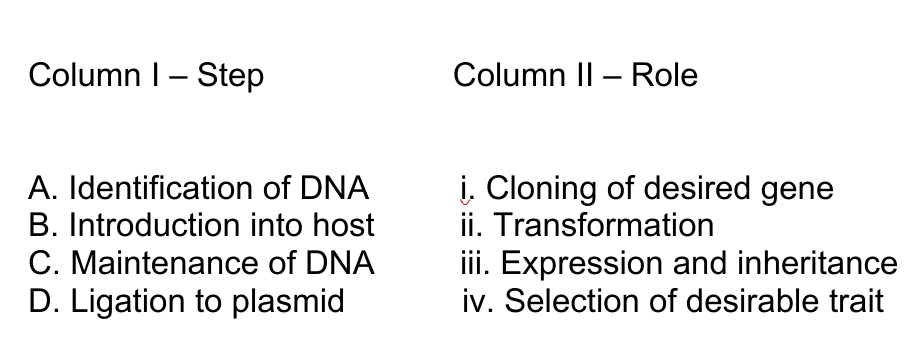
- Q2. Match the columns:
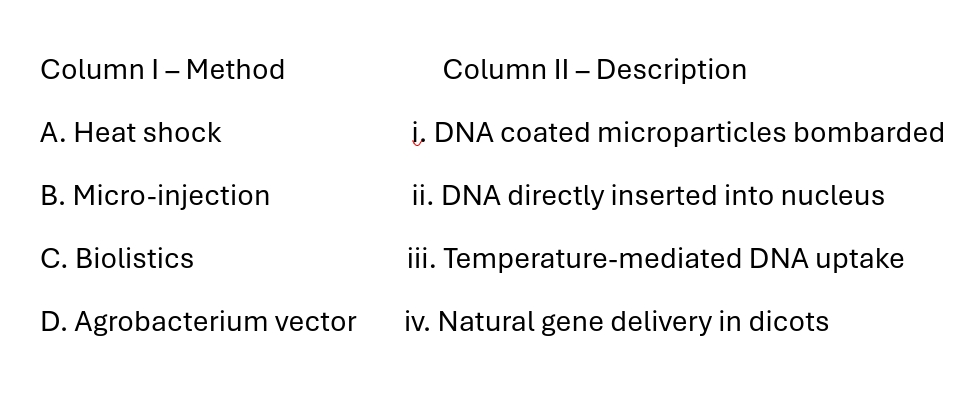
- Q3. Match the following components of recombinant DNA technology with their correct features/functions: Column I A. Hind II B. Plasmid of Salmonella typhimurium C. pBR322 vector D. Agrobacterium tumifaciens E. Biolistics (gene gun) Column II 1. Delivers T-DNA into dicot plant cells causing tumor formation (modified for gene transfer) 2. First restriction endonuclease discovered, cuts DNA at specific recognition sequence 3. Autonomously replicating extra-chromosomal DNA, used for cloning 4. High-velocity particles of gold/tungsten used to deliver DNA into plant cells 5. Loses tetracycline resistance after foreign DNA insertion, selected on ampicillin medium
- Q4. Match the technique with its purpose: Column I (Technique) A. PCR B. Electrophoresis C. Transformation D. Ligation Column II (Purpose) I. DNA uptake by host II. Joining DNA ends III. DNA amplification IV. Fragment separation
- Q5. Assertion (A): Genetic engineering allows the introduction of a single desirable gene without introducing undesirable genes. Reason (R): In traditional hybridisation, recombination always introduces a large number of genes simultaneously.
- Q6. Assertion (A): Cloning refers to making multiple identical copies of a DNA template. Reason (R): DNA replication occurs only when DNA is inserted into human chromosomes.
- Q7. Arrange the following steps of Polymerase Chain Reaction (PCR) in correct sequence: 1. Extension of primers by thermostable DNA polymerase (Taq polymerase) using supplied nucleotides 2. Denaturation of double-stranded DNA into single strands by heating 3. Repeated cycling of the three steps to achieve exponential amplification (~1 billion copies) 4. Annealing of primers to complementary sequences on single-stranded DNA templates
- Q8. Arrange the following steps in correct sequence for the formation of recombinant DNA by the action of restriction endonuclease enzyme EcoRI: 1. Cutting of DNA molecules at specific palindromic recognition sites 2. Binding of EcoRI to the DNA at its recognition sequence 3. Formation of sticky ends due to staggered cuts on opposite strands 4. Joining of DNA fragments using DNA ligase 5. Creation of recombinant DNA molecules composed of DNA from different sources
- Q9. Arrange the following steps involved in obtaining a foreign gene product through recombinant DNA technology in the correct sequence: 1. Insertion of alien DNA into a suitable cloning vector and its transfer into a host cell 2. Expression of the foreign gene under appropriate conditions to produce a target protein 3. Large-scale culture of recombinant host cells using bioreactors under optimal conditions 4. Extraction and purification of the desired protein using separation techniques 5. Multiplication of recombinant DNA inside the host cells
- Q10. Consider the following statements about genetic engineering and bioprocess engineering: 1. Genetic engineering is concerned with altering DNA or RNA and introducing it into host organisms to change their phenotype. 2. Bioprocess engineering provides sterile conditions to grow only desired microbes or eukaryotic cells in large quantities. 3. The three fundamental steps of genetic modification are: identifying desirable DNA, introducing it into the host, and ensuring its maintenance and inheritance. 4. Genetic engineering is mainly focused on maintaining sterile industrial conditions for large-scale product manufacture. 5. Bioprocess engineering is unrelated to the production of antibiotics, vaccines, or enzymes.
You’ve practised 10 of 240 Biotechnology: Principles and Processes questions in this set.
Practise all 240 + every chapter — free app →Sample NEET PYQs — Biotechnology: Principles and Processes
The taq polymerase enzyme is obtained from:
- A. Thermus aquaticus
- B. Thiobacillus ferroxidans
- C. Bacillus subtilis
- D. Pseudomonas putida
Explanation: Answer: (A) Thermus aquaticus Solution: Repeated PCR amplification requires a thermostable DNA polymerase (Taq polymerase) that stays active through the high-temperature denaturation step; NCERT states it is isolated from the bacterium Thermus aquaticus. Thiobacillus ferroxidans (bioleaching), Bacillus subtilis and Pseudomonas putida (the 'superbug') are unrelated to PCR enzymes. The 'thermostable' property is precisely why a thermophile source is needed. NCERT Reference: Ch 9, p.173, line(s) 10 — "polymerase (isolated from a bacterium, Thermus aquaticus), which"
Stirred-tank bioreactors have been designed for
- A. Purification of product
- B. Addition of preservatives to the product
- C. Availability of oxygen throughout the process
- D. Ensuring anaerobic conditions in the culture vessel
Explanation: Answer: (C) Availability of oxygen throughout the process Solution: In a stirred-tank bioreactor the stirrer (agitator) does two jobs: it mixes the contents evenly and it ensures oxygen is available throughout the vessel; air may also be bubbled (sparged) through. Aerobic microbial/cell cultures need a continuous oxygen supply, so the stirring design is meant to provide this, not anaerobic conditions. Purification and preservative addition belong to downstream processing, not the bioreactor itself. NCERT Reference: Ch 9, p.174, line(s) 4-5 — "mixing and oxygen availability throughout the bioreactor."
Which of the following restriction enzymes produces blunt ends?
- A. Sal I
- B. Eco RV
- C. Xho I
- D. Hind III
Explanation: Answer: (B) Eco RV Solution: Restriction enzymes that cut both strands exactly at the centre of the palindrome leave flush/blunt ends, while those that cut a little away from the centre (between the same two bases on opposite strands) leave single-stranded overhangs called sticky ends; EcoRV cuts at the centre giving blunt ends, whereas Sal I, Xho I and Hind III leave sticky (overhanging) ends. NCERT describes the sticky-end mechanism explicitly; the specific blunt-cutter EcoRV is an NCERT-extension example consistent with that mechanism (NCERT names EcoRI/Hind II/Hind III but not EcoRV by enzyme-specific cut, so cited line is the closest mechanistic anchor). NCERT Reference: Ch 9, p.167, line(s) 8-10 — "Restriction enzymes cut the strand of DNA a little away from the centre"
Which of the following is not a component of downstream processing?
- A. Separation
- B. Purification
- C. Preservation
- D. Expression
Explanation: Answer: (D) Expression Solution: After the biosynthetic (fermentation) stage, the product is taken through separation and purification, followed by formulation with preservatives and quality control — these steps are collectively called downstream processing. Separation and purification are explicitly named as downstream processing. 'Expression' of the foreign gene is part of obtaining the gene product (an upstream/biosynthetic event), not downstream processing, so (D) is the odd one out. NCERT Reference: Ch 9, p.175, line(s) 45 — "include separation and purification, which are collectively referred to as downstream processing"
Frequently Asked Questions — Biotechnology: Principles and Processes NEET
How many questions from Biotechnology: Principles and Processes come in NEET?+
How many Biotechnology: Principles and Processes questions does MedicNEET have?+
What is the NEET weightage of Biotechnology: Principles and Processes?+
Are Biotechnology: Principles and Processes questions available in Hindi?+
Are Biotechnology: Principles and Processes questions NCERT-based?+
Which is the best app for Biotechnology Principles and Processes NEET preparation?+
How to score full marks in Biotechnology: Principles and Processes in NEET?+
What are ReNEET 2026-style reasoning Biotechnology: Principles and Processes questions?+
Are these Biotechnology: Principles and Processes MCQs free to practise?+
Practise Biotechnology: Principles and Processes — Free
All 338+ Biotechnology: Principles and Processes questions · ReNEET 2026 reasoning + every format · Bilingual Hindi & English · NCERT-mapped explanations · No paywall
📲 Download MedicNEET App (Free)