How many questions from Molecular Basis of Inheritance in NEET?
4–5 questions from Molecular Basis of Inheritance appear in NEET every year (16–20 marks, ~8% of NEET Biology — the single highest-weightage chapter). High-yield: semi-conservative DNA replication, transcription (template strand), translation (start/stop codons), lac operon, HGP, DNA fingerprinting. Practice all 807 MBI questions free in bilingual Hindi & English in the MedicNEET app.
Year-wise NEET Questions — Molecular Basis of Inheritance
| Year | Questions | Marks |
|---|---|---|
| NEET 2016 | 12 | 48 |
| NEET 2017 | 7 | 28 |
| NEET 2018 | 5 | 20 |
| NEET 2019 | 14 | 56 |
| NEET 2020 | 4 | 16 |
| NEET 2021 | 8 | 32 |
| NEET 2022 | 6 | 24 |
| NEET 2023 | 16 | 64 |
| NEET 2024 | 6 | 24 |
| NEET 2025 | 10 | 40 |
| NEET 2026 | 7 | 28 |
Practise Molecular Basis of Inheritance MCQs — Free
Every Molecular Basis of Inheritance question format NEET uses, starting with the newest ReNEET 2026-style reasoning MCQs. Tap an option for the answer + NCERT explanation.
✨ Molecular Basis of Inheritance — ReNEET 2026-Style Reasoning Questions
The newest, most exam-current format — reasoning-based questions modelled on ReNEET 2026. This is where NEET is heading; practise the pattern before the exam does.
- Q1. What role do hydrogen bonds play in the DNA double helix?
- Q2. What would happen if electrophoresis was skipped in the DNA fingerprinting process?
- Q3. Why did Frederick Griffith conclude that a ‘transforming principle’ existed in his experiments with Streptococcus pneumoniae?
- Q4. RNA is considered unstable mainly because:
- Q5. 6. Why is DNA replication referred to as semi-conservative?
- Q6. Why is prokaryotic mRNA often polycistronic?
- Q7. Which of the following explains why RNA is the first product of gene expression?
- Q8. Which property ensures that the same codon codes for the same amino acid across most organisms?
- Q9. How does energy expenditure ensure fidelity during elongation?
- Q10. What would be the consequence if overlapping sequences were missed during alignment?
You’ve practised 10 of 142 Molecular Basis of Inheritance questions in this set.
Practise all 142 + every chapter — free app →📑 Molecular Basis of Inheritance — NEET 2025 & 2026 Long-Form MCQs
The long, multi-statement questions that dominated NEET 2025 & 2026 — each covers 5-6 concepts at once, so they double as fast full-chapter revision.
- Q1. Which of the following statements accurately reflect Chargaff's rules and their implications for a double-stranded DNA molecule? S1: The ratios of (Adenine + Thymine) to (Guanine + Cytosine) are constant and equal to one for all double-stranded DNA molecules. S2: If a double-stranded DNA sample has 15% Guanine, then the percentage of Adenine in that sample will be 35%. S3: Chargaff's rule of A/T = 1 and G/C = 1 is also observed in viral genomes that contain single-stranded DNA. S4: The observation that a purine always pairs with a pyrimidine helps maintain the uniform diameter of the DNA double helix. S5: The total amount of purines is always equal to the total amount of pyrimidines in any double-stranded DNA, as a direct consequence of complementary base pairing.
- Q2. Match the following components with their characteristics and functions in DNA fingerprinting: Column I (Component) A. VNTR B. Restriction endonuclease C. Nitrocellulose/Nylon membrane D. Autoradiography Column II (Characteristic/Nature) I. Varying copy numbers II. Enzyme III. Synthetic filter IV. Photographic technique Column III (Function in DNA Fingerprinting) P. Cleaves DNA at specific sites Q. Provides a unique banding pattern due to polymorphism R. Visualizes hybridised radioactive bands S. Medium for transferring DNA fragments Which of the following represents the correct match?
- Q3. Which of the following statements correctly support the semi-conservative mode of DNA replication as established by experimental evidence? S1: In Meselson and Stahl’s experiment, the appearance of DNA with intermediate density after one generation in ¹⁴N medium was key evidence. S2: The experiment by Taylor and colleagues using radioactive thymidine in Vicia faba chromosomes further confirmed semi-conservative replication in eukaryotes. S3: If DNA replication were conservative, a single band of hybrid density would be observed after two generations in a light medium. S4: The discontinuous synthesis of one of the DNA strands necessitates the action of DNA ligase, which is characteristic of semi-conservative replication. S5: The phenomenon of complementary base pairing suggests the possibility of a copying mechanism for genetic material, supporting the semi-conservative model.
- Q4. Match the following scientists/research teams in Column I with their significant experimental contributions/methods in Column II, and the major concept elucidated in Column III, as discussed in the context of molecular biology. Column I A. Hershey and Chase B. Marshall Nirenberg C. Meselson and Stahl D. Har Gobind Khorana Column II 1.Cell-free system for protein synthesis 2.Bacteriophage infection experiments 3.Chemical synthesis of RNA polymers 4.Heavy nitrogen (¹⁵N) isotope labeling Column III I. DNA as the genetic material II. Deciphering the genetic code III. Semiconservative DNA replication IV. Defined RNA sequences for codon assignment
You’ve practised 4 of 145 Molecular Basis of Inheritance questions in this set.
Practise all 145 + every chapter — free app →🧩 Molecular Basis of Inheritance — All-Format Questions — Match, Assertion-Reason, Statement & Image-Based
Every question format NEET uses — match-the-column, assertion-reason, statement-based, and image/diagram questions — not just plain MCQs. Each with an instant NCERT-referenced solution.
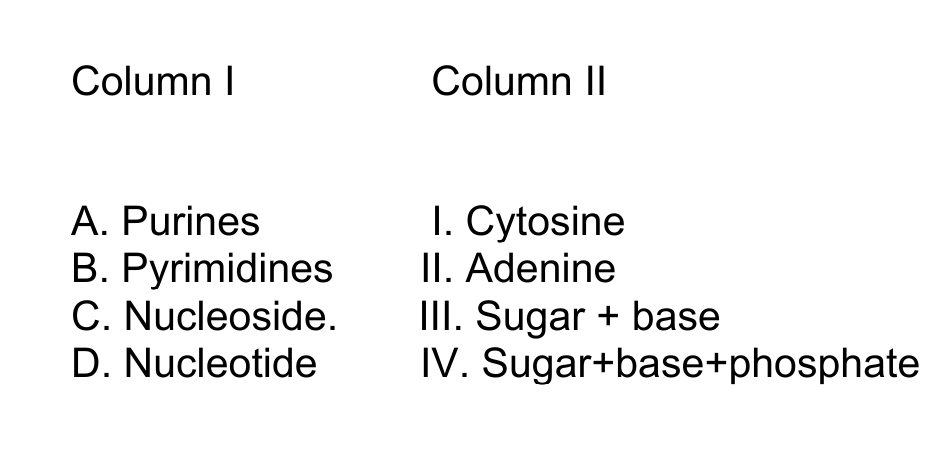
- Q1. Match the Column:
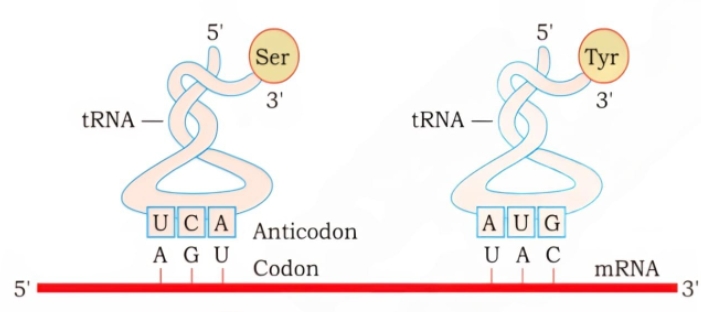
- Q2. According to the figure, the codon ‘AUG’ on mRNA pairs with which anticodon on tRNA and codes for which amino acid?
- Q3. Match the following with their correct outcomes or properties of the genetic code: Column I A. Amino acid sequence: Met–Phe–Phe–Phe–Phe–Phe–Phe B. mRNA sequence: AUG UUU UUC UUC UUU UUU GUG C. Property of genetic code: More than one codon can code for the same amino acid D. Property of genetic code: Code is read in a continuous manner without punctuation Column II 1. Degeneracy of the genetic code 2. Contiguous (commaless) nature of the code 3. mRNA sequence: AUG UUU UUC UUC UUU UUU GUG 4. Amino acid sequence: Met–Phe–Phe–Phe–Phe–Phe–Phe
- Q4. Match the following features with their details regarding the Human Genome Project (HGP): Column I A. Total base pairs sequenced B. Estimated number of genes C. Chromosome 1 gene count D. Chromosome Y gene count E. Percentage of genome coding for proteins Column II 1. ~20,000–25,000 genes 2. ~3 × 10⁹ base pairs 3. ~2968 genes 4. ~231 genes 5. <2% of total genome
- Q5. Assertion (A): In DNA, the amount of purines equals pyrimidines. Reason (R): Chargaff’s rule states that A pairs with T and G with C.
- Q6. Assertion (A): DNA is a polymer of nucleotides. Reason (R): Nucleotides are composed of nitrogenous base, pentose sugar, and phosphate group.
- Q7. Arrange the following steps of DNA replication in prokaryotes (E. coli) in the correct chronological order: 1. Semi-conservative daughter DNA molecules are formed. 2. Continuous synthesis occurs on leading strand and discontinuous synthesis on lagging strand. 3. DNA-dependent DNA polymerase adds nucleotides in the 5’→3’ direction. 4. Joining of Okazaki fragments by DNA ligase. 5. Unwinding of DNA helix at the origin of replication forms replication fork.
- Q8. Consider the following statements regarding regulation of gene expression: 1. Regulation of gene expression can occur at multiple levels: transcription, translation, and post-translation. 2. In prokaryotes, gene regulation is usually at the transcriptional level, as seen in the lac operon. 3. In eukaryotes, regulation can involve chromatin structure, transcription factors, splicing, and RNA processing. 4. Gene expression is always constitutive and cannot be switched on or off depending on cellular needs. (Wrong) 5. Regulation ensures that proteins are produced only when required, thus conserving energy and resources.
- Q9. Arrange the following key steps of Hershey and Chase’s experiment in the correct chronological sequence: 1. Radioactive phages were allowed to infect E. coli bacteria. 2. Some viruses were grown in medium containing radioactive sulfur (³⁵S) → labeled proteins. 3. Some viruses were grown in medium containing radioactive phosphorus (³²P) → labeled DNA. 4. After infection, phage coats were removed by blending and separated by centrifugation. 5. Bacteria infected with ³²P-labeled phages became radioactive, showing DNA entered cells.
- Q10. Consider the following statements regarding the salient features of the Double-helix structure of DNA: 1. DNA is made of two polynucleotide chains where the backbone is constituted by sugar-phosphate and the bases project inside. 2. The two chains have anti-parallel polarity, i.e., one runs 5’→3’ and the other 3’→5’. 3. Adenine forms three hydrogen bonds with Thymine, while Guanine forms two hydrogen bonds with Cytosine. 4. The two chains are coiled in a right-handed fashion with a pitch of 3.4 nm and 10 base pairs per turn. 5. Base pairs are stacked over one another, and along with H-bonds, this stacking provides stability to the helical structure.
You’ve practised 10 of 514 Molecular Basis of Inheritance questions in this set.
Practise all 514 + every chapter — free app →Sample NEET PYQs — Molecular Basis of Inheritance
Which of the following rRNAs acts as structural RNA as well as ribozyme in bacteria?
- A. 5 S rRNA
- B. 18 S rRNA
- C. 23 S rRNA
- D. 5.8 S rRNA
Explanation: Answer: (C) 23 S rRNA. Solution: In bacteria the 23S rRNA of the large ribosomal subunit is both a structural component and the catalyst (ribozyme) for peptide bond formation. NCERT Ch 5, p.99, lines 19-20: "The ribosome also acts as a catalyst (23S rRNA in bacteria is the enzyme- ribozyme) for the formation of peptide bond."
Which of the following statements about the lac-operon is correct?
- A. A. Gene $i$ is constitutively expressed
- B. B. Lactose activates the repressor to bind to the operator
- C. C. Genes $i$, $z$, $y$ and $a$ share a single common promoter
- D. D. Galactose can act as an inducer of the lac operon
Explanation: Correct Answer (A): Gene $i$ is constitutively expressed The regulatory gene $i$ is expressed constitutively (always on) to make the repressor. Lactose (its isomer allolactose), not galactose, is the inducer and it INACTIVATES the repressor (so the repressor binds operator only in the ABSENCE of lactose). The structural genes $z$, $y$, $a$ share a promoter, but gene $i$ has its own promoter. So only statement (1) is correct.
The correct statement regarding RNA and DNA, respectively is:
- A. The sugar component in RNA is arabinose and the sugar component in DNA is 2'-deoxyribose.
- B. The sugar component in RNA is ribose and the sugar component in DNA is 2'-deoxyribose.
- C. The sugar component in RNA is arabinose and the sugar component in DNA is ribose.
- D. The sugar component in RNA is 2'-deoxyribose and the sugar component in DNA is arabinose.
Explanation: Answer: (B) The sugar component in RNA is ribose and the sugar component in DNA is 2'-deoxyribose. Solution: Both nucleic acids contain a pentose sugar in their nucleotides — ribose in RNA and deoxyribose (2'-deoxyribose) in DNA; the only difference is the –OH versus –H at the 2' carbon. Arabinose is not a component of either. NCERT Ch 5, p.80, lines 20-21: "a nitrogenous base, a pentose sugar (ribose in case of RNA, and deoxyribose for DNA), and a phosphate group."
Which one of the following is the starter codon?
- A. AUG
- B. UGA
- C. UAA
- D. UAG
Explanation: Answer: (A) AUG. Solution: AUG is the initiator (start) codon and also codes for methionine; UGA, UAA and UAG are the three stop (terminator) codons. NCERT Ch 5, p.96, lines 22-24: "AUG has dual functions. It codes for Methionine (met), and it also act as initiator codon. UAA, UAG, UGA are stop terminator codons."
Frequently Asked Questions — Molecular Basis of Inheritance NEET
How many questions from Molecular Basis of Inheritance come in NEET?+
How many Molecular Basis of Inheritance questions does MedicNEET have?+
What is the NEET weightage of Molecular Basis of Inheritance?+
Are Molecular Basis of Inheritance questions available in Hindi?+
Are Molecular Basis of Inheritance questions NCERT-based?+
What are ReNEET 2026-style reasoning Molecular Basis of Inheritance questions?+
Are these Molecular Basis of Inheritance MCQs free to practise?+
Practise Molecular Basis of Inheritance — Free
All 801+ Molecular Basis of Inheritance questions · ReNEET 2026 reasoning + every format · Bilingual Hindi & English · NCERT-mapped explanations · No paywall
📲 Download MedicNEET App (Free)