
Sacred Groves and Protected Areas — Meghalaya, Rajasthan, Western Ghats, MP
✅ Asked in NEET 2024Identify the place(s) from the following where sacred groves are not found: (NEET 2024)
Identify the place(s) from the following where sacred groves are not found: (NEET 2024)
Match the List-I with List-II: (NEET 2022 Phase 2) List – I (a) Sacred groves (b) Zoological park (c) Nile perch (d) Amazon forest List – II (i) Alien species (ii) Release of large quantity of oxygen (iii) Ex-situ conservation (iv) Khasi Hills in Meghalaya
All of the following are included in ex situ conservation except: (NEET 2018)
Answer & NCERT explanation
Correct answer: B — C only
Without seeing the specific options A, B, C, D in the image/map, this question asks about places where sacred groves are NOT found. Sacred groves are traditional forest patches conserved by local communities for religious/cultural reasons, typically found in regions like Western Ghats, Meghalaya, Rajasthan. The answer C only suggests a specific location lacks sacred groves.
Read more NCERT concept on the PYQ
In India, ecologically unique and biodiversity-rich regions are legally protected as biosphere reserves, national parks and sanctuaries. India now has 14 biosphere reserves, 90 national parks and 448 wildlife sanctuaries. India has also a history of religious and cultural traditions that emphasised protection of nature. In many cultures, tracts of forest were set aside, and all the trees and wildlife within were venerated and given total protection. Such sacred groves are found in Khasi and Jaintia Hills in Meghalaya, Aravalli Hills of Rajasthan, Western Ghat regions of Karnataka and Maharashtra and the Sarguja, Chanda and Bastar areas of Madhya Pradesh. In Meghalaya, the sacred groves are the last refuges for a large number of rare and threatened plants.
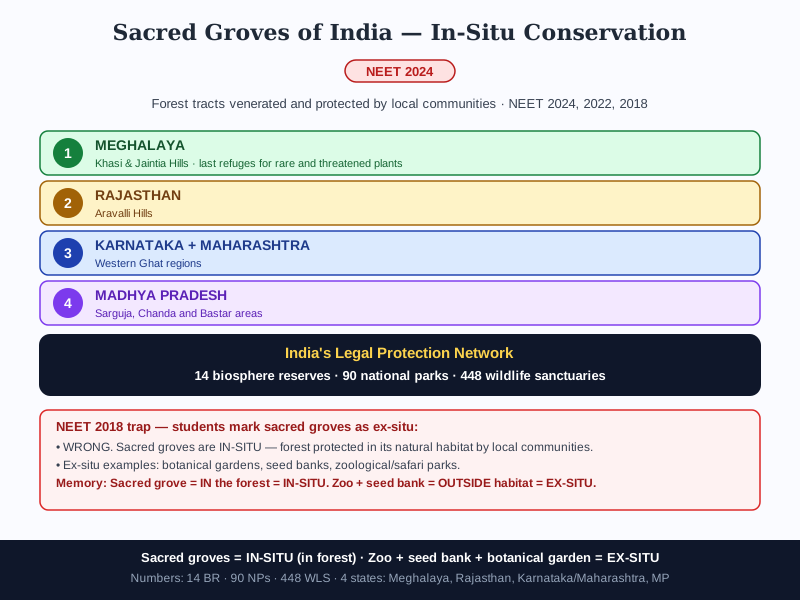
India protects its ecologically unique and biodiversity-rich regions legally as biosphere reserves, national parks and wildlife sanctuaries — currently 14 biosphere reserves, 90 national parks and 448 wildlife sanctuaries. Alongside this legal framework, India has a cultural tradition of conservation: sacred groves are forest tracts venerated and given total protection by local communities for religious reasons. NCERT examples are the Khasi and Jaintia Hills (Meghalaya), Aravalli Hills (Rajasthan), Western Ghat regions of Karnataka and Maharashtra, and the Sarguja, Chanda and Bastar areas of Madhya Pradesh. In Meghalaya, sacred groves are the LAST REFUGES for many rare and threatened plant species.
Sacred groves are IN-SITU conservation (protection within natural habitat) — NEET 2018 explicitly asked which option was NOT ex-situ and tested precisely this. NEET 2022 paired sacred groves with Khasi Hills, Meghalaya in a matching question. Students confuse sacred groves with zoological parks, botanical gardens and seed banks — these three are ex-situ. The four-state list (Meghalaya, Rajasthan, Karnataka/Maharashtra, MP) is directly testable; states absent from this list are valid trap options.
Sacred groves are an example of ex-situ conservation, similar to botanical gardens and seed banks.
Sacred groves are IN-SITU conservation — forest tracts protected in their natural habitat by local communities for religious/cultural reasons.
Sacred grove = IN the forest = IN-SITU. Zoo + botanical garden + seed bank = OUTSIDE habitat = EX-SITU.
- India: 14 biosphere reserves, 90 national parks, 448 wildlife sanctuaries (NCERT exact numbers).
- Sacred groves located in: Khasi/Jaintia Hills (Meghalaya), Aravalli Hills (Rajasthan), Western Ghats (Karnataka/Maharashtra), Sarguja/Chanda/Bastar (MP).
- Meghalaya sacred groves = last refuges for rare and threatened plants.
- Sacred groves = in-situ conservation; zoological parks, seed banks, botanical gardens = ex-situ.
Consider the following statements about India's biodiversity-rich regions and sacred groves: S1: India has 14 biosphere reserves, 90 national parks and 448 wildlife sanctuaries. S2: Sacred groves are an example of ex-situ conservation similar to botanical gardens. S3: Sacred groves are found in the Khasi and Jaintia Hills of Meghalaya and the Aravalli Hills of Rajasthan. S4: In Meghalaya, sacred groves are the last refuges for many rare and threatened plant species. S5: Sarguja, Chanda and Bastar areas of Madhya Pradesh are home to sacred groves.
View bonus solution & explanation
Correct answer: B — S1, S3, S4 and S5
S1 CORRECT: NCERT gives exactly 14 biosphere reserves, 90 national parks, 448 wildlife sanctuaries. S2 WRONG: Sacred groves are IN-SITU conservation (protection within natural habitat), not ex-situ — NEET 2018 directly tested this as the EXCEPTION among ex-situ options. S3 CORRECT: Khasi/Jaintia Hills (Meghalaya) and Aravalli Hills (Rajasthan) are NCERT-listed sacred grove sites. S4 CORRECT: Meghalaya sacred groves are explicitly described as last refuges for rare and threatened plants. S5 CORRECT: Sarguja, Chanda and Bastar in MP are NCERT-listed sites.
What is Sacred Groves and Protected Areas?
What did NEET 2024 ask on Sacred Groves and Protected Areas?
What is the most common NEET trap on Sacred Groves and Protected Areas?
How do you remember Sacred Groves and Protected Areas for NEET?
What are the key components of Sacred Groves and Protected Areas?
Through deep analysis of NEET and NTA, 176 of the 180 ReNEET 2026 (June 21) questions were already in the MedicNEET question bank before the exam.
176/180MedicNEET's Biology question bank is built from the same NCERT lines NTA picks repeatedly. Not random MCQs — questions crafted exactly like NTA crafts them.
You just learned this concept. The free app turns it into a daily goal built from your weak topics and brings it back just before you forget it — using active recall and spaced repetition — so it stays till exam day.