
G.N. Ramachandran — Collagen Triple Helix (1954) and Ramachandran Plot
📚 Practice ConceptG.N. RAMACHANDRAN, an outstanding figure in the field of protein structure, was the founder of the 'Madras school' of conformational analysis of biopolymers. His discovery of the triple helical structure of collagen published in Nature in 1954 and his analysis of the allowed conformations of proteins through the use of the 'Ramachandran plot' rank among the most outstanding contributions in structural biology. He was born on October 8, 1922, in a small town, not far from Cochin on the southwestern coast of India. His father was a professor of mathematics at a local college and thus had considerable influence in shaping Ramachandran's interest in mathematics. After completing his school years, Ramachandran graduated in 1942 as the top-ranking student in the B.Sc. (Honors) Physics course of the University of Madras. He received a Ph.D. from Cambridge University in 1949. While at Cambridge, Ramachandran met Linus Pauling and was deeply influenced by his publications on models of the α-helix and β-sheet structures that directed his attention to solving the structure of collagen. He passed away at the age of 78, on April 7, 2001.
G.N. Ramachandran discovered the α-helix structure of proteins and published it in Nature in 1954.
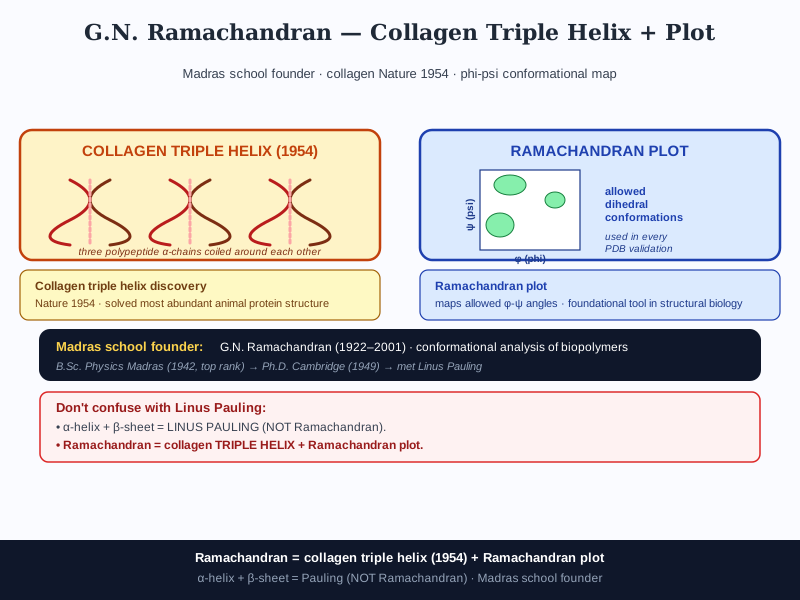
Ramachandran discovered the TRIPLE HELICAL STRUCTURE OF COLLAGEN (Nature, 1954). The α-helix was Linus Pauling's discovery (Pauling influenced Ramachandran).
Ramachandran = COLLAGEN triple helix (1954) + Ramachandran plot. Pauling = α-helix + β-sheet. Don't reverse the two.
- G.N. Ramachandran (1922-2001) founded the 'Madras school' of conformational analysis of biopolymers.
- Discovery: triple helical structure of COLLAGEN, published in Nature in 1954.
- Ramachandran plot maps allowed phi-psi conformations of proteins — universal in structural biology.
- Linus Pauling (NOT Ramachandran) discovered the α-helix and β-sheet; Pauling influenced Ramachandran's work.
Consider the following statements: 1. Reductionist Biology explains the molecular basis of physiological processes and even abnormal processes in diseased conditions. 2. The physico-chemical approach involves studying cell-free systems to describe processes in molecular terms. 3. G.N. Ramachandran discovered the α-helix structure of proteins and published it in Nature in 1954. 4. The Ramachandran plot, used to study allowed conformations of proteins, is one of his outstanding contributions. 5. He was deeply influenced by Linus Pauling's work on α-helix and β-sheet structures during his Ph.D. at Cambridge.
View bonus solution & explanation
Correct answer: A — Statements 1, 2, 4 and 5 are correct
1 CORRECT: Reductionist Biology explains molecular basis of both physiological and abnormal/disease processes. 2 CORRECT: Physico-chemical approach uses cell-free systems for molecular-level investigation. 3 WRONG: Ramachandran did NOT discover the α-helix — that was LINUS PAULING. Ramachandran discovered the TRIPLE HELICAL structure of COLLAGEN (Nature, 1954). 4 CORRECT: Ramachandran plot is one of his outstanding contributions. 5 CORRECT: He met Pauling at Cambridge and was deeply influenced by Pauling's α-helix/β-sheet work. Correct: 1, 2, 4, 5 → option A.
What is G.N. Ramachandran?
What did NEET previous years ask on G.N. Ramachandran?
What is the most common NEET trap on G.N. Ramachandran?
How do you remember G.N. Ramachandran for NEET?
What are the key components of G.N. Ramachandran?
Through deep analysis of NEET and NTA, 176 of the 180 ReNEET 2026 (June 21) questions were already in the MedicNEET question bank before the exam.
176/180MedicNEET's Biology question bank is built from the same NCERT lines NTA picks repeatedly. Not random MCQs — questions crafted exactly like NTA crafts them.
You just learned this concept. The free app turns it into a daily goal built from your weak topics and brings it back just before you forget it — using active recall and spaced repetition — so it stays till exam day.