
Mesosomes — Plasma Membrane Extensions in Bacteria for Cell Wall, DNA
✅ Asked in NEET 2024Cell wall formation in bacteria is facilitated by:
Cell wall formation in bacteria is facilitated by:
Mesosome in a cell is a: NEET 2024
Given below are two statements: Statement I: In bacteria, the mesosomes are formed by extensions of the plasma membrane. Statement II: The mesosomes in bacteria help in DNA replication and cell wall formation. NEET 2023
Answer & NCERT explanation
Correct answer: D — Mesosomes
Mesosomes are specialized membranous structures in bacterial cells formed by invaginations of the plasma membrane. They play a crucial role in cell wall formation by providing sites for peptidoglycan synthesis and septum formation during cell division. According to NCERT, mesosomes also assist in DNA replication and respiratory processes. Ribosomes synthesize proteins, centrosomes are absent in bacteria, and Golgi apparatus is found only in eukaryotes.
Read more NCERT concept on the PYQ
A special membranous structure is the mesosome which is formed by the extensions of plasma membrane into the cell. These extensions are in the form of vesicles, tubules and lamellae. They help in cell wall
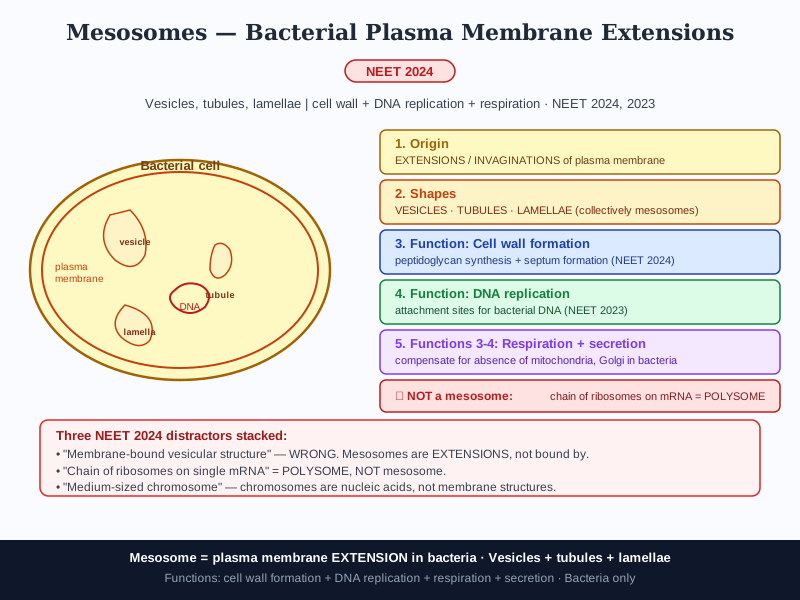
MESOSOMES are SPECIAL MEMBRANOUS STRUCTURES in BACTERIAL (prokaryotic) cells, formed by EXTENSIONS or INVAGINATIONS of the PLASMA MEMBRANE into the cell. These extensions appear as VESICLES, TUBULES and LAMELLAE. Mesosomes help in: (1) CELL WALL FORMATION — providing sites for peptidoglycan synthesis and septum formation during cell division; (2) DNA REPLICATION — providing attachment sites for bacterial DNA; (3) RESPIRATORY PROCESSES — housing some respiratory enzymes; and (4) SECRETION. Because bacteria lack the membrane-bound organelles of eukaryotes, mesosomes serve multiple membrane-dependent functions that eukaryotes assign to mitochondria, Golgi, and ER.
Three NEET tests in three consecutive years: NEET 2024 (twice) and NEET 2023 all asked about mesosomes. Key facts: (1) Mesosomes are EXTENSIONS of the plasma membrane — NOT separate membrane-bound vesicles, NOT polyribosomes, NOT chromosomes. (2) They FACILITATE CELL WALL FORMATION in bacteria — NEET 2024 direct answer. (3) Functions include DNA replication AND cell wall formation (NEET 2023 — both statements correct). Mesosomes exist ONLY in prokaryotes (bacteria). Don't confuse mesosomes with eukaryotic organelles or with ribosomes/polysomes.
Mesosomes are membrane-bound vesicular structures or chains of ribosomes attached to mRNA.
Mesosomes are EXTENSIONS of the PLASMA MEMBRANE (invaginations) in bacterial cells. NOT vesicles, NOT polyribosomes, NOT chromosomes.
Mesosome = plasma membrane EXTENSION (in bacteria). Functions: cell wall formation + DNA replication + respiration + secretion. Prokaryote-only.
- Mesosomes = special membranous structures in bacteria; formed by EXTENSIONS/INVAGINATIONS of plasma membrane.
- Appear as vesicles, tubules, and lamellae projecting into the cell.
- Functions: cell wall formation, DNA replication, respiration, secretion (multi-functional in bacteria).
- EXCLUSIVELY prokaryotic — eukaryotes don't have mesosomes (they have ER, Golgi, mitochondria instead).
Consider the following statements about mesosomes: S1: Mesosomes are special structures formed by extension of the plasma membrane in bacterial cells. S2: Mesosomes appear as vesicles, tubules and lamellae projecting into the cell. S3: Mesosomes help in cell wall formation by providing sites for peptidoglycan synthesis. S4: Mesosomes are chains of many ribosomes attached to a single mRNA in bacterial cells. S5: Mesosomes assist in DNA replication by providing attachment sites for bacterial DNA.
View bonus solution & explanation
Correct answer: B — S1, S2, S3 and S5
S1 CORRECT: NEET 2024 explicit — mesosomes are formed by plasma membrane extension. S2 CORRECT: Appear as vesicles, tubules, lamellae (NCERT). S3 CORRECT: NEET 2024 explicit — mesosomes facilitate cell wall formation. S4 WRONG: That description (chain of ribosomes on a single mRNA) defines POLYRIBOSOMES or POLYSOMES — NOT mesosomes. NEET 2024 placed this exact distractor. S5 CORRECT: NEET 2023 confirms mesosomes help DNA replication and cell wall formation.
What is Mesosomes?
What did NEET 2024 ask on Mesosomes?
What is the most common NEET trap on Mesosomes?
How do you remember Mesosomes for NEET?
What are the key components of Mesosomes?
Through deep analysis of NEET and NTA, 176 of the 180 ReNEET 2026 (June 21) questions were already in the MedicNEET question bank before the exam.
176/180MedicNEET's Biology question bank is built from the same NCERT lines NTA picks repeatedly. Not random MCQs — questions crafted exactly like NTA crafts them.
You just learned this concept. The free app turns it into a daily goal built from your weak topics and brings it back just before you forget it — using active recall and spaced repetition — so it stays till exam day.