
Inclusion Bodies — Reserve Material Free in Prokaryotic Cytoplasm
✅ Asked in NEET 2020Which of the following statements about inclusion bodies is incorrect? NEET 2020
Which of the following statements about inclusion bodies is incorrect? NEET 2020
Answer & NCERT explanation
Correct answer: D — These are involved in ingestion of food particles
Option d is incorrect because inclusion bodies are NOT involved in ingestion of food particles. According to NCERT, inclusion bodies are reserve materials like glycogen, starch, or lipids that lie free in the cytoplasm without membrane boundaries. Food ingestion is carried out by specialized structures like pseudopodia in amoeba or food vacuoles, not by inclusion bodies which only store nutrients.
Read more NCERT concept on the PYQ
Inclusion bodies: Reserve material in prokaryotic cells are stored in the cytoplasm in the form of inclusion bodies. These are not bound by any membrane system and lie free in the cytoplasm, e.g., phosphate granules, cyanophycean granules and glycogen granules. Gas vacuoles are found in blue green and purple and green photosynthetic bacteria.
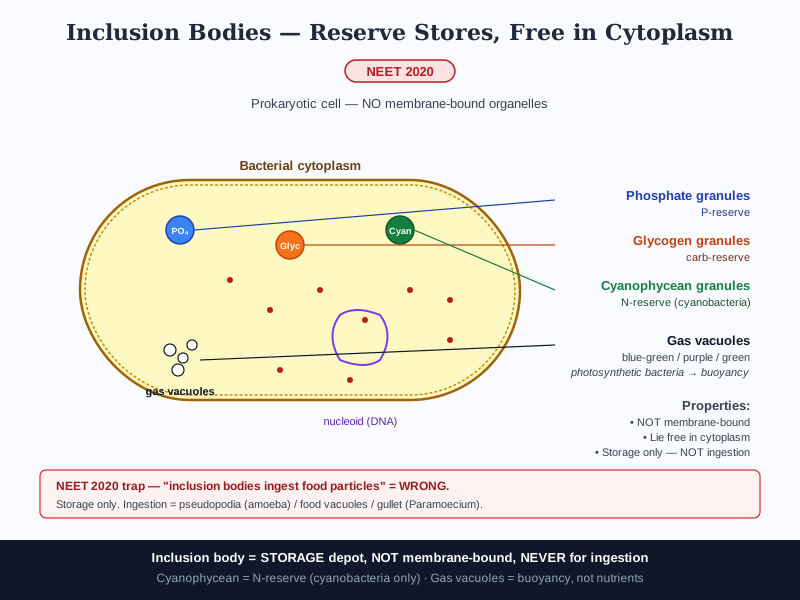
In prokaryotic cells, reserve materials are stored as inclusion bodies in the cytoplasm. These are NOT bound by any membrane system — they lie free in the cytoplasm. Examples include phosphate granules, cyanophycean granules (in cyanobacteria), and glycogen granules. Gas vacuoles are a special type of inclusion body found in blue-green, purple, and green photosynthetic bacteria — they provide buoyancy. The defining properties of inclusion bodies: (1) not membrane-bound, (2) lie free in cytoplasm, (3) represent reserve material — they do NOT ingest food particles.
NEET 2020 asked which statement about inclusion bodies is incorrect — Option D (involved in ingestion of food particles) was wrong. Inclusion bodies are purely storage structures. Food ingestion in unicellular organisms involves pseudopodia, food vacuoles, or gullets (as in Paramoecium) — not inclusion bodies. Gas vacuoles, while technically inclusion bodies, serve buoyancy regulation rather than nutrient storage — they contain gas, not organic reserves.
Inclusion bodies are involved in ingestion of food particles from the environment.
Inclusion bodies STORE reserve materials (glycogen, phosphate, cyanophycean granules). They have NO role in food ingestion.
Inclusion bodies = STORAGE only. Ingestion = pseudopodia / food vacuoles / gullet. Two different processes.
- Inclusion bodies: NOT membrane-bound, free in cytoplasm, reserve material — phosphate, glycogen, cyanophycean granules.
- Gas vacuoles: in blue-green, purple, and green photosynthetic bacteria — buoyancy, NOT nutrient storage.
- Cyanophycean granules: nitrogen-reserve granules found specifically in cyanobacteria.
- Prokaryotic cells lack membrane-bound organelles — all storage is in free cytoplasmic inclusions.
Which of the following statements about inclusion bodies in prokaryotic cells is INCORRECT? A. Inclusion bodies lie free in the cytoplasm without a surrounding membrane. B. These represent reserve material in the cytoplasm, such as glycogen granules. C. Gas vacuoles are a type of inclusion body found in blue-green photosynthetic bacteria. D. Inclusion bodies are involved in the ingestion of food particles from the external environment. E. Phosphate granules and cyanophycean granules are examples of inclusion bodies.
View bonus solution & explanation
Correct answer: C — D only
A CORRECT: Inclusion bodies are NOT membrane-bound — they lie free in cytoplasm. B CORRECT: They represent reserve material (glycogen, phosphate, cyanophycean granules). C CORRECT: Gas vacuoles are indeed found in blue-green, purple, and green photosynthetic bacteria. D INCORRECT: Inclusion bodies do NOT ingest food — they only STORE reserves. Food ingestion involves different mechanisms. E CORRECT: Phosphate granules and cyanophycean granules are examples listed in NCERT. Therefore only D is incorrect — NEET 2020 answer.
What is Inclusion Bodies?
What did NEET 2020 ask on Inclusion Bodies?
What is the most common NEET trap on Inclusion Bodies?
How do you remember Inclusion Bodies for NEET?
What are the key components of Inclusion Bodies?
Through deep analysis of NEET and NTA, 176 of the 180 ReNEET 2026 (June 21) questions were already in the MedicNEET question bank before the exam.
176/180MedicNEET's Biology question bank is built from the same NCERT lines NTA picks repeatedly. Not random MCQs — questions crafted exactly like NTA crafts them.
You just learned this concept. The free app turns it into a daily goal built from your weak topics and brings it back just before you forget it — using active recall and spaced repetition — so it stays till exam day.