
Pili and Fimbriae — Surface Structures Without Motility
✅ Asked in NEET 2016Select the wrong statement: (NEET 2016 Phase 2)
Select the wrong statement: (NEET 2016 Phase 2)
Answer & NCERT explanation
Correct answer: B — Pili and fimbriae are mainly involved in motility of bacterial cells.
Option b is wrong because pili and fimbriae are NOT involved in motility. According to NCERT, flagella are responsible for bacterial motility, while pili help in conjugation (genetic material transfer) and fimbriae help in attachment to surfaces. Other options are correct: bacterial cell walls contain peptidoglycan, cyanobacteria lack flagella, and mycoplasma lacks cell walls.
Read more NCERT concept on the PYQ
Besides flagella, Pili and Fimbriae are also surface structures of the bacteria but do not play a role in motility. The pili are elongated tubular structures made of a special protein. The fimbriae are small bristle like fibres sprouting out of the cell. In some bacteria, they are known to help attach the bacteria to rocks in streams and also to the host tissues.
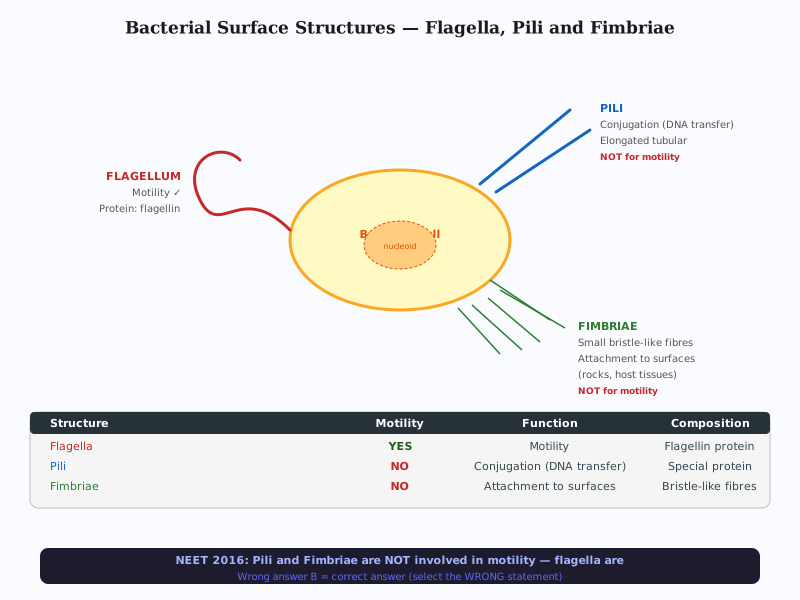
Bacteria have three types of surface structures: flagella, pili, and fimbriae. Flagella are responsible for motility. Pili are elongated tubular structures made of a special protein — their primary role is conjugation (transfer of genetic material between bacteria), not movement. Fimbriae are small bristle-like fibres that help bacteria attach to surfaces such as rocks in streams and host tissues during infection. Neither pili nor fimbriae contribute to motility. This distinction is critical because NEET 2016 asked students to identify the WRONG statement — option B (pili and fimbriae involved in motility) was the correct answer to select.
NCERT states pili are made of 'special protein' without naming it — the protein is pilin. Fimbriae serve a different function from pili: fimbriae mediate non-specific attachment (adhesion to surfaces), while pili (specifically sex pili or F pili) mediate specific attachment during conjugation. In pathogenic bacteria, fimbriae help colonise host tissues — making them virulence factors. Cyanobacteria lack flagellated cells entirely (NEET trap in same question).
Pili and fimbriae are involved in the motility of bacterial cells.
Pili and fimbriae are NOT involved in motility. Pili = conjugation (DNA transfer). Fimbriae = surface attachment.
Flagella = FLY (motility). Pili = PASS DNA. Fimbriae = FASTEN to surface. None of them overlap.
- Pili are elongated tubular structures made of special protein — primarily function in conjugation (genetic transfer between bacteria).
- Fimbriae are small bristle-like fibres that help bacteria attach to rocks in streams and host tissues — important in infection.
- Cyanobacteria lack flagellated cells — they are non-motile prokaryotes (verified NEET trap statement).
- Mycoplasma is wall-less — the only prokaryote lacking a cell wall (another option in the same NEET 2016 question).
Which of the following sets of statements correctly describes the properties of bacterial surface structures? S1: Flagella are responsible for bacterial motility and are composed of flagellin protein. S2: Pili are elongated tubular structures that help bacteria attach to rocks and host tissues. S3: Fimbriae are small bristle-like fibres involved in conjugation and genetic transfer. S4: Neither pili nor fimbriae play a role in the motility of bacteria. S5: Cyanobacteria lack flagellated cells.
View bonus solution & explanation
Correct answer: C — S1, S4 and S5
S1 CORRECT: Flagella = motility, composed of flagellin. S2 WRONG: Pili attach to surfaces during CONJUGATION — it is FIMBRIAE that attach to rocks/host tissues. S3 WRONG: Fimbriae are for surface attachment; PILI are for conjugation — these are reversed. S4 CORRECT: Neither pili nor fimbriae are involved in motility (NCERT exact statement). S5 CORRECT: Cyanobacteria lack flagellated cells.
What is Pili and Fimbriae?
What did NEET 2016 ask on Pili and Fimbriae?
What is the most common NEET trap on Pili and Fimbriae?
How do you remember Pili and Fimbriae for NEET?
What are the key components of Pili and Fimbriae?
Through deep analysis of NEET and NTA, 176 of the 180 ReNEET 2026 (June 21) questions were already in the MedicNEET question bank before the exam.
176/180MedicNEET's Biology question bank is built from the same NCERT lines NTA picks repeatedly. Not random MCQs — questions crafted exactly like NTA crafts them.
You just learned this concept. The free app turns it into a daily goal built from your weak topics and brings it back just before you forget it — using active recall and spaced repetition — so it stays till exam day.